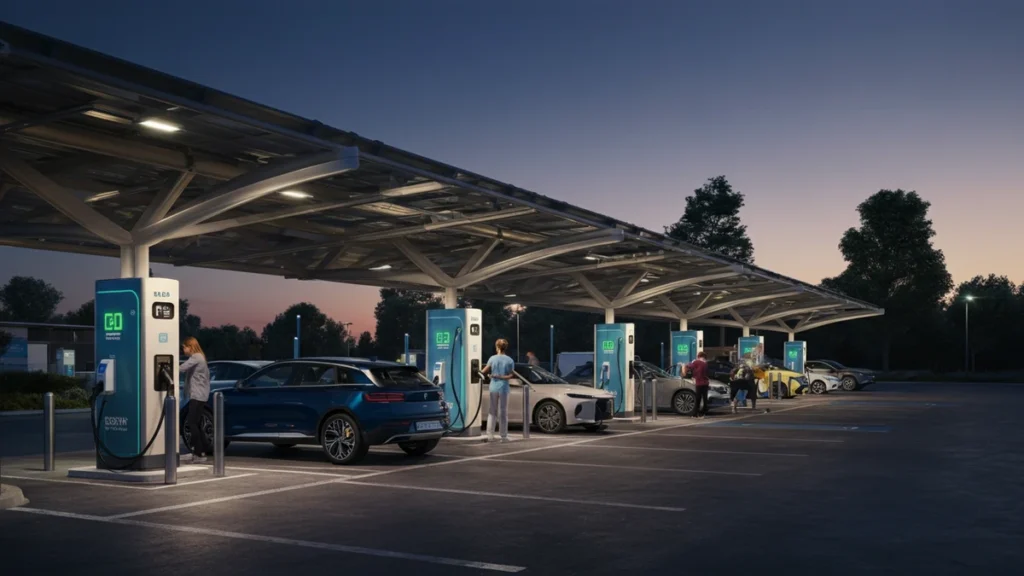
An AI-generated editorial illustration of several modern electric vehicles, including an SUV, charging at a busy, well-lit station at twilight. | MW3.biz
The Shift from Early Adopters to Mass Market Is Here
For years, early adopters drove the discussion about the electric vehicle. These tech enthusiasts and eco-conscious buyers paid extra for new technology. But the industry is now on the verge of a huge change. Analysts, automakers, and energy agencies see 2026 as a key year. It marks the start of the true **EV adoption next phase**. The market will move from a niche interest to a mainstream reality. Affordability, improved infrastructure, and a wider variety of models are driving this shift.
Organizations like the International Energy Agency and BloombergNEF track rapid growth in EV sales. But they also highlight main problems for typical car buyers: cost, range anxiety, and difficult charging. The next few years will systematically remove these barriers. The industry is maturing. Larger production, strong competition, and new technologies are creating a perfect storm. This will make electric cars available to millions more people globally. This change isn’t just about selling more cars. It will fundamentally reshape how people get around for the next generation.
The Affordability Revolution: Sub-$25,000 EVs Arrive
The biggest barrier to widespread EV adoption has always been the price tag. Luxury models from Tesla captured public interest. However, their cost was too high for most families. The **EV adoption next phase** relies on affordability. Automakers are now competing to produce good, reliable electric vehicles for under $25,000. This competition is a good thing for consumers.
General Motors has impressed with its updated Chevrolet Bolt. It has also promised to launch more affordable models. Ford, Volkswagen, Hyundai, and Kia are investing billions to develop their own low-cost EV platforms. Even Tesla, long known for premium EVs, has often said it plans to make a cheaper, next-generation vehicle, often called the “Model 2.” This competition drives innovation in battery chemistry and manufacturing. It aims to lower costs without losing essential range and safety.
Government incentives will remain very important. In the United States, legislation like the Inflation Reduction Act offers significant tax credits for new and used EVs. These credits apply if vehicles meet specific battery sourcing and manufacturing requirements. Automakers are adjusting their supply chains to meet these rules. As a result, consumers can expect these credits to apply to more affordable vehicles. This will effectively lower the entry price even further.
Solving the Range and Charging Anxiety Puzzle
After cost, potential EV buyers most often worry about range anxiety. This is the fear of running out of power far from a charger. They also worry about the perceived hassle of charging. The industry is quickly solving this two-part problem. By 2026, battery technology and charging infrastructure will look very different than today.
Technologically, the focus is on more efficient, energy-dense batteries. The traditional lithium-ion battery continues to improve. Automakers are also researching alternatives like lithium iron phosphate (LFP) batteries, which are cheaper and more durable. The ultimate goal is solid-state battery technology. It promises faster charging, more energy density, and better safety. These advancements mean lower-priced EVs will soon offer a comfortable 300 miles of range. This is a psychological benchmark for many consumers.
At the same time, public charging is expanding greatly and becoming standardized. Most major automakers made a key decision to adopt Tesla’s charging plug. This is now called the North American Charging Standard (NACS). This change is a game-changer. This move will unite a divided market. It gives non-Tesla drivers access to the large Supercharger network. It also simplifies charging for everyone. Companies like Electrify America and EVgo are quickly expanding their networks. They are focusing on installing more high-speed DC fast chargers along major highways and in cities. This quick expansion helps assure consumers. They can road-trip in an EV as easily as in a gasoline car.
A Flood of New Models: More Choices for Every Driver
The first wave of modern EVs was dominated by sedans and small hatchbacks. The **EV adoption next phase** will be diverse. Automakers know they must offer electric SUVs and pickup trucks to win the mass market. These are the most popular vehicle types.
The market already shows a surge in appealing electric SUVs and crossovers. Vehicles like the Kia EV9, a three-row family SUV, and the affordable Volvo EX30 prove this. They show that practical design, style, and electric power can exist together. By 2026, almost every major brand will offer an electric crossover. These will compete directly with popular gasoline models.
The electric truck market is also heating up. The Ford F-150 Lightning electrified America’s best-selling vehicle. Its success has encouraged competitors. Alongside the distinctive Rivian R1T and Tesla’s Cybertruck, legacy automakers like General Motors and Ram are rolling out their own electric pickups. Expanding into the profitable and popular truck segment is key. It will help capture a large part of the American auto market.
The Used EV Market Comes of Age
A healthy used market is a key, often overlooked, part of widespread vehicle adoption. The first mass-produced EVs from the late 2010s and early 2020s are now coming off lease. They are entering the used car market. This creates a new, more affordable way to own an EV. This is a vital step in the **EV adoption next phase**, as many consumers rely on the used market for their vehicle purchases.
Concerns about battery degradation are now being addressed more openly. Tools and services are now available for “battery health reports.” These are like vehicle history reports. They give buyers confidence in their purchase. Also, the Inflation Reduction Act offers a tax credit for used EVs. This makes them even more appealing. Valuation experts at Kelley Blue Book say prices will become more competitive. This will happen as the supply of used EVs grows. They will compete with similar gasoline cars, removing another barrier for buyers on a budget. The Internal Revenue Service offers clear rules for claiming this credit. This further legitimizes the used EV market.
Global Trends and Competitive Pressures
The move to the next phase of EV adoption isn’t happening in isolation. Strong global competition is a main driver. Chinese automakers like BYD and Nio are innovating very fast. BYD has already sold more EVs globally than Tesla. They have a big lead in battery production. They already make many affordable, high-tech EVs. Their presence in the U.S. market is small now. But their global influence is strong. It forces Western automakers to speed up their development and pricing plans.
In Europe, strict rules are driving the market forward. The European Union plans to ban new gasoline and diesel car sales by 2035. This leaves automakers no choice but to fully embrace electric vehicles. This government push creates a huge, predictable market for EVs. It encourages innovation and lowers costs. These effects will be felt worldwide.
This regulatory push is not just for cars; the wider technology sector is also adapting, with the EU AI Act’s impact on startups being a key development.
What This Means for You
The path to 2026 involves innovation, competition, and a clear focus on the average consumer. The **EV adoption next phase** means more choices, lower prices, and greater convenience than ever before. If high costs or practical concerns have stopped you from buying an EV, the next few years will likely change your mind. The question is no longer *if* electric cars will become mainstream, but *how quickly* it will happen.