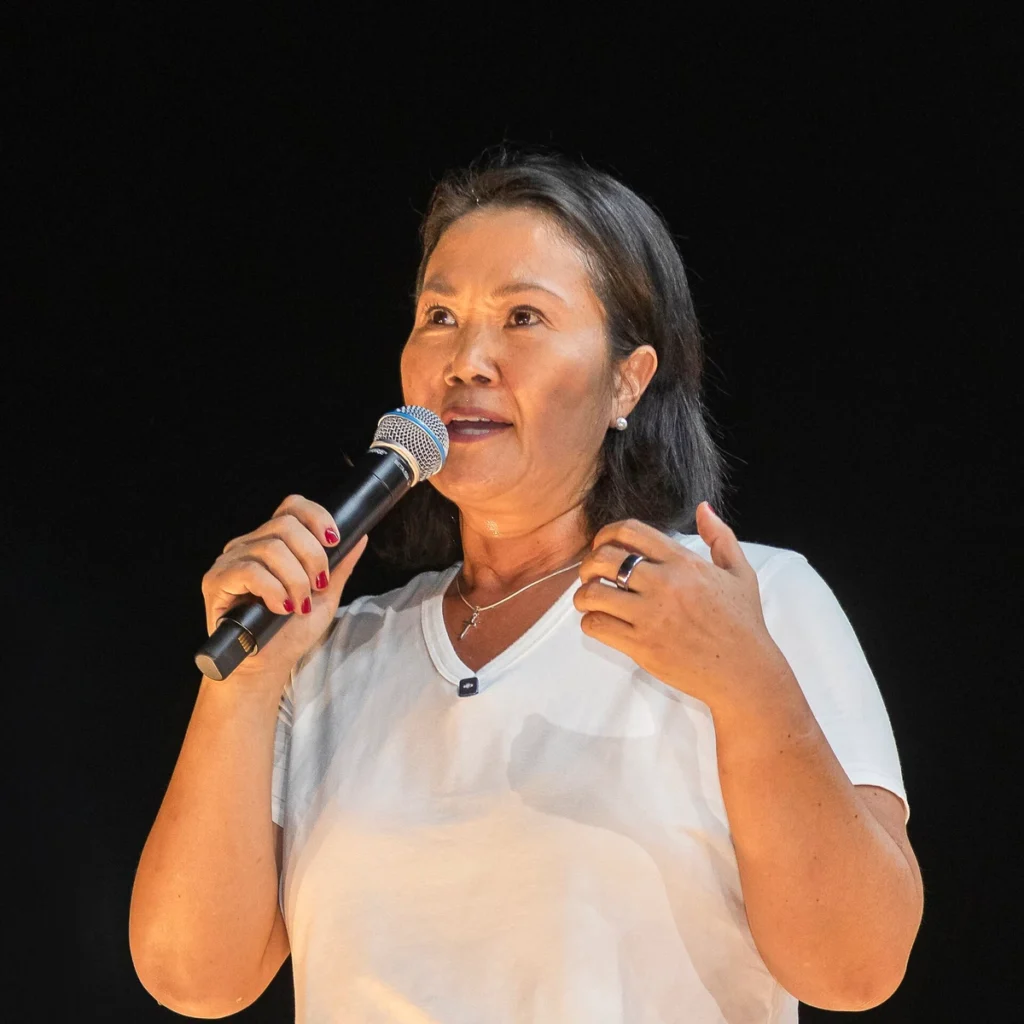
After three defeats and more than a decade of trying, Keiko Fujimori has finally won the presidency of Peru – by one of the narrowest margins the country has ever seen. Fujimori edged the June runoff with 50.135% of valid votes, a whisker ahead of her left-wing rival, and will be sworn in later this month as Peru’s first woman president-elect.
The victory closes a remarkable personal arc for Keiko Fujimori, a conservative leader who had lost three previous presidential races, each time falling agonisingly short. But it opens a far harder chapter: governing a bitterly divided nation with a mandate of barely half the vote, in a country that has churned through president after president for a decade.
Her win is at once historic and contested – a milestone for female political leadership in Peru, and a flashpoint in a long-running national argument about her family and its legacy.
A Razor-Thin Victory
The result could hardly have been closer. Fujimori took 50.135% of valid votes in the June 7 runoff against left-wing congressman Roberto Sanchez’s 49.865% – a difference of roughly 50,000 ballots out of about 18 million cast. It took Peru’s electoral authorities some three weeks to finish the count before confirming her as the winner.
A margin that thin shapes everything that follows. Fujimori enters office without a decisive popular mandate, having won essentially half the country while the other half backed her opponent. In a polarised political climate, that near-even split is a warning about how difficult it will be to build the consensus any Peruvian leader needs to govern effectively.
The closeness also all but guarantees scrutiny of the result. In tight, drawn-out counts, the losing side often questions the process, and Peru’s fractured politics leaves little room for the benefit of the doubt. Fujimori’s team will point to the official confirmation by the electoral authorities as settling the matter; her opponents’ willingness to accept the outcome gracefully will be an early test of whether the country can move past the vote without fresh conflict.
Fourth Time
Persistence defines Fujimori’s political story. This was her fourth bid for the presidency, following unsuccessful campaigns in 2011, 2016 and 2021 – several of them lost by similarly slender margins. Few politicians anywhere keep returning to the ballot after so many near-misses; fewer still eventually break through.
That persistence has made her one of the most durable figures in Peruvian politics, the leader of the Fuerza Popular party and a fixture of the country’s public life for years. To her supporters, the long road to victory is evidence of resilience and conviction. To her critics, her repeated candidacies and the controversies around them are a source of the very polarisation she must now try to overcome.
A Historic First, and a Divisive Legacy
Whatever one makes of her politics, the milestone is real: Fujimori will be the first woman to be elected president of Peru, a significant moment in a region where female heads of state remain relatively rare. For many Peruvians, that alone is a landmark worth marking.
Yet her name carries a heavy inheritance. She is the daughter of former president Alberto Fujimori, one of the most consequential and divisive figures in modern Peruvian history – credited by supporters with defeating an insurgency and taming hyperinflation in the 1990s, and condemned by opponents over the authoritarian turn and human rights abuses of his rule. That legacy has shadowed every campaign Keiko Fujimori has run, energising a loyal base while hardening the opposition against her. Her presidency will inevitably reopen that debate, and how she handles it will shape her ability to unify the country.
Keiko Fujimori has spent her career navigating that inheritance, at times embracing her father’s movement and at others seeking to soften its harder edges to broaden her appeal. She has also faced her own legal battles, including long-running investigations she has denied wrongdoing in, which her supporters cast as politically motivated and her critics see as disqualifying. How she reconciles that contested past with the demands of the presidency – reassuring institutions and investors while keeping her base – is among the central questions of her incoming term.
A Country of Constant Turnover
Fujimori inherits a state defined by instability. When she takes office, she will become Peru’s tenth president since 2016 – an almost unheard-of rate of turnover that reflects years of clashes between presidents and Congress, corruption scandals, impeachments and resignations. She succeeds an interim leader who himself took over only in February.
That churn is the backdrop to everything she will try to do. Peruvian presidents have repeatedly found themselves undone by a hostile legislature and a restless public, and the structures that toppled her predecessors remain in place. Governing durably, rather than becoming yet another short-lived occupant of the office, may be the single biggest test of her presidency – and one that a narrow mandate makes harder still.
The Challenges Ahead
Beyond the politics of survival, the substantive problems are formidable. Peru has grappled with slow growth, public insecurity and crime, and deep disillusionment with a political class widely seen as self-serving. Voters on both sides of the runoff were, in large part, expressing frustration with the status quo as much as enthusiasm for a candidate.
Meeting those expectations with half the country opposed to her from the outset will require a degree of pragmatism and coalition-building that Peru’s recent history suggests is hard to sustain. Fujimori will have to decide whether to govern to her base or reach toward the centre – a choice every narrowly elected leader faces, and one that tends to define whether a presidency succeeds or stalls.
The composition of the incoming Congress will weigh heavily on that choice. Peru’s presidents govern alongside a legislature that has repeatedly proven willing to obstruct and, in several recent cases, to remove them. Whether Fujimori’s party and its allies can assemble a workable majority, or at least a stable enough set of alliances to pass a budget and survive confidence votes, may matter more to the fate of her presidency than any single policy she campaigned on.
What Comes Next
Fujimori, 51, is due to be sworn in on July 28, Peru’s independence day, for a five-year term, alongside her two vice-presidents. The inauguration will formally end the uncertainty that hung over the drawn-out count, even as it opens the far larger uncertainty of how she will actually rule.
Her victory lands in a year crowded with consequential elections and high-stakes diplomacy around the world, from Latin America to the recent NATO summit in Ankara. For Peru itself, the immediate question is whether this election finally brings a measure of stability or simply resets the cycle of confrontation. A leader who fought for more than a decade to reach the presidency now faces the harder task of holding on to it – and of proving that a win by 50,000 votes can be turned into a mandate to govern a fractured country.