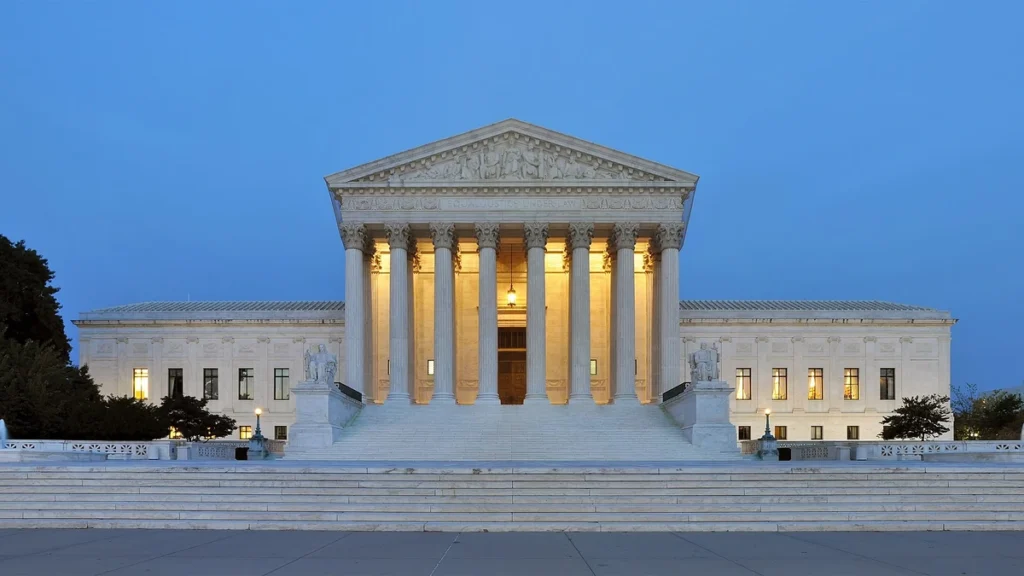
The Supreme Court has delivered one of the most consequential rulings of its term, striking down President Trump’s attempt to end birthright citizenship in a 6-3 decision that reaffirms a principle written into the US Constitution more than 150 years ago.
In Trump v. Barbara, decided on June 30, 2026, the justices held that the president’s executive order was invalid, and that children born on American soil are citizens at birth. The ruling on birthright citizenship is a significant legal defeat for the administration on one of its signature immigration policies – and a notable outcome from a court whose majority was appointed by Republican presidents.
Beyond the headline result, the decision is a study in how the justices reasoned their way to it, revealing fault lines that ran in unexpected directions and a debate over exactly why the order could not stand.
What the Court Held
At the center of the case is the Citizenship Clause of the Fourteenth Amendment, ratified after the Civil War, which declares that all persons born in the United States and “subject to the jurisdiction thereof” are citizens. For well over a century, that language has been understood to grant automatic citizenship to nearly everyone born on US soil.
The Court reaffirmed that understanding. The majority concluded that children born in the United States – including those born to parents who are in the country unlawfully or only temporarily – are “subject to the jurisdiction” of the United States and are therefore citizens at birth. In doing so, it rejected the narrower reading the executive order had tried to impose.
The dispute turned largely on five words: “subject to the jurisdiction thereof.” The administration argued that people in the country illegally or temporarily are not fully subject to US jurisdiction in the sense the clause intended, and that their children therefore fall outside its guarantee. The majority disagreed, reasoning that anyone born in the country and bound by its laws is subject to its jurisdiction, with only narrow historical exceptions such as the children of foreign diplomats. That reading has underpinned American citizenship law since a landmark 1898 case, and the Court declined to overturn it.
The Executive Order at the Center
The policy the Court reviewed was among the first acts of Trump’s second term. Issued on January 20, 2025, the executive order provided that babies born in the United States to parents present in the country illegally or temporarily would not be automatically entitled to citizenship – a sharp break from the prevailing interpretation of the Constitution.
The order was challenged almost immediately, setting up a direct test of presidential power against the text of the Fourteenth Amendment. Supporters argued it was a legitimate effort to reinterpret an ambiguous phrase and to address illegal immigration; opponents argued it plainly contradicted the Constitution and more than a century of settled understanding. The Court sided decisively with the latter.
The stakes of that argument were enormous and immediate. Had the order taken effect, it could have altered the citizenship status of large numbers of children born in the country each year, creating a class of people born on US soil but without automatic nationality. Lower courts had blocked the order while the litigation proceeded, and the case moved quickly to the Supreme Court precisely because the question – who counts as a citizen from birth – is too fundamental to leave unresolved.
Roberts’ Majority Opinion
Chief Justice John Roberts wrote the opinion, grounding it firmly in history. He traced the idea of citizenship by birth from the colonists’ demands for the “rights of Englishmen” through the abolitionists who praised what they called the “ancient and universal” rule of citizenship by birth alone.
“The Framers of the Fourteenth Amendment extended that promise to ‘every free-born person in this land,'” Roberts wrote. “We keep that promise today.” It was a deliberately sweeping conclusion, framing the decision not as a narrow technical holding but as the vindication of a foundational American commitment. Five justices signed on to that constitutional reasoning, giving the majority its core.
Kavanaugh’s Narrower Path
The sixth vote came with a caveat. Justice Brett Kavanaugh agreed that the executive order was invalid, but he reached that conclusion by a different route. In his view, the order did not violate the Fourteenth Amendment itself; instead, it violated a federal law providing that children “born in the United States, and subject to the jurisdiction thereof” are citizens.
That distinction carries real weight. Kavanaugh suggested that Congress “could amend” the statute or “otherwise enact new legislation establishing exceptions to birthright citizenship” for children born to foreign citizens unlawfully or temporarily in the country. “But,” he noted pointedly, “Congress has not yet done so.” His concurrence leaves open a legislative door that the majority’s constitutional reasoning would keep firmly shut – a subtle but important difference in how durable the protection is.
The Dissents
Three justices disagreed with the outcome. Justice Clarence Thomas wrote a lengthy dissent, joined by Justice Neil Gorsuch, and separate dissenting opinions came from Justices Thomas, Samuel Alito and Gorsuch. Their objections centered on the meaning of “subject to the jurisdiction thereof” and on whether the original understanding of the clause reached the children of parents without lawful status.
The dissents matter beyond this case. They lay out an alternative reading of the Citizenship Clause that could shape future arguments, and they signal that the question, while settled for now as a matter of law, remains contested among some of the Court’s members. That a minority of justices was willing to endorse a narrower view of birthright citizenship is itself a notable marker of where parts of the legal debate now sit.
Reaction to the decision broke along familiar lines. Immigrant-rights groups and many legal scholars welcomed it as a defense of a core constitutional guarantee, while supporters of tighter immigration controls expressed disappointment and pointed to the dissents as evidence the question is not truly closed. The administration, for its part, criticised the outcome while signalling it would continue to pursue its broader immigration priorities through other avenues – a reminder that a single ruling, however significant, rarely ends a political fight of this scale.
What It Means
In practical terms, the ruling preserves the status quo: nearly all children born in the United States remain citizens at birth, and the executive order cannot be enforced. For the families whose children’s status hung on the outcome, the decision removes an immediate cloud of uncertainty.
Politically, it is a high-profile check on executive power, delivered by a court often assumed to be sympathetic to the administration – a reminder that judicial outcomes do not always track the appointing party, part of a broader pattern in which the courts are shaping some of the most contested questions in American life, from immigration to the corporate antitrust fights playing out elsewhere. The administration is likely to keep pressing its immigration agenda through other means, and Kavanaugh’s concurrence hints at where a future fight – in Congress rather than the courts – might yet be waged. But on the specific question of birthright citizenship, the Supreme Court has spoken clearly, and the answer, at least for now, is settled.