Britain has a new prime minister, and he has spent his opening days trying to prove that a change of leader can mean a change of direction. Andy Burnham’s first week in Downing Street delivered a rebuilt cabinet, a tax cut aimed squarely at household electricity bills, and the cancellation of the digital ID scheme his predecessor had championed.
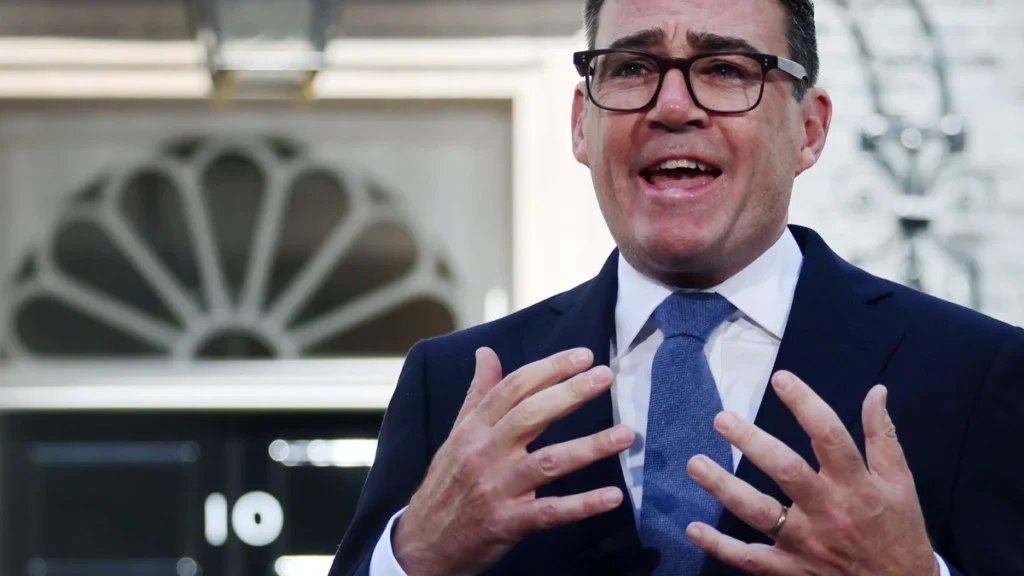
Andy Burnham, the 56-year-old former mayor of Greater Manchester, was appointed on Monday 20 July 2026 after a formal audience with King Charles III at Buckingham Palace. He is the seventh person to hold the office in a decade, and he arrived promising to make that statistic the last of its kind.
How Britain Got Its Seventh Prime Minister in a Decade
Burnham took over from Keir Starmer, who agreed to step down after a run of election defeats, policy reversals and scandals, barely two years after leading Labour to a landslide general election victory. Starmer announced his intention to resign on 22 June and was formally replaced a month later.
Both men come from the same centre-left Labour Party, and under the British system a governing party can change its leader, and therefore the prime minister, in the middle of an electoral cycle without a national vote. Burnham was appointed unchallenged. As NBC News reported, the man long nicknamed the “King of the North” walked into a job that has changed hands seven times since 2016.
That instability is the backdrop to everything he says. Burnham has described himself as “fed up” with the revolving door at the top of British politics and told reporters that “Britain needs to show the world that we can regain our stability once again”, promising what he called “a new political model and a new economic model”.
The Cabinet Reshuffle That Set the Tone
The clearest signal of intent came before any policy did. Burnham moved quickly to remake the government, removing several senior figures closely associated with Starmer and promoting allies who had left the previous cabinet.
Rachel Reeves was removed as chancellor of the exchequer. Her replacement is John Healey, a former defence secretary who had quit the government in June accusing the Treasury of failing to fund the armed forces adequately. In an interview after his resignation, Healey called the Treasury “a dead hand on dynamic government” and said it was “in denial”. He now runs it.
Wes Streeting, whose resignation as health secretary in May helped bring Starmer down, took over defence. Ed Miliband moved up to foreign secretary from the energy brief. Angela Rayner became housing secretary. Shabana Mahmood was reappointed as home secretary, one of the few senior figures to keep a major department. David Lammy was dismissed as deputy prime minister and justice secretary.
The new cabinet met for the first time on Tuesday 21 July. Burnham told the room he wanted a “one-team approach”, and framed the whole enterprise in a single phrase: this would be, he said, a “cost-of-living government”.
A Tax Cut Aimed Straight at the Electricity Bill
The first concrete policy landed on that same day. From 1 October, value-added tax will be removed from domestic electricity bills. Downing Street put the saving at roughly £45 a year for the average household.
It is a modest number set against a long cost-of-living squeeze, and Burnham did not oversell it. “We need to think every day, what can we do just to take that little bit of pressure off people’s shoulders, to give them that little extra sense that help is coming, so they can have that bit of hope that things are getting better,” he told the cabinet, in remarks reported by the Associated Press.
Healey, the new chancellor, framed the measure as short-term relief timed for the coldest months, saying the aim was to give households “breathing room on bills, and provide some reassurance this winter”. The timing is deliberate: the cut takes effect just as heating demand climbs.
Why the Digital ID Scheme Was the First Thing to Go
The money for the VAT cut comes from cancelling something. Burnham confirmed that the government is scrapping the digital ID card scheme announced under Starmer, a programme costed at around £1.8 billion over three years.
Starmer had argued that state-issued digital identity would help stop people working illegally and would modernise access to public services. It was initially presented as mandatory for right-to-work checks, before the mandatory element was dropped in January in favour of a voluntary system. That retreat did not settle the argument.
Opposition was unusually broad and unusually large. A parliamentary petition against mandatory digital ID gathered close to three million signatures, making it the second-largest on record, and TechCrunch noted that critics framed the scheme as a surveillance risk. For older observers it echoed the identity card programme of the 2000s, which was legislated for and then scrapped in 2011 after a change of government.
The Money Question Nobody Has Answered Yet
Presenting a cancellation as a funding source invites an obvious question, and it has already been asked. TechCrunch reported that the £1.8 billion figure itself is disputed, with claims that the money to fund the scheme had never actually been allocated. If that is right, the savings backing the electricity measure are less solid than the announcement implies.
There is friction inside government too. PoliticsHome reported that the decision created confusion across Whitehall and led to an apology to civil servants who had been working on the programme, a reminder that a fast policy reversal has costs that do not appear on a balance sheet.
Burnham has not pretended the arithmetic is easy. He told the cabinet that the government would have to make difficult financial decisions and “take a really hard look at what our priorities are”. Healey arrives at the Treasury having argued that defence spending, set at 2.6% of GDP next year, should reach 3% by 2030. He now has to find that money while also funding tax cuts.
What Burnham Has Promised Next
In his first speech outside Downing Street, Burnham set out an agenda considerably wider than one tax cut. He pledged to ease the cost of living, to decentralise political power away from Westminster, to revitalise British industry, and to end street homelessness.
Each of those is a substantial undertaking against a decade of weak economic growth. The decentralisation pledge is the most personal: Burnham built his national profile over nine years as mayor of Greater Manchester, and the argument that power and money should sit closer to the places they affect has been his consistent theme.
The cost-of-living framing also connects to a broader argument about how British working life is structured, a debate we examined in our look at what the evidence shows about the four-day work week in 2026.
What to Watch in the Weeks Ahead
Three tests will show whether Andy Burnham’s first week was a reset or a rebrand.
The first is the autumn fiscal statement, where Healey has to reconcile tax cuts, defence commitments and a slow-growing economy. The second is whether the decentralisation promise produces actual transfers of power and budget to city regions rather than a consultation. The third is parliamentary: a cabinet assembled by removing several senior colleagues creates a bench of former ministers with little reason for loyalty, and Burnham’s Commons majority still depends on MPs elected under his predecessor.
For now the government has bought itself a plausible opening. A visible bill cut, a cancelled scheme that millions of people objected to, and a leader who talks about stability rather than transformation add up to a coherent first week. Whether it holds is a question for the autumn, not for July.
This article was AI-assisted and edited for accuracy.