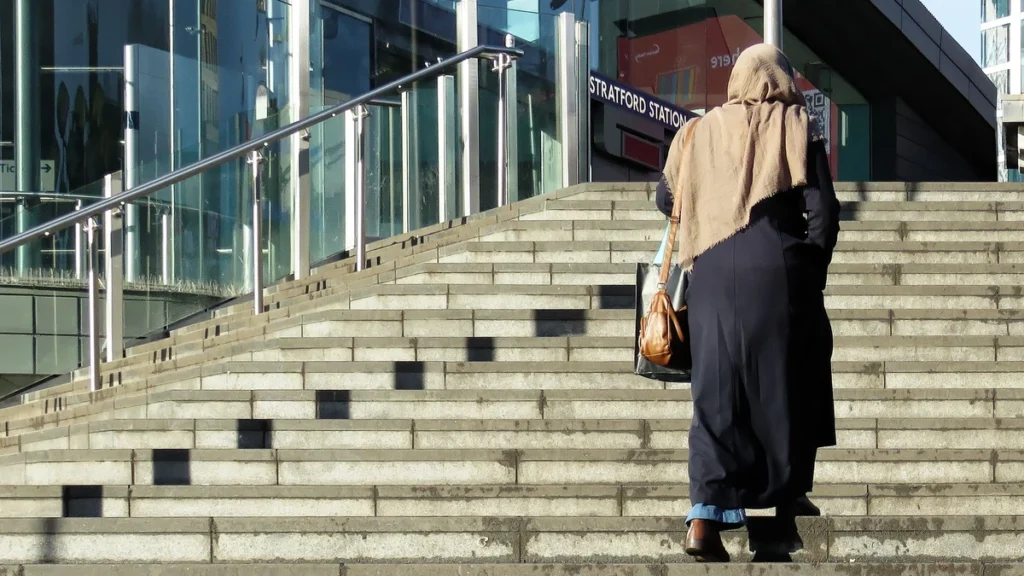
Commuters climbing the steps outside Stratford station in east London.
Commuters climbing the steps outside Stratford station in east London.
A wrist monitor worn for seven days by 91,292 British adults has produced the clearest evidence yet that the shape of a sedentary day matters as much as its length. Each additional hour spent in prolonged sitting, meaning an unbroken block of at least half an hour, was associated with a 9% higher risk of dying from cancer across the years that followed.
The study, published in PLOS Medicine by a team led from the University of Glasgow, carries an unusually practical companion number. Replacing five minutes a day of that unbroken sitting with vigorous activity was associated with a 22% lower risk of cancer death. That is a larger reduction than swapping a full hour for gentle movement, and it costs a twelfth of the time.
What the Glasgow Team Actually Measured
The participants came from UK Biobank, the long-running cohort that asked a subset of its volunteers to wear an Axivity AX3 triaxial accelerometer on the wrist, continuously, for a week. The device samples at 100 Hz, which is fast enough to capture the difference between a still arm and a moving one many times a second.
Raw acceleration on its own does not say whether someone is sitting. The researchers ran the signal through a validated two-step classifier built on a random forest model to sort the recorded time into sedentary and non-sedentary behaviour. From there they cut the sedentary time two ways, and that split is the whole point of the paper.
Prolonged sedentary behaviour was defined as any bout lasting at least 30 minutes during which at least 90% of the time was sedentary. Interrupted sedentary behaviour covered everything else: stretches shorter than 30 minutes, or longer ones broken up by more than 10% non-sedentary movement. Two people can log identical daily sitting totals and fall on opposite sides of that line.
Participants were then followed for a median of 12.38 years, with an interquartile range of 11.56 to 13.15 years, and their cancer diagnoses and deaths recorded against national registries.
Nine Percent per Hour, and the Mirror Image
For cancer mortality, each extra hour per day of prolonged sedentary behaviour carried a hazard ratio of 1.09, with a 95% confidence interval of 1.06 to 1.11 and a p-value below 0.001. That is the 9% figure, and the confidence interval is narrow enough to make it hard to dismiss as noise.
The number that gives the paper its force is the one sitting directly opposite. Each extra hour per day of interrupted sedentary behaviour carried a hazard ratio of 0.82, with a confidence interval of 0.78 to 0.86. The same activity, sitting, moved risk in opposite directions depending only on whether it was accumulated in long blocks or short ones.
That symmetry is what separates this analysis from a decade of research treating sedentary time as a single daily total. A total cannot distinguish an office worker who takes a call standing up every twenty minutes from one who does not move between nine and one. On these numbers, those are not the same person.
Why Five Minutes Beat a Full Hour
The team then ran isotemporal substitution models, which ask what happens statistically when a slice of prolonged sitting is exchanged for the same slice of something else. The results scale with intensity rather than duration, and they scale steeply.
Replacing one hour a day of prolonged sedentary time with light physical activity (walking about, household chores, anything that keeps a person upright and moving gently) was associated with a hazard ratio of 0.88 for cancer death, a 12% reduction, with a confidence interval of 0.79 to 0.99. Replacing 30 minutes with moderate activity produced a hazard ratio of 0.92, an 8% reduction, at a confidence interval of 0.86 to 0.99.
Replacing just five minutes with vigorous activity was associated with a hazard ratio of 0.78. That is a 22% reduction from a twelfth of the time commitment the light-activity swap required.
The authors are careful not to read that as a licence to sit still for the rest of the day. Their stated conclusion runs the other way, towards inclusion rather than substitution of one prescription for another. “Current health guidelines focus heavily on moderate or vigorous exercise, but our findings show that light movement shouldn’t be ignored,” the authors write. Both swaps helped; the vigorous one simply bought more per minute.
The Cancers That Move With the Numbers
Mortality was not the only outcome tracked. Prolonged sedentary behaviour was also associated with overall cancer incidence, at a hazard ratio of 1.03 per additional hour a day, with a confidence interval of 1.02 to 1.04.
The association was stronger for two specific groupings. Obesity-related cancers, a set that includes oesophageal, liver, kidney, pancreatic, colorectal, breast, ovarian and thyroid cancers, showed a hazard ratio of 1.05, at a confidence interval of 1.03 to 1.06. Cancers linked to type 2 diabetes showed a hazard ratio of 1.05 as well, with a confidence interval of 1.04 to 1.07.
The incidence effects are visibly smaller than the mortality effect, which is a pattern worth noticing rather than glossing. Prolonged sitting appears to be more strongly tied to dying of cancer than to being diagnosed with it, and the paper does not claim to have resolved why.
What This Does Not Prove
The design is observational. It can establish that prolonged sitting and cancer death travel together in this cohort; it cannot establish that one causes the other, and the authors say so directly in their limitations.
UK Biobank also carries a well-documented healthy-volunteer bias. Its participants are, on average, more physically active and in better health than the wider UK population, which tends to compress the range of behaviour under study and can pull associations towards the null. The accelerometer sub-study inherits that bias.
There is a further gap the wrist cannot fill. The recordings say when someone was sedentary; they say nothing about why. Sitting at a desk, sitting in traffic and sitting in front of a television are indistinguishable in the data, and any confounding that travels with those contexts, including job type, income, commute length and diet, travels into the result with them.
The work was funded by the American Cancer Society, under grant MRSG-17-200-01-NEC, and by the US National Institutes of Health, under grants U01CA261961, R01CA263776 and R01CA285851. The reported findings were circulated through EurekAlert and picked up widely in the science press, including a summary in ScienceDaily.
One more caveat belongs with the headline number. Wrist accelerometry infers posture from movement rather than measuring it directly, so a person sitting perfectly still and a person standing perfectly still can look similar to the classifier. The two-step random forest model used here was validated against reference data precisely because that ambiguity exists, but no wrist device resolves it completely, and misclassification of that kind would tend to blur the contrast between the prolonged and interrupted groups rather than manufacture it.
What Changes on Monday Morning
Public health guidance is currently written in weekly totals: a target number of minutes of moderate or vigorous activity, accumulated however a person manages it. Nothing in this paper argues against that target. What it adds is a second axis that the weekly total is blind to, which is how the remaining fifteen or sixteen waking hours are distributed.
This is a familiar problem with headline figures. A single aggregate can move in one direction while the structure underneath it moves in another, which is exactly the trap in reading a monthly payrolls print without its internals. Total daily sitting time behaves the same way here: two identical totals, two different risk profiles.
The practical reading is narrow and cheap. The intervention that produced the largest association in this data set was five minutes, and the one that produced the second largest was ordinary walking. Neither requires a gym membership, a behaviour-change programme or a standing desk. It requires the thirty-minute block not to reach thirty minutes.
Whether breaking those blocks up actually lowers anyone’s cancer risk is a question only a trial can answer, and no trial of that size and duration is currently running. Until one is, 91,292 people wearing monitors for a week is the best evidence available, and it points consistently in one direction.