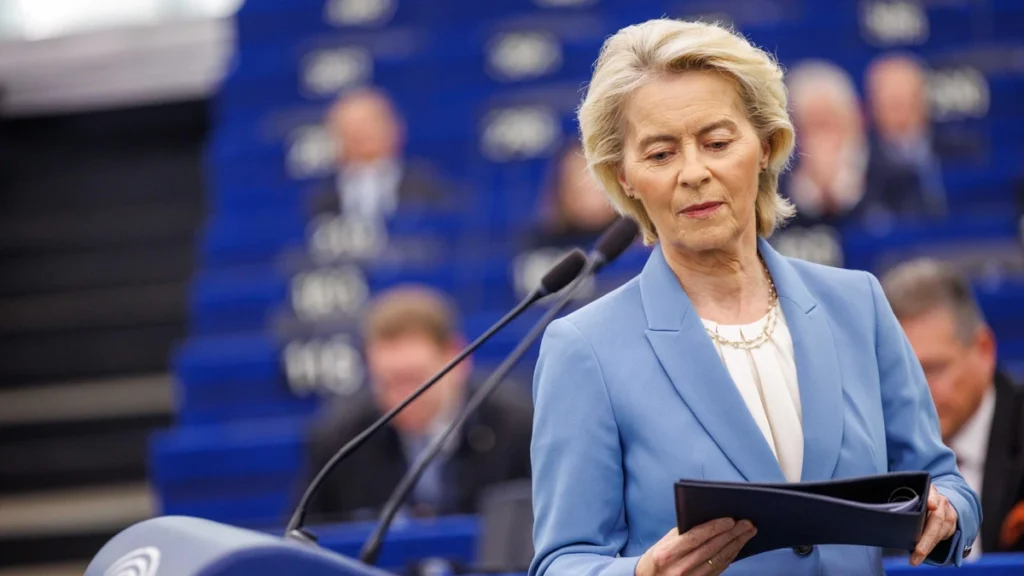
Ursula von der Leyen at the European Parliament in Strasbourg on 6 October 2026
Ursula von der Leyen at the European Parliament in Strasbourg on 6 October 2026
The European Commission on Tuesday adopted its most detailed blueprint yet for how the European Union would take in new members, and its sharpest edge is aimed at the countries that join. Under the EU enlargement plan, a new member state that seriously breaches the bloc’s founding values during a long post-accession window could see its voting rights in the Council restricted.
The package, titled “Preparing for a wider Union” and presented in Strasbourg by Enlargement Commissioner Marta Kos, also asks governments to give up unanimity on several decisions, sets out how the budget would stretch to new members, and proposes targeted limits on financial support and market access for Ukraine’s farm sector. It is not an accession timetable. Roadmaps for Montenegro, Albania, Moldova and Ukraine are due in the Commission’s 2026 enlargement package later this month, and only if those countries keep up the pace of reform.
What the Commission Actually Adopted
The package is made up of a communication and a staff working document that review EU policies in light of upcoming enlargements. It answers a mandate that goes back three years. Commission President Ursula von der Leyen announced the pre-enlargement policy reviews in her 2023 State of the Union address. The Granada Declaration that same year split the work in two: candidate countries reform, and the Union prepares. A March 2024 communication set out a work programme, and in June 2024 the European Council asked for in-depth reviews with operational detail in four areas: values, policies, the budget and governance.
Von der Leyen framed Tuesday’s result as a strategic choice. “Enlargement of our Union is a geopolitical imperative,” she said in the Commission’s press release. “Today, we are laying the groundwork to ensure that a larger Union is also a stronger one: more resilient, more effective, and firmly anchored in the values and rules that define us.”
The central finding of the reviews is that no new treaty is needed. The Commission concludes that the Union can accommodate a larger membership within the existing treaty framework and future accession treaties. The weak point it identifies again and again is administrative rather than legal: skills, regulatory and supervisory capacity, interoperable systems and cooperation between national administrations, both inside the EU and in the countries hoping to join.
A Safeguard That Could Last 15 Years
The provision most likely to be read closely in candidate capitals concerns what happens after a country joins. Previous enlargements used three sectoral safeguard clauses, covering the economy, the internal market, and justice and home affairs, which could only be triggered for a limited period after accession. The Commission wants future accession treaties to extend that period significantly, well beyond the old three-year window, according to EUalive’s reading of the communication.
It also proposes something new: an institutional safeguard for serious breaches of the values listed in Article 2 of the Treaty on European Union, which include democracy and the rule of law, and of the principle of sincere cooperation between member states and the Union. The clause would apply for up to 15 years after accession, Ukrinform and EUalive reported, could be proposed by the Commission or at a member state’s request, and would sit under judicial review. “In the most serious cases, measures could include the suspension of Council voting rights,” the Commission said.
The institutional safeguard is designed to complement Article 7, the existing procedure for sanctioning a member state over its values, rather than replace it. The Commission also wants a more effective handling of Article 7 procedures, including possible timeframes. New members would additionally be asked, for a limited period, not to block later enlargements because of bilateral disputes. Transitional arrangements stay on the table too, covering the free movement of workers and services, agriculture, sensitive products, funding and participation in common EU systems. Every safeguard, the Commission stresses, would be temporary, targeted, reversible and subject to regular review.
Fewer Vetoes on the Way to Membership
The second half of the package is about how a larger Union would take decisions. Unanimity still governs sanctions, parts of foreign and security policy, tax and some energy measures, and every extra seat at the table makes those decisions harder to reach. The Commission is not proposing treaty change. Instead it wants governments to use the “passerelle” clauses already written into the treaties, which allow the European Council or the Council to switch a policy area from unanimity to qualified majority voting.
The areas it names are sanctions, human rights, civilian missions under the Common Security and Defence Policy, tax fraud and avoidance, fiscal measures in energy policy, and social protection, according to Ukrinform. It also urges fuller use of Article 31(2) of the Treaty on European Union, which already allows majority voting in defined foreign-policy cases, and asks the Council to stop defaulting to consensus where the treaties already provide for a vote. Existing protections such as the “emergency brake”, which lets a government refer a decision to the European Council, would accompany any extension.
For enlargement itself, the Commission proposes qualified majority voting for opening negotiating clusters and other intermediate steps in accession talks. Kos told reporters in Strasbourg that this would reduce the number of areas in which a single country could veto decisions supported by all the others, Ukrinform reported. The decision that matters most would not change: the final say on a country’s accession stays unanimous under Article 49.
The Commission does not hide the catch. Activating a passerelle clause itself requires unanimity, and in some cases the consent of the European Parliament and national parliaments. Where a policy remains blocked, the communication points to enhanced cooperation, which lets a group of at least nine member states move ahead in a specific area and was used to set up the EU’s loan to support Ukraine for 2026 and 2027.
Ukraine’s Farms Get Their Own Chapter
Ukraine is the candidate whose size most changes the arithmetic, and the EU enlargement plan treats it accordingly. Given “the scale, structure and very high productivity of its agricultural sector”, the Commission wrote, targeted arrangements “should significantly limit financial support and market access for sensitive agricultural products”, while helping Ukraine regain access to its traditional export markets outside the EU. Ukrinform reported that these measures are expected to be built into the EU’s common positions on Cluster 5, which covers resources, agriculture and cohesion, during Ukraine’s accession negotiations.
On defence the document points the other way, highlighting Ukraine’s practical experience and industrial capacity. It envisages deeper cooperation before membership through Ukraine’s association with the European Defence Fund, joint European Defence Projects of Common Interest, the SAFE initiative and the European Defence Industry Programme. Some integration is already part of daily life: Ukraine and Moldova joined the EU’s Roam Like at Home system on 1 January 2026, extending domestic mobile roaming conditions to their citizens and to travellers from the Union.
Kos said Ukraine’s roadmap would differ from those of Montenegro, Albania and Moldova because the country is at war with Russia, according to Ukrinform. She added that as technical negotiations advance, with clusters opened, key benchmarks met and clusters closed, the conditions that would eventually appear in an accession treaty would become clearer.
Who Pays for a Bigger Union
On money, the Commission’s message is that the budget can accommodate new member states while continuing to finance the Union’s existing priorities. Under its proposal for the 2028-2034 Multiannual Financial Framework, candidates would be funded through the Global Europe instrument before accession. On joining, that support would move into the new member’s National and Regional Partnership Plans, with additional funding for cohesion, agriculture, home affairs and Interreg cross-border programmes.
The model rests on what Brussels calls objective-based financing, in which payments follow delivered reforms. The Growth Plans for the Western Balkans and Moldova and the Ukraine Facility already work this way. In its questions and answers on the reviews, the Commission cites the financial package for Montenegro presented in June 2026 as the template for bridging pre- and post-accession funding without gaps. Support would remain conditional on reform progress and on better national financial controls, with suspensions or reductions where conditions are not met.
Gradual Integration Before the Treaty Is Signed
The offer to countries still outside is gradual integration: earlier participation in selected EU policies, programmes and parts of the single market before formal accession. The 2020 enlargement methodology already allowed some of this, and the Commission now wants it turned into a coherent framework that is merit-based, conditional and reversible. It names energy, transport, digital and defence as the strategic sectors, and it will open annual dialogues with each enlargement partner to track progress and close gaps.
Access would depend on preparation in the policy concerned, the capacity to enforce the rules, and alignment with the EU’s common foreign and security policy, including sanctions. Where alignment is missing on investment screening, export controls or sensitive technologies, the scope of participation would be cut back, EUalive noted. A Commission official told Ukrinform that gradual integration is an accelerator towards membership rather than an alternative to it, and insisted the EU is not lowering its standards.
What Happens Next
None of this binds governments yet. The EU enlargement plan feeds into the European Council’s strategic discussion on enlargement and reform in October, and the Commission has invited the European Parliament and the Council to advance institutional preparations. The 2026 enlargement package, with indicative roadmaps for Montenegro, Albania, Moldova and Ukraine, is due later this month.
Some institutional questions are deliberately left for later. The treaties already provide for a Commission with fewer members than there are member states, and EUalive noted that the practice of one commissioner per country would have to be revisited before a 30th member joins. The European Parliament is capped at 750 members plus its president, so any enlargement forces a redistribution of seats among existing members.
Candidates are also being asked to align with the bloc’s rules on economic security, investment screening and export controls before they get a vote on them, at a time when Europe’s industrial map is already shifting, as the Ineos pause in Hull showed last month. The Commission’s wager is that a Union of 30 or more members can work under the treaties it already has, provided governments are willing to use the majority voting those treaties allow. Whether national capitals agree is now a question for the European Council.