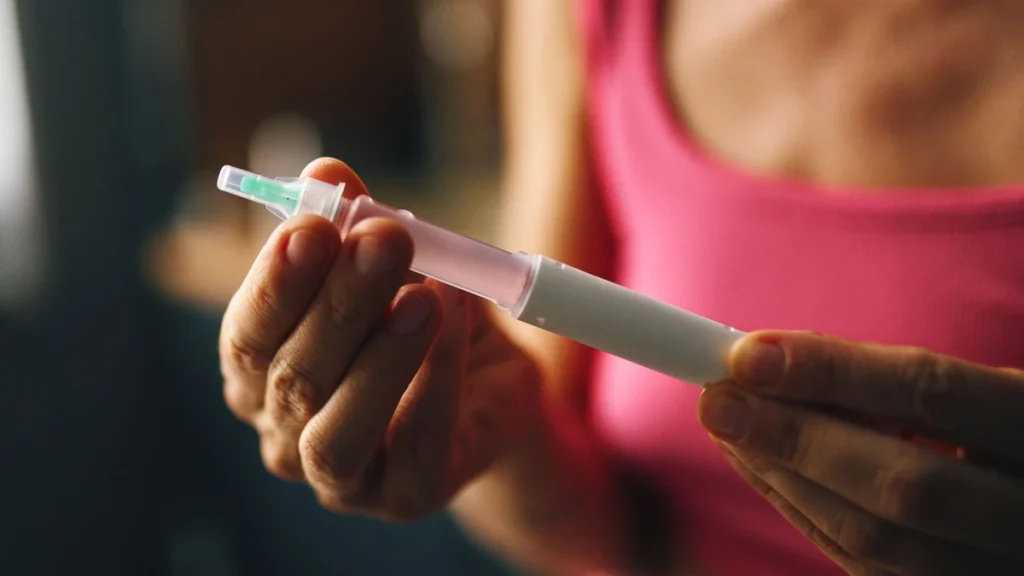
A patient prepares a pre-filled injection pen. Weekly injectable GLP-1 drugs are now taken by about 11% of US adults for weight loss.
A patient prepares a pre-filled injection pen. Weekly injectable GLP-1 drugs are now taken by about 11% of US adults for weight loss.
About 11% of American adults are now taking a GLP-1 drug to lose weight, according to Gallup, up from 3% in 2024. The evidence on GLP-1 side effects at that scale is arriving far more slowly than the prescriptions, and this week added two more pieces to an unfinished picture: a global study of eating disorders that clinicians connect to misuse of the drugs, and survey data showing American employers retreating from paying for them.
What follows separates the evidence into three piles: the side effects that are established, the ones that are contested in research and in court, and the questions on which almost no data yet exists.
How Many Americans Now Take a GLP-1
Gallup’s figures come from a web survey of 5,065 US adults conducted between 28 May and 5 June 2026, part of its National Health and Well-Being Index. It found that 11% currently take a GLP-1 medication such as semaglutide (sold as Ozempic and Wegovy), liraglutide (Saxenda) or tirzepatide (Mounjaro and Zepbound) for weight loss, and that 15% have done so at some point, nine points more than in 2024. Awareness of the drugs reached 90%, against 80% two years earlier, according to Gallup’s published results.
The same survey tracked the adult obesity rate falling to 36.8% so far in 2026, from a record 39.9% in 2022, a decline Gallup describes as tracking inversely with rising GLP-1 use. Brand-name products account for 66% of current use, while 18% of users take a compounded or custom-mixed version and 13% are unsure which they have. That matters for monitoring: as NPR has reported, drugs sold online often come with little or no medical supervision, which leaves fewer clinicians in a position to notice and report problems.
The Side Effects Nobody Disputes
The most common GLP-1 side effects are gastrointestinal: nausea, vomiting, diarrhoea and constipation. The drugs have also been linked to pancreatitis and gallstone disease, as MIT Technology Review’s biotech newsletter set out earlier this month, noting that “we’re still figuring out exactly what those might be, and how widespread they are”.
The US Food and Drug Administration’s adverse event database gives a rough sense of volume. NPR found nearly 190,000 reports about the drugs since 2024, most of them describing minor gastrointestinal problems, dosing errors or redness at the injection site. Its analysis of the same database counted 1,928 reports of pancreatitis over that period, including 135 cases of the necrotising form.
Those numbers need careful handling. Reporting to the database is mostly voluntary and the FDA does not verify the reports, so they can flag a possible problem but cannot show that a drug caused it. Obesity and diabetes raise the background risk of many of the same conditions, which makes attribution harder still. Mohammed Ali, a diabetes specialist at Emory University, told NPR he did not report three patients who developed pancreatitis or gallstones while taking GLP-1s because he could not be sure the drugs were responsible.
Vision Loss Is the Most Contested Question
The most serious dispute concerns non-arteritic anterior ischaemic optic neuropathy, or NAION, in which tiny strokes cut off blood flow to the optic nerve and can cause sudden, permanent loss of sight. A 2024 study in JAMA Ophthalmology found higher rates of NAION among diabetic patients taking semaglutide. Two professional bodies, the American Academy of Ophthalmology and the North American Neuro-Ophthalmology Society, responded that “this is not the type of study that can show the treatment caused NAION”, while accepting that a link was possible and advising patients not to stop their medication.
The FDA’s database now holds more than 1,000 reports of optic neuropathy linked to GLP-1s since 2024, out of nearly 190,000 reports in total, NPR reported on 10 October. The agency told NPR it has undertaken its own study of the NAION risk and will “determine the need for regulatory action” once its assessment is complete. It has not requested changes to the US warning labels.
The question is also being tested in court. Two consolidated multi-district lawsuits include 247 plaintiffs with NAION and more than 4,000 with serious digestive conditions such as pancreatitis or gallstones. Novo Nordisk, which makes Ozempic and Wegovy, says the cases are without merit and points to later research casting doubt on a causal link. Eli Lilly, which makes Mounjaro and Zepbound, said it will “vigorously defend against these claims”. Jonathan Orent, a lead court-appointed attorney for the plaintiffs, argues that warnings should be updated in the US as they have been in Europe, because clinical trials are never large or varied enough to catch rare events.
Hair, Nails and the Signals Still Being Measured
Below the level of litigation sits a set of weaker signals that researchers are still quantifying. A team led by Savanna Vidal at the George Washington University School of Medicine and Health Sciences analysed electronic health data from 67 US health-care organisations and found that GLP-1 use was associated with an increased risk of hair loss, although it is not thought to be common.
At a conference in Austria this autumn, another group presented a smaller study in which 66% of GLP-1 users reported at least one nail disorder, in some cases involving nail detachment. Nail conditions were also fairly common among people who were not taking the drugs, and the authors did not claim the medicines were the cause.
Not every new signal points the same way. Data presented by Eli Lilly and Novo Nordisk at an ageing meeting in Boston suggested that overweight and diabetic people taking GLP-1s had a biological age roughly two to three years younger than similar people on a placebo. Like the hair and nail findings, that result measures association rather than proving a long-term effect, and it comes from the companies that sell the drugs.
Children Are the Largest Gap in the Data
The thinnest evidence concerns the youngest patients. Between 2019 and 2026 there was a 310-fold increase in GLP-1 prescriptions for American children aged eight to 11 with obesity. Prescriptions in that age group remain rare: a study in the journal Pediatrics, cited by Health Policy Watch, estimated that roughly 20,000 of more than 3.5 million children with obesity and without diabetes had been prescribed the drugs. A separate analysis from Lurie Children’s Hospital in Chicago linked GLP-1 use in children to nutritional deficiencies, most notably a lack of vitamin D, and found that only 5% of the young patients received nutritional counselling.
On 7 October the World Health Organization published its first guidelines on managing obesity in children and adolescents. For children under 10, the WHO does not recommend obesity drugs or bariatric surgery, putting structured changes to diet, physical activity and behaviour at the centre of care instead. For adolescents aged 10 to 19, obesity drugs may be used in some cases when that approach has failed, and surgery is reserved for the most severe obesity under a conditional recommendation. The guidelines state that the recommendation for younger children “accounts for the lack of evidence on both benefits and the potential adverse events” of the medicines on normal growth, development and mental health.
Why Eating-Disorder Clinicians Are Raising the Alarm
The newest concern comes from specialists in eating disorders. A study by Ruhai Bai of the Children’s Hospital of Nanjing Medical University and colleagues, published in JAMA Psychiatry on 28 October, estimated that the global incidence of anorexia nervosa and bulimia nervosa rose by 71% between 1990 and 2023, when an estimated 18.1 million people were living with one of the two conditions. The team projects 21.8 million by 2050. The study did not examine GLP-1s, and its authors did not set out the causes of the rise.
Clinicians interviewed by MIT Technology Review on 30 October drew the connection themselves. Cheri Levinson, a clinical psychologist at the University of Louisville, said she is seeing more patients with more severe symptoms than at any time in nearly 20 years of practice. “This is the worst I’ve seen things,” she said. In a small study published earlier this year, Levinson and colleagues found that 30% of people with eating disorders had used GLP-1 drugs and that about 10% appeared to have misused them, a figure she believes is an underestimate. She also described children as young as 11 buying versions of the drugs through TikTok.
Social media sits in the same picture. Researchers at the University of Melbourne found that the TikTok feeds of users with eating disorders served them 4,343% more harmful eating-disorder videos than the feeds of users without them, the kind of exposure that has fed the debate over keeping younger teenagers off the platforms, which MW3.News examined in its look at whether age checks can make an under-16 social media ban work. Cynthia Bulik of the University of North Carolina contributed to clinical guidelines published this month that recommend doctors screen for eating disorders before prescribing GLP-1s, along with more patient education and closer monitoring.
What Employers Are Deciding Before the Evidence Settles
Payers are not waiting for the safety picture to complete. A WTW survey of employers, reported by CNBC on 27 October, found that 53% of employers with more than 100 staff cover GLP-1s for weight loss, down from 57% in 2025 and the first decline in three years. Another 16% said they cover the drugs now but are considering removing them, up from 9% a year earlier. Marsh expects health insurance costs per employee to rise 8.2% in 2027, the largest increase since 2003, with GLP-1 use accounting for a full percentage point of that growth. “Employers are really balancing empathy with economics,” said Caroline Susie of Marsh.
Many patients will simply pay themselves. Self-pay prices quoted by CNBC start at $149 a month for the Wegovy pill, $199 for the injection and $299 for Zepbound. “Many people will choose to pay for this on their own even if it’s not covered by the plan,” said Jeff Levin-Scherz of WTW. Paying privately also widens the routes into treatment, including online sellers that offer little or no medical supervision, which a pharmacist at the West Texas Poison Control Center told NPR is one reason more callers are reporting vomiting and other side effects.
The benefits, meanwhile, keep accumulating in the data. A study in the October issue of the journal Obesity, involving researchers from the Regenstrief Institute, found that patients who regained weight after bariatric surgery and then took a GLP-1 lost 9.6% of the regained weight at six months, against 4.3% for comparable non-users, and 14.8% against 8.1% at 12 months, although the groups were small.
That is the shape of the evidence today. The headline benefits are measured in trials and health records, while the rarer GLP-1 side effects are still being counted, one adverse event report, lawsuit and cohort study at a time. The next markers to watch are the FDA’s NAION assessment, the progress of the two consolidated lawsuits and how many employers keep coverage when the 2027 plan year begins.