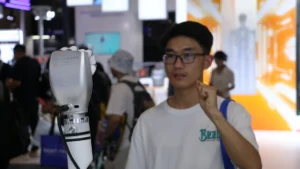
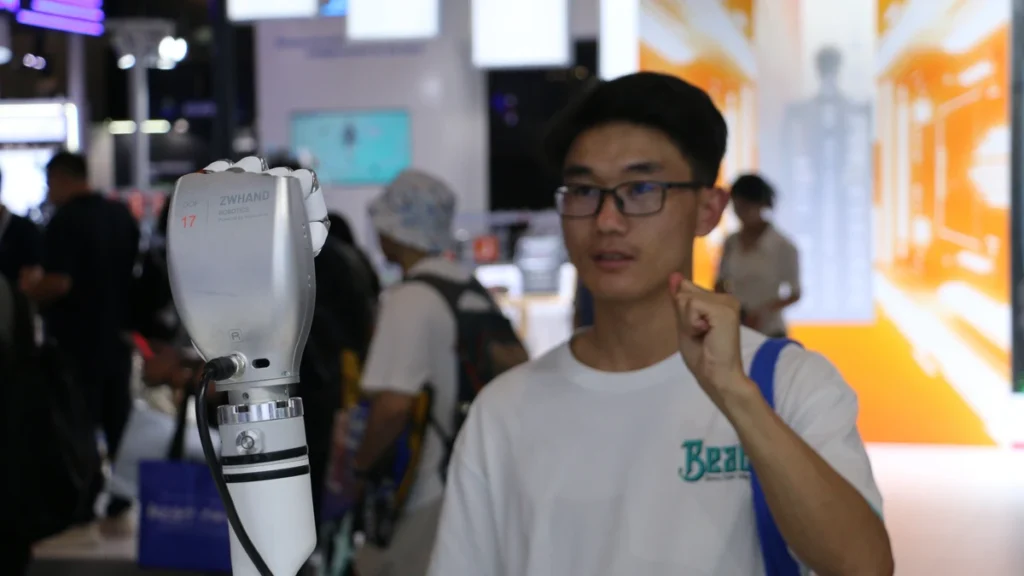
A visitor mirrors a robotic hand at the World Artificial Intelligence Conference in Shanghai.
A visitor mirrors a robotic hand at the World Artificial Intelligence Conference in Shanghai.
China has put a number on how powerful an artificial intelligence model can be before it needs the state’s permission to leave the country: 2 trillion parameters. Under new AI export controls proposed on 16 October by the Ministry of Commerce and the Ministry of Science and Technology, the weights, source code and other core components of any large model at or above that size, or one ranked among the world’s ten best, would join China’s catalogue of restricted technologies. The draft names 23 AI technologies among 40 items in total and is open for public comment until 15 November.
The draft is not a ban on Chinese AI abroad. Apps, websites and APIs sit outside it, already-published open-source work is exempt, and within a week two of the country’s best-known developers said they had cleared the registration step it introduced. What the rules change is who decides when China’s most capable models, and the know-how behind them, cross a border.
What the Draft Actually Covers
The list is broader than AI. According to the Associated Press, the 40 technologies span 23 in artificial intelligence, 12 tied to solar power, including the production of polysilicon, the core raw material of the solar supply chain, and five in biomedicine, including cell and gene therapy. Chip design sits inside the AI section: The Next Web reports that the draft would restrict design know-how for AI chips made at 14 nanometres or below, for chips built by stacking in 2.5D or 3D configurations, and for certain memory chip designs.
For large models, the draft works in two tiers. Some exports would be prohibited outright: the core technologies of large models trained on sensitive national data, and AI agents designed for highly sensitive environments such as national defence and critical information infrastructure. A second tier would be restricted, meaning an export needs approval. That tier covers models with at least 2 trillion parameters, or with what the ministries describe as world-leading capability, which The Next Web reports as a top-ten ranking on public performance and safety tests. Computing clusters are on the list as well.
The proposal does not name any model. The AP noted that Moonshot’s Kimi K3 and Alibaba’s Qwen 3.8-Max are among the Chinese models whose parameter counts already exceed 2 trillion, which places at least two of the country’s flagship systems inside the restricted tier from the start. A parameter count is one of the standard ways to describe a model’s scale, and it reflects how much the model can learn during training.
Where the Line Falls for Apps, APIs and Open Weights
The exemptions matter as much as the list. Open-source code and published research are excluded, because they are already in the public domain. Chinese companies can keep serving overseas users through apps, websites and APIs, so a developer in London who calls a Chinese model over the internet is not receiving an export under these rules.
Deployment is where it gets technical. Running a controlled model on foreign servers counts as an export, according to The Next Web, but firms operating models on their own cloud servers abroad could receive automatic licensing. Reuters reported that the commerce ministry has said most AI technologies would remain exportable, with simplified licensing for open-source technology exports and for Chinese companies running their own computing centres overseas.
One part of the regime is not a draft at all. A temporary registration requirement took effect on 16 October, the day the catalogue was published, obliging firms to register before exporting any of the listed items. It also applies to deals that were agreed but not yet completed, so companies with contracts already in motion have had to engage with the process immediately rather than wait for the final text.
DeepSeek and MiniMax Clear the First Hurdle
The first test of that registration came quickly. On 22 October, Yuyuan Tantian, a social media account affiliated with the state broadcaster CCTV, said DeepSeek and MiniMax had won state approval for global use of their AI models, Reuters reported. In a separate post the following day, the same account said that “overseas internet users had also urged other Chinese open-source large language models to follow suit.” Neither company immediately replied to Reuters’ requests for comment.
The two developers were the first reported to complete registration for open-sourcing their AI technologies, about a week after the draft was released, Crypto Briefing reported. The approvals let both companies publish their models openly and authorise their use overseas, and the same report notes that API access and software-as-a-service offerings fall outside the scope of regulated exports.
That sequence changes how the policy reads. When the catalogue appeared, a reasonable reading was that the rules could slow or stop open-weight releases from China’s largest labs. Six days later, two prominent open-source developers had a working path through the process, and a state-affiliated outlet was presenting the approvals as something foreign users wanted more of. On this evidence, the registration looks less like a wall and more like a checkpoint that open releases are expected to pass.
Why Beijing Says It Needs the Rules
Officials framed the move as security policy. “The Chinese government is implementing such necessary measures with the aims of reinforcing the security bottom line,” the commerce ministry said in a statement quoted by the AP. A ministry spokesperson said the rules were meant to “prevent misuse and abuse” and to “ensure that AI remains under human control”, and added that the plan did not target any specific country or firm.
The timing is notable. The AP reported that the proposal arrived as China and the United States made progress in talks on AI safety and governance, including a notification mechanism between the two countries for AI incidents that could threaten national security. The Financial Times reported in July that China was weighing export controls on AI models and chips, according to The Next Web, so the draft did not come out of nowhere. What is new is that its scope and thresholds are now public.
A Mirror Image of Washington’s Playbook
For years, export controls on AI have mostly run in one direction. US-led restrictions have blocked China from buying the most advanced AI chips and the machines used to make them. China’s draft borrows the same tools and applies them to what its own industry now produces at scale: large models and the engineering behind them.
Lian Jye Su, chief analyst at the technology research group Omdia, told the AP the move “can be seen as a response to Western countries posting sovereignty requirements on AI, robotics, telecommunications.” Washington has also gone beyond chips. In June, the US Commerce Department asked Anthropic to bar foreign nationals from using some of its most powerful models, Fable 5 and Mythos 5, citing national security concerns, before those restrictions were lifted, according to the AP.
Gary Ng, a senior economist at the French bank Natixis, described the direction of travel. “AI is increasingly strategic for both China and the U.S.,” he told the AP. “The world is getting more fragmented in trade and investment.” The two largest AI powers now both treat access to their most capable models as something the state can grant or withhold, even though both have, for now, chosen to keep most doors open.
What Changes for Developers and Businesses Abroad
For most people outside China, very little changes this month. Anyone using a Chinese chatbot, or calling a Chinese model through an API, is outside the scope of the draft, and models that have already been published as open source remain in the public domain.
The effects show up further along the supply chain. Companies that build products on Chinese open-weight models will be watching whether future releases above the 2 trillion parameter line arrive on schedule, or only once a licence is in hand. Hosting a controlled model on foreign servers counts as an export under the draft, which matters to anyone running Chinese models on their own infrastructure, while Chinese firms that run models on their own cloud servers abroad could receive automatic licensing. Chip designers and hardware partners face the most concrete restrictions, because the know-how for advanced AI chips, stacked packaging and certain memory designs is listed by technical specification rather than by company.
The draft also leaves a measurement question open. A parameter count is easy to state and hard to check from outside a lab, and a top-ten ranking depends on which public leaderboards are used. How the ministries define those tests in the final text will decide how many models the AI export controls actually reach.
What to Watch Before 15 November
The comment period closes on 15 November, and the final catalogue could move the thresholds, narrow the list or add detail on how licences are granted. Three questions will shape how much the rules matter in practice: whether open-weight releases above the threshold keep passing registration as quickly as DeepSeek’s and MiniMax’s did, how the world-leading capability test is measured, and whether the chip-design restrictions are applied as tightly as the draft’s specifications suggest.
Technical definitions often decide whether a headline policy bites. MW3.News made the same point about how age checks will decide whether the under-16 social media ban works, and China’s AI export controls are a similar case. The direction of policy is settled. The thresholds in the final text will determine who actually needs a licence, and how long the next large Chinese model takes to reach the rest of the world.