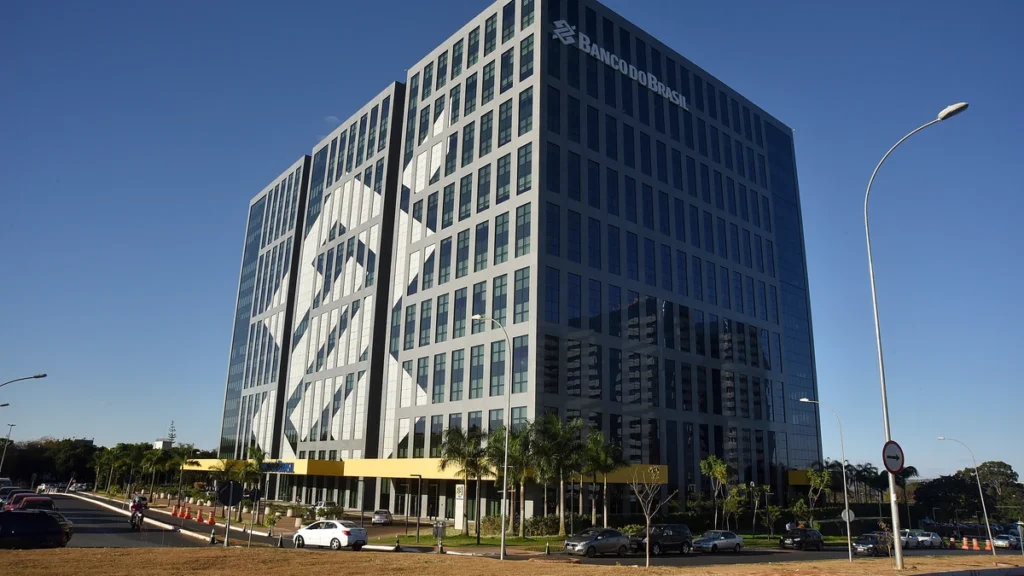
Banco do Brasil earned R$1.27 billion in adjusted net income in the third quarter of 2026, 66.5% less than the R$3.78 billion it made a year earlier, as farmers who borrowed from Brazil’s largest agricultural lender fell further behind on their payments. The state-controlled bank also cut its full-year profit forecast in half and said it would pay out only the mandatory minimum in dividends.
The results, published on Wednesday, 11 November, sent the shares down as much as 12% when trading opened in São Paulo the next morning, Revista Oeste reported. The damage was concentrated in one place: loans to medium-sized and large soybean, corn and cattle producers, most of them in Brazil’s Center-West farm belt.
What the Third-Quarter Numbers Show
The headline figure is adjusted net income, which strips out one-off items. At R$1.27 billion, about $230 million by The Rio Times’ conversion, it was also 67.5% below the R$3.91 billion Banco do Brasil earned in the second quarter, according to Brazil Stock Guide’s breakdown of the results. Analysts had expected a weak quarter, but not this weak: BTG Pactual, the Brazilian investment bank, had forecast R$1.9 billion, The Rio Times reported.
Over the first nine months of the year, adjusted profit came to R$8.6 billion, down 42.4% from R$14.9 billion in the same period of 2025. Return on equity, which measures how much profit the bank generates on its shareholders’ capital, fell to 2.8% in the quarter from 8.4% a year earlier, and the cost-to-income ratio worsened to 30.3% from 28%.
Not every line went the wrong way. Fee and commission income rose 4.6% year on year to R$9.3 billion, supported by asset management and consórcios, a pooled form of financing widely used in Brazil. But net interest income, the core revenue the bank earns from lending, slipped 1.5% year on year to R$26 billion, and administrative expenses rose 4.8% to R$10.3 billion. The expanded loan portfolio stood at R$1.307 trillion, down 0.5% on the quarter and up 2.2% on the year, so the bank was not growing fast enough to outrun its losses.
Where the Farm Loans Went Wrong
The single biggest drag was the cost of credit, the bank’s measure that combines provisions for expected defaults, discounts granted in renegotiations and money recovered from old debts. It reached R$21.2 billion between July and September, 18.4% more than a year earlier and 14.9% more than in the second quarter. Over nine months, credit costs climbed 33.2% to R$58.6 billion.
Agribusiness carried a disproportionate share of that bill. Of R$22.37 billion in expected credit loss charges on the domestic loan book, R$12.15 billion, about 54%, came from farm lending, even though agribusiness makes up roughly 31% of Banco do Brasil’s expanded portfolio. The share of farm loans more than 90 days overdue rose to 6.92% in September, from 6.27% in June and 4.84% a year earlier.
The deterioration was sharpest in operating loans, the short-term credit farmers use to buy seed, fertiliser and other inputs for each season. Their delinquency rate reached 12.52%, against 7.09% in September 2025. New non-performing farm loans jumped to R$14.72 billion in the quarter from R$5.72 billion in the previous three months, equal to 3.49% of the portfolio against 1.37%. The bank wrote off R$13.2 billion of agribusiness credit, more than double the R$5.3 billion written off in the second quarter.
In its statement, the bank said the rise mainly reflected continued growth in delinquency in part of its agribusiness portfolio, plus targeted reinforcements for some companies in its wholesale segment, ICL Notícias reported. On Thursday’s call with investors, chief executive Tarciana Medeiros said the bank was going through the most severe agribusiness credit-cost cycle in its history, according to Revista Oeste.
Why Brazil’s Farmers Are Struggling to Repay
The squeeze on Brazilian agriculture is a margin story rather than a harvest story. Brazil is on course for a record soybean crop of 6.5 billion bushels in the 2025-26 season, yet farm margins are expected to fall to their lowest level in nearly two decades, according to an analysis by Purdue University’s Center for Commercial Agriculture. Lower soybean prices, high production costs and weak port premiums have compressed profitability.
Costs are the stubborn part. Purdue’s researchers note that Brazil imports nearly 85% of its fertiliser, and because those inputs are priced in US dollars, a stronger dollar against the real raises farmers’ bills. In Mato Grosso, the leading soybean state, production costs for high-yield farms reached $602 per acre in the 2022-23 season, the highest in a series running back to 2009-10.
For a lender with Banco do Brasil’s exposure, thin margins on the farm turn into missed instalments at the bank. The bank said the defaults sit mainly with medium-sized and large producers, and that its greatest exposure is in the Center-West, the heart of the country’s grain and cattle industry. It also booked additional, targeted provisions for certain large corporate borrowers in its wholesale segment.
A Forecast Cut in Half, and a Smaller Dividend
Banco do Brasil now expects adjusted net income of R$9 billion to R$11 billion for 2026, down from a previous range of R$18 billion to R$22 billion. To land inside the new range, it needs to earn roughly R$400 million to R$2.4 billion in the fourth quarter. It raised its full-year credit cost forecast to R$80 billion to R$83 billion, from R$65 billion to R$70 billion.
Lending will shrink rather than grow. The bank replaced its forecast of 0.5% to 4.5% growth in the domestic loan book, excluding government lending, with a range running from no growth to a 2% contraction, and it now expects its farm portfolio to fall by 1% to 3%. That portfolio stood at R$403.6 billion at the end of September, down 4.3% from June. Net interest income growth for the year was cut to 2.5% to 4.5%, from 7% to 11%.
Shareholders will feel it directly. The bank said it would distribute only 25% of 2026 profit, the mandatory minimum, and that it would declare no interim dividends in 2027. Interest on capital for the third quarter, known in Brazil as juros sobre capital próprio, totalled R$197 million, or R$0.04 per share, about 52% less than a year earlier. The complement for 2026 is due to be announced on 17 February 2027 and paid on 10 March.
Capital buffers are thinner too. The Basel ratio, which compares a bank’s capital with the risk carried in its loans, ended September at 13.45%, against 14.81% a year earlier, and the common equity tier 1 ratio fell to 10.80% from 11.16%. Coverage of loans more than 90 days overdue dropped to 137.8%, from 174.3% a year earlier, which means provisions have not kept pace with the stock of bad loans.
How the Market Reacted
Banco do Brasil shares, which trade on São Paulo’s B3 exchange under the ticker BBAS3, fell as far as R$14.85 in the morning, a drop of 12%. By about 2.50pm Brasília time they were down 7.64% at R$15.60, while the benchmark Ibovespa index was 0.7% lower, Revista Oeste reported. The Rio Times put the late-afternoon price at about R$15.37, roughly 9% below Wednesday’s close of R$16.89.
Analysts were not rushing back in. Citi rates the stock a sell with a R$15 price target, and XP, the Brazilian brokerage, has a neutral rating, The Rio Times reported.
The Political Reading in Brasília
Because the federal government controls Banco do Brasil, its results are read politically as well as financially. In its report on the third-quarter profit fall, Revista Oeste noted that the quarter came in the final year of President Luiz Inácio Lula da Silva’s current term, and compared it with the third quarter of 2022, under former President Jair Bolsonaro, when the bank earned more than R$8 billion, a 62.7% increase on 2021. The magazine wrote that the figures revive questions about how state companies have been run under Workers’ Party governments, with critics pointing to political interference as a risk to their health.
The bank’s own explanation is the agricultural credit cycle, and the breakdown of the quarter shows where the losses originated: agribusiness produced more than half of the quarter’s loss charges from less than a third of the loan book. Supporters and critics of the government draw different conclusions from the same numbers, but the breakdown shows plainly where the provisions are going: the farm book.
What to Watch Before the Full-Year Results
The fourth quarter is the next test of whether provisions are peaking. The bank said it is prioritising loans with stronger risk-adjusted returns while stepping up renegotiations, collection efforts and the recovery of pledged collateral. It disbursed R$24.5 billion in the first three months of the 2026-27 agricultural financing season, known as Plano Safra.
Three numbers will tell the story: the share of farm loans more than 90 days overdue, now 6.92%; new non-performing loans across the whole bank, which reached R$28 billion in the third quarter against R$21.66 billion in the second; and the coverage ratio, which has fallen for a year. Total write-offs rose to R$22.8 billion from R$14.2 billion in the second quarter, so the bank is clearing bad loans off its books faster, but new ones are still arriving faster than before. MW3.News also reported in September on how Brazil’s central bank sold $1 billion and bought it back.