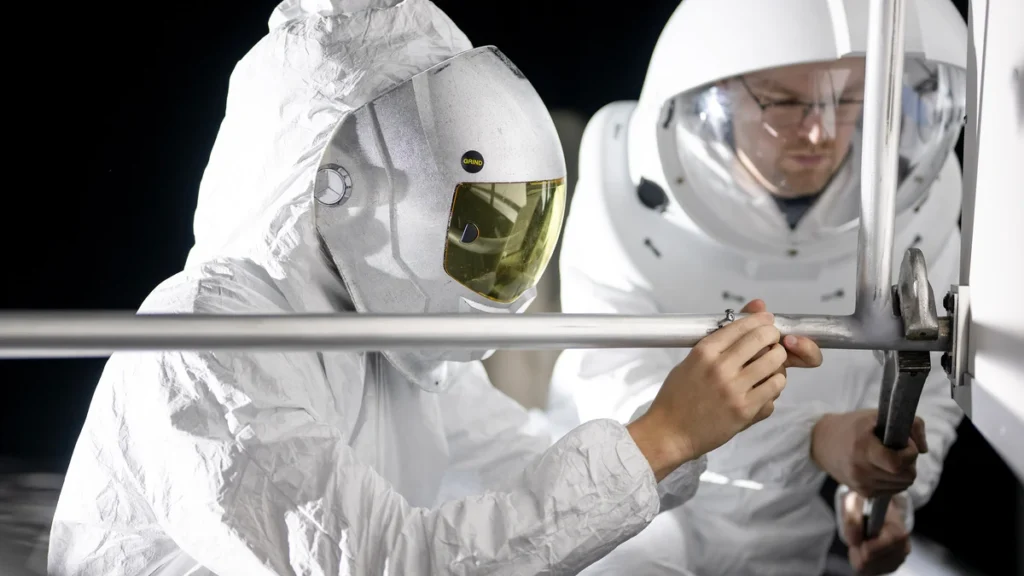
NASA engineers at Marshall Space Flight Center simulate the lunar lighting environment in preparation for the crewed Artemis III landing.
NASA engineers at Marshall Space Flight Center simulate the lunar lighting environment in preparation for the crewed Artemis III landing.
The most stubborn passenger on the next crewed Moon landing may be a common household fungus. A NASA-led team has modelled what would happen to the microbes that inevitably travel with astronauts, and found that parts of the lunar south pole are cold enough, and shaded enough, to keep some of them alive. The hardiest of the five organisms tested was Aspergillus niger — the black mold that turns up on damp walls and forgotten onions.
The paper, Potential survivable niches for microbial life on the lunar south pole, was published on 19 August in Science Advances (2026; 12:34, DOI 10.1126/sciadv.aec0811). It is led by Prabal Saxena, a planetary scientist at NASA’s Goddard Space Flight Center in Greenbelt, Maryland, with co-authors including Stefano Bertone, Heather V. Graham, Natalie M. Curran, Aaron B. Regberg, Andrew Needham and Noah E. Petro. The finding does not describe life on the Moon. It describes something more awkward for the science that Artemis is meant to deliver: a place where the things we bring with us do not immediately die.
The Five Organisms That Went Into the Model
The team did not fly anything anywhere. They built an environmental model, combining elevation and temperature maps from NASA’s Lunar Reconnaissance Orbiter with radiation modelling, then tested that environment against the known heat and ultraviolet tolerances of five organisms drawn from earlier laboratory work.
The five were chosen because they are already known to be difficult to kill in spaceflight conditions: the fungus Aspergillus niger; the bacteria Bacillus subtilis, Staphylococcus aureus and Deinococcus radiodurans; and several species of Fusarium. Between them they cover the usual suspects of crewed spaceflight — skin flora, spore-formers, and the radiation-hardy outliers that microbiologists reach for when they want to know the upper limit of survivability.
Three regions of the lunar south pole were modelled, and they are not arbitrary. Nobile Rim, Connecting Ridge and De Gerlache Rim are candidate landing sites for the crewed Artemis III mission. The study is, in effect, a survivability map of the ground NASA is most likely to stand on.
Why Black Mold Outlasted the Rest
Across the modelled terrain, Aspergillus niger came out ahead, and the reason is ultraviolet light. The Moon has no atmosphere to filter it, so on a sunlit surface UV is the fastest killer available. A. niger was the most UV-resistant of the five, to the point that it retained viability even in areas receiving some direct sunlight, rather than needing permanent shadow.
The word “survive” is doing narrow work here. In this study, survival means remaining viable for at least one Earth day. It does not mean growing, dividing or establishing anything. The researchers are explicit that there is no evidence the Moon offers what microbial growth requires — liquid water, an atmosphere, moderate temperatures. What the model describes is persistence, not colonisation: a dormant cell that is still a cell tomorrow.
That distinction matters for how the result should be read. Nothing here suggests the Moon can be infected. It suggests that a sample collected near a boot print may not be as pristine as the instrument reading it assumes.
Survivable Niches From Crater Floors to a Boot Print
The most striking output of the lunar south pole model is its range of scale. The survivable niches the team mapped run from crater floors several miles across down to areas no larger than an astronaut’s boot print.
That lower bound is the operationally awkward one. A permanently shadowed crater is a known quantity: it can be planned around, approached carefully, sampled with protocol. A boot-print-sized cold pocket is created by the very activity that contaminates it. An astronaut walking across regolith casts small, deep shadows, and the model suggests some of those shadows are survivable niches that did not exist a second earlier. Contamination and habitat arrive together, in the same footstep.
The same shadowed terrain is scientifically valuable for exactly the reason it is microbially hospitable. Permanently shadowed regions stay extremely cold and shield their contents from radiation, which is why they are expected to preserve water ice and ancient volatile chemistry. The conditions that make them worth visiting are the conditions that make a hitchhiking spore hard to sterilise.
Why This Complicates the Search for Native Lunar Chemistry
Robotic missions have a well-established answer to this problem: bake it. Spacecraft hardware bound for sensitive destinations is heat-sterilised at temperatures above 400F, and planetary protection protocols are built around the assumption that the vehicle is the only vector. Crewed missions break that assumption. A human being cannot be sterilised, and the study notes that microbial contamination becomes a substantially more complicated issue the moment people are the delivery mechanism.
Saxena framed the problem in human terms. “Humans are natural explorers, and with them come their voices, their memories … and their microbes,” he said in NASA’s account of the work.
The consequence is measurement, not infection. Organic chemistry is one of the main prizes at the lunar poles, and terrestrial biology is made of organic chemistry. If a returned sample contains carbon compounds, the first question becomes whether they are lunar or whether they walked in. Co-author Heather Graham put the operational point plainly: “The Moon is a place where a cell can survive, so our first exploration of these sites should pay extra attention,” she said — characterising the chemistry before human visits alter what there is to find.
What It Means for Artemis and the Missions After It
None of this is an argument against going. It is an argument about sequencing. The practical reading of the paper is that baseline measurements are perishable: the value of a pre-contact chemical survey drops the moment the first crew lands, and it cannot be recovered afterwards. Artemis III, currently slated for 2027, is the deadline attached to that logic.
There is also a straightforward mission-design implication. If survivable niches are terrain-specific and can be as small as a footprint, then contamination is not a uniform field to be estimated — it is a map that depends on where crews walk, where they park hardware, and which shadows they cast. That is a tractable problem, but only if it is treated as one before landing rather than reconstructed afterwards from photographs.
For readers who followed our coverage of how narrow the observing window was for the total solar eclipse over Spain, the shape of the problem will be familiar: in observational science, some measurements are only available once, and the schedule decides whether anyone gets them.
The Mars Question Behind the Moon Study
The Moon is the rehearsal. The reason this result carries beyond lunar geology is that Mars is the destination where a false positive would be most expensive, and the same crew-borne organisms would be making the trip.
Co-author Andrew Needham drew that line directly: “when we go to Mars to search for signs of life beyond our planet, we will want to make sure it’s not stuff we brought,” he said, as reported by Phys.org. A detection of biological material on another world is only meaningful if the alternative explanation — that it is ours — has been ruled out in advance. Building that ruling-out capability at a destination three days away, rather than several months away, is the cheapest version of the exercise available.
The immediate finding is modest and specific: under modelled conditions at three candidate Artemis sites, certain resilient Earth organisms would stay viable for at least a day, and black mold would stay viable longest. The broader point, as summarised in coverage of the study, is that the era in which the lunar surface could be assumed sterile is ending on a known date — and the science that depends on that assumption should be done first.