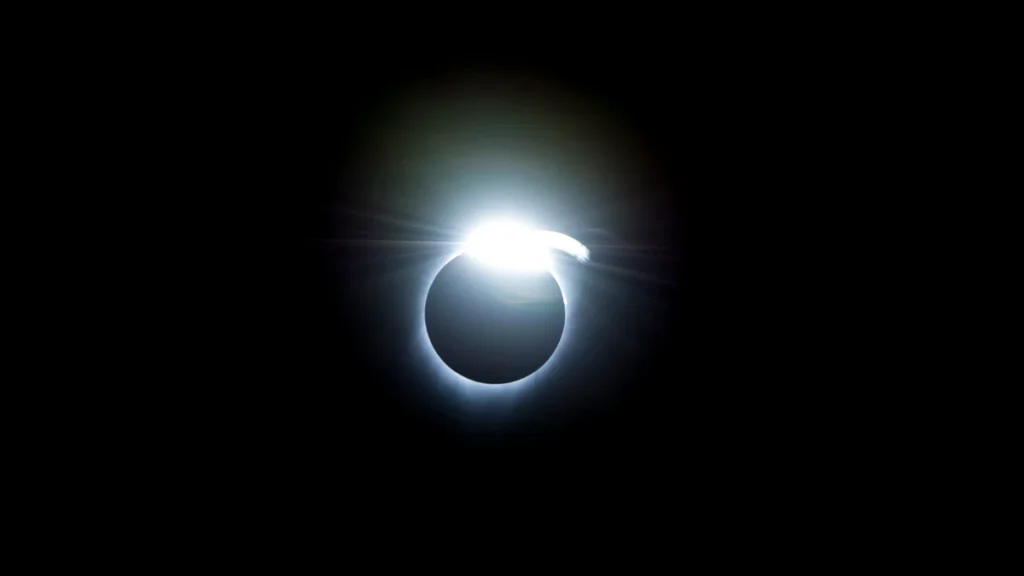
The diamond ring effect at the start of totality, the moment Spain may catch just above its western horizon.
The diamond ring effect at the start of totality, the moment Spain may catch just above its western horizon.
For all the years of planning, the hotel prices and the road plans, the total solar eclipse over Spain on Wednesday 12 August gives anyone standing in the right field a maximum of 108 seconds. That is the longest totality available anywhere in the country, and most people inside the path will get rather less than that. It is the shortest possible payoff for the largest single-day astronomy event Europe has staged in a generation.
The scarcity is the point. This is the first total solar eclipse visible from mainland Europe since 1999, and Spain’s own Instituto Geografico Nacional describes it as the first total eclipse visible from the Iberian Peninsula in more than a century. NASA has the shadow crossing six countries and territories before it gets there.
Where the Moon’s Shadow Actually Lands
The shadow starts at sunrise over Siberia, crosses the Arctic and eastern Greenland, clips western Iceland, then curves down the North Atlantic and reaches Spain as the sun is going down. A small north-eastern corner of Portugal catches the very edge of it; the Montesinho Natural Park near Braganca is the only part of the country inside the line of totality.
In Spain the band is about 293 kilometres wide and touches twelve autonomous communities. They include all four Galician provinces and every province of Castile and Leon except Salamanca, along with Asturias, Cantabria, the Basque Country, Navarre, Aragon, the Guadalajara and Cuenca parts of Castile-La Mancha, south-western Catalonia, the Castellon and Valencia provinces, and all of the Balearic Islands. Bilbao, Santander, Burgos, Valladolid, Zaragoza, Valencia and Palma are all inside the line.
The timings are tight and they run west to east across the country in a matter of minutes. NASA puts totality at Leon between 8:28pm and 8:30pm local time, and at Valencia between 8:32pm and 8:33pm. Reykjavik gets its turn far earlier in the day, between 5:48pm and 5:49pm local time. The BBC Sky at Night Magazine guide lists maximum eclipse at Bilbao at 20:27, Zaragoza and Barcelona at 20:29, Valladolid at 20:30, Madrid at 20:31 and Valencia at 20:33.
Why 108 Seconds Is the Whole Show
Totality is short here because of geometry rather than bad luck. The eclipse falls near lunar perigee, so the Moon appears large enough to cover the Sun completely, but Spain sits well off the centre line where the shadow lingers longest. Euronews reports a maximum of one minute and 48 seconds anywhere in Spain. NASA’s own framing is blunter: for most people in the path the Sun will be fully covered for less than two minutes, and even at the very centre of the track, out over Greenland, northern Russia and the open Atlantic, it stays under two and a half.
What happens inside those seconds is what people travel for. Cesar Gonzalez, an astronomy communicator at the Madrid Planetarium, told Euronews that “as soon as the Moon completely covers the Sun, the brightness decreases. We can start to pick out the brightest stars and planets in the sky.” He added that “the temperature drops. It can fall by as much as five degrees, and a slight breeze always starts to blow.”
That description has not changed in a hundred years. Tomas Martinez, a teacher in O Barco de Valdeorras who watched the last comparable event over Spain in 1912, wrote that “the landscape looked sad and wan, and the cold was quite intense. The hens were looking for their roost.”
What Europe Sees Outside the Path
Nearly everyone else in Europe still gets something, and in some places it is close to the real thing. Madrid misses totality by a hair at 99.97 per cent obscuration, with Barcelona at 99.8 per cent. Across the whole Iberian Peninsula the Sun dims by at least 92 per cent.
Further out, NASA’s figures put Dublin at 94 per cent, London at 91 per cent, Algiers at 96 per cent and Berlin at 85 per cent. The Sky at Night guide breaks the British Isles down further: Cardiff and Belfast at 93 per cent, Edinburgh at 91 per cent, Cork at 96 per cent. In Portugal, Braganca reaches 99.9 per cent, Porto 98.2 per cent and Lisbon 94.5 per cent.
North America gets the thin end. Anchorage sees 28 per cent of the Sun covered, Boston 16 per cent and New York just 9 per cent. Parts of the northern United States from Alaska to North Carolina, most of Canada and north-western Africa all catch a partial eclipse of some depth.
The Sunset Problem Nobody Can Solve
Spain’s eclipse has a complication that the maps do not show. It happens as the Sun is dropping towards the horizon in mid-August, which makes it visually spectacular and logistically fragile at the same time. A low Sun means a clear western horizon is not a nice-to-have but a requirement: a ridge, a treeline, a building or a bank of coastal cloud in the wrong place removes the event entirely for whoever is standing behind it.
The upside is that a horizon-level totality is the kind of thing photographers plan careers around. With the Sun low, the diamond ring effect, the brief flare as the last sliver of photosphere slips behind the Moon, can appear against landscape rather than empty sky. It is the single most reproduced image in eclipse photography and Spain may get it framed by hills.
A Country That Booked Out Years in Advance
The economics arrived long before the shadow did. Phys.org reported in May that a modest hostel room in Teruel was going for around 300 euros on 12 August, with a privately rented apartment at 1,400 euros. In Burgos there was nothing under 600 euros, and one 60 square metre apartment was listed at 5,000 euros.
Regional government has leaned into it. Castile and Leon’s presidency councillor estimated two million visitors for the region. The Generalitat Valenciana’s tourism portal recorded an 80 per cent surge in bookings for inland Castellon. The Spanish Rural Development Network puts the combined value of all three coming eclipses at close to 1.4 billion euros. Teruel’s tourism office has been selling the least glamorous assets it has, promoting “open landscapes, clear skies and low levels of light pollution”, and the national government has been explicit that it wants the event to pull visitors away from the coast and into the interior, a shift that sits alongside the wider changes in how Europeans are booking their summers.
The science infrastructure has been mobilised too. The Yebes Observatory in Guadalajara province, described as a key node in global radio astronomy networks, is acting as an official monitoring centre. The European Space Agency is broadcasting live from the Javalambre Astrophysical Observatory in Teruel, and Leon is running a free public observation programme with its university and city council. NASA is streaming from 1:15pm EDT.
How to Watch Without Damaging Your Eyes
The safety guidance is the one part of this that carries no nuance. Outside the brief window of totality, anyone looking at the Sun needs certified eye protection: solar viewing glasses or handheld solar viewers meeting the ISO 12312-2 standard. Ordinary sunglasses do not work at any darkness, and safe solar filters are thousands of times darker than they are.
NASA is emphatic on one specific mistake: never look at the Sun through a camera lens, telescope or binoculars while wearing eclipse glasses, because the concentrated light burns straight through the filter. Anyone without certified glasses can use a pinhole projector instead, standing with their back to the Sun and looking at the projected image.
The medical risk from getting it wrong is solar retinopathy, and Euronews lists the symptoms clinicians watch for: blurred vision, blind spots, distorted shapes and light sensitivity severe enough to cause headaches. Only during the seconds of complete totality, inside the path, is it safe to look at the eclipse with the naked eye. Everywhere in Madrid, Barcelona, London or Dublin, where the Sun is 91 to 99.97 per cent covered but never fully hidden, the filters stay on for the entire event.
Then It Happens Twice More
The strangest thing about the total solar eclipse over Spain is that it is not a one-off. On 2 August 2027 a second total eclipse crosses the south of the country through Cadiz, Malaga, Granada, Almeria, Ceuta and Melilla, and that one runs to roughly five minutes of totality. On 26 January 2028 an annular eclipse follows, the ring-of-fire type where the Moon sits too far away to cover the Sun completely.
Three eclipses in eighteen months over one country is not a coincidence so much as a quirk of orbital arithmetic. Eclipses repeat on the Saros cycle of roughly 18 years, 11 days and 8 hours, and the paths those cycles trace occasionally cluster. Euronews describes the run as a unique trio in 21st-century Europe, and Spain is the country it happens to have landed on.
Which puts Wednesday’s 108 seconds in a slightly gentler light. If cloud closes in over Burgos or the horizon fills in over Valencia, the wait for another go is not another century. It is next August.