
The Senate Commerce, Science and Transportation Committee spent about an hour on 5 August working through five children’s online-safety bills. Four of them advanced. The one that did not advance, the SCREEN Act, is the one that actually won its vote.
It collected a 15-13 result in committee and then watched the result evaporate, because too few senators were physically in the room to establish the quorum a binding vote requires. That is a procedural stall rather than a defeat, and the bill is neither dead nor voted down. It also happens to contain one of the broadest provisions Congress has written into an age-verification bill so far, and it is a single clause about IP addresses.
The Vote It Won and Still Lost
The committee’s executive session listed five bills. The Kids Online Safety Act cleared on a unanimous voice vote with its contested duty-of-care provision intact. Three artificial-intelligence bills aimed at minors advanced alongside it with markedly less friction. Then came S.737, and the count went 15-13 along party lines before the quorum problem voided it, as Tech Times reported from the markup.
Formally, the bill sits exactly where it has sat since Senator Mike Lee of Utah introduced it on 26 February 2025 with four cosponsors: referred to Commerce, status “Introduced,” per the official record on Congress.gov. Its full name is the Shielding Children’s Retinas from Egregious Exposure on the Net Act. A committee can take it up again at any point, and a companion measure has already travelled further than the Senate version has.
The Sentence That Names VPNs Outright
Most age-verification proposals treat circumvention as an enforcement problem to be solved later. This one writes it into the text. The Congressional Research Service summary states that covered services must “subject users’ Internet Protocol (IP) addresses, including known virtual proxy network (VPN) IP addresses, to the technology verification measures, unless the service determines a user is not located within the United States.”
Read plainly, that inverts how privacy tools normally work. A virtual private network exists to keep a connection from being tied to a person or a place. Under this drafting, traffic arriving from an address a service recognises as a VPN is precisely the traffic that must be pushed into identity checks, because the service cannot rule out that the user is in the United States. Choosing the privacy tool becomes the trigger for having to identify yourself.
The Electronic Frontier Foundation, which opposes the bill, put it bluntly in its analysis of the legislation: “It is particularly galling that the SCREEN Act forces users who intentionally take steps to protect their privacy to identify themselves.” The group notes that VPN use is routine among journalists, activists, remote workers on public Wi-Fi and anyone trying to limit commercial tracking.
Why Netflix and Discord Sit Inside the Net
The bill’s reach comes from what it leaves out. Many state age-verification laws apply only when a substantial share of a site’s content is sexually explicit, a threshold that keeps general-purpose platforms outside the rules. This bill sets no such threshold. A service that makes even a single qualifying item available commercially falls within scope, and once inside, the verification duty applies to every user of that service rather than to one section of it.
That drafting choice is why analysts keep listing mainstream names. Streaming catalogues, large forums and chat platforms all host material that could meet the definition somewhere in their libraries. Netflix, Reddit, Discord and Bluesky have all been cited as services that would plausibly be captured, not because they are pornography sites but because scope follows a single item rather than a proportion.
The End of the “Click Here if You’re 18” Box
The bill explicitly rejects self-attestation. Asking a user to confirm they are not a minor “shall not be sufficient,” which retires the checkbox that has served as the internet’s default age gate for roughly three decades. In its place, services must deploy technology verification measures tied to a real identity.
In practice that means a short list: a government-issued ID, facial age estimation, credit-card data, or a third-party verification vendor that collects, processes and stores those documents on the platform’s behalf. The text requires reasonable data-protection steps and bars keeping information longer than necessary, but it sets no hard collection, use or retention limits. Nor does it require any privacy-preserving alternative. Zero-knowledge proofs, which can mathematically confirm that someone is over eighteen without transmitting the underlying identity data, are not mandated anywhere in the current text.
What the Verification Industry Has Already Leaked
The argument against building a national identity layer is not hypothetical, because the vendors that would run it have a public record. AU10TIX, a verification provider used by TikTok and X, left administrative credentials exposed for more than a year, a window in which anyone with access could have retrieved government ID numbers, document images, names and dates of birth.
In October 2025, a breach at a third-party customer-support vendor working with Discord exposed government ID photographs belonging to roughly 70,000 users who had submitted them through an age-appeal process. In February 2026, researchers examining an exposed domain belonging to the provider Persona found publicly accessible code showing that its age checks included screening against terrorism and espionage watchlists and that biometric data could be retained for up to three years.
Each incident involved a small number of vendors serving a handful of platforms. A statutory mandate covering every commercial service with a single qualifying item would multiply both the number of checks performed and the quantity of identity documents sitting in third-party databases.
The Case the Sponsors and Parents Make
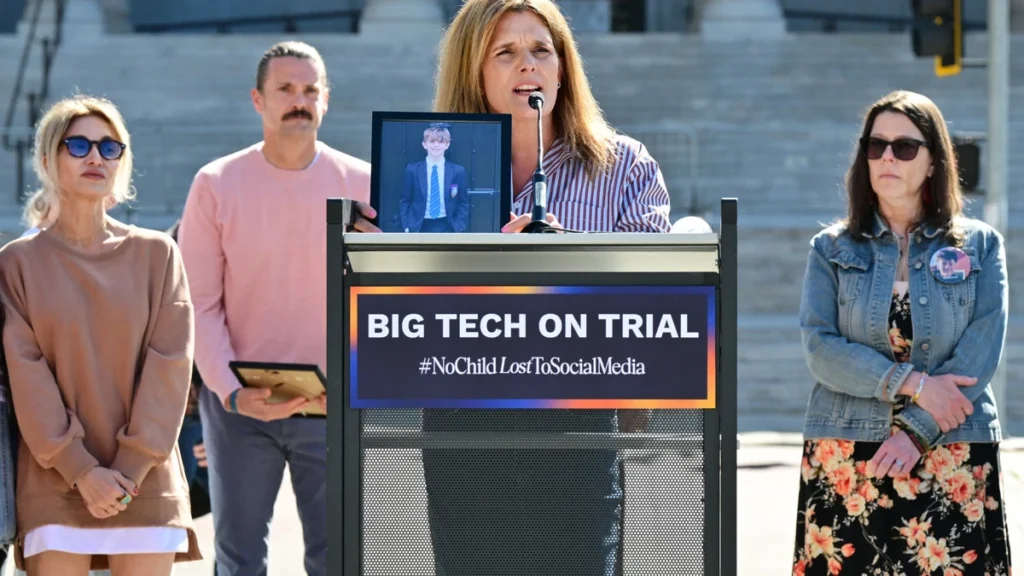
The other side of this argument is not abstract either, and the committee room made that visible. Members of ParentsSOS, a coalition of families who have lost children to online harms, sat in the gallery, and one senator asked them to stand and say their child’s name aloud. The bills on the agenda exist because that constituency has spent years arguing that voluntary platform measures have not worked.
Senator Marsha Blackburn of Tennessee, who sponsors the Kids Online Safety Act with Senator Richard Blumenthal of Connecticut, was pointed about the weaker package the House had passed. “The Senate cannot and will not accept the version that the House passed earlier,” she said at the hearing, calling it “a pale imitation of Big Tech accountability” and adding that “the parents have waited a long time.” Josh Golin, executive director of the advocacy group Fairplay, read the week as convergence rather than conflict, saying that “the bill’s success in both chambers shows that our leaders in Congress agree far more than they disagree when it comes to kids’ online safety.”
Even among critics, the disagreement is largely about method. The Center for Democracy and Technology told the committee that privacy-focused legislation “would help to address some of the root causes animating the concerns for kids’ safety online.” The Electronic Frontier Foundation makes a similar argument, pressing for a national consumer privacy law and limits on behavioural advertising instead of identity checks at the door. Both accept the harm; they dispute that verifying every adult is the instrument that fixes it.
Where the SCREEN Act Goes Next
The quorum failure changed the timetable and nothing else. The bill can be recalled for another committee vote whenever the members are in the room, and its provisions have a second route entirely: the House companion, H.R. 1623, introduced by Representative Mary Miller of Illinois, was folded into the KIDS Act, which the House passed last month 267-117. Anything the two chambers reconcile could carry that language forward even if S.737 never gets its own clean committee vote.
That is the practical shape of this fight. The Senate is arguing about liability, the House is arguing about verification, and the bill most likely to change what an ordinary adult experiences online is the one that technically failed. Age checks tend to be debated as a question about children’s access; the drafting here decides something different, which is how much identity every adult hands over to reach lawful material. The economics of the modern web already run on identity and attention data, a dynamic visible in everything from ad targeting to how brand payments concentrate among a small share of creators, and a federal verification mandate would add a durable new layer of it.
For anyone using a VPN as ordinary hygiene rather than evasion, the clause to watch is the short one about IP addresses. It is the part of the SCREEN Act that reaches furthest past the websites the bill is named for.
This article was AI-assisted and edited for accuracy.