
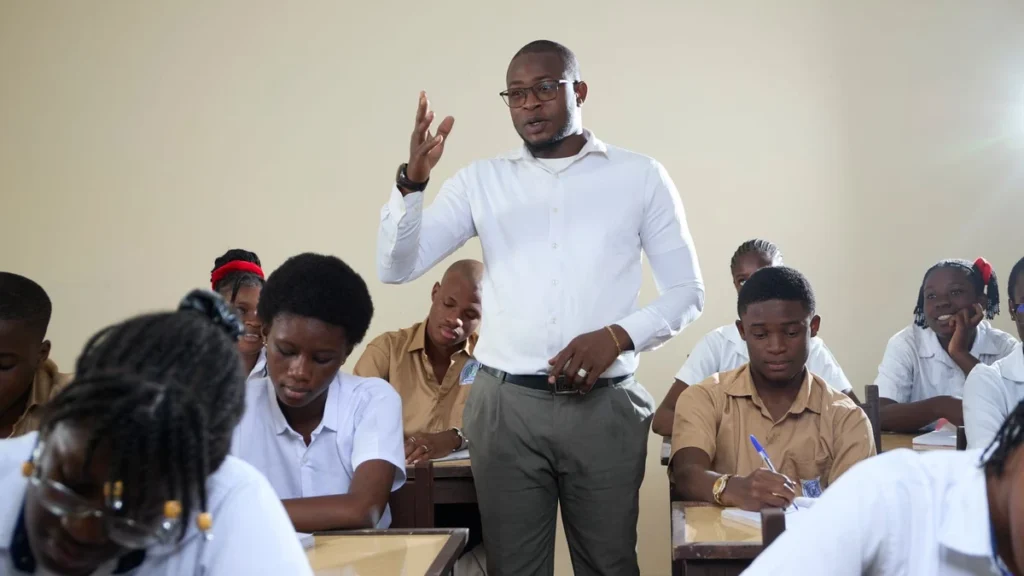
The autumn term has opened on a policy change that took barely two years to go from contested to ordinary. School phone bans are now the default across a large part of the United States, and almost nobody is arguing about them any more. What is striking is how completely the argument moved on, and how little of that energy followed the students to the place they now actually do their thinking.
The device that dominated a decade of parent-teacher evenings has been removed from the desk. The one that can write the essay sitting on it has not.
What 22 States Actually Changed
The numbers are unusually clean for an education debate. As of June 2026, according to a review of state legislation by digital-literacy author Diana Graber, 22 states and the District of Columbia had adopted bell-to-bell cellphone bans, meaning a student generally cannot reach a phone at any point between arrival and dismissal. Another 19 states had passed looser laws that permit or encourage districts to restrict phones without mandating a statewide all-day ban. Education Week’s own tracker puts at least 38 states in the restricted-or-banned column in some form.
The mechanics are deliberately unglamorous. In Kansas, which moved to a statewide bell-to-bell rule this year, students at Eisenhower Middle School in Kansas City hand devices to their first-period teacher. “Kids’ first-hour teacher has a box, and an assigned number students will place their cells in,” principal Catherine Carter told KCTV5 as the district opened its year. Parents who want to reach a child call the office, or use the school messaging app.
A box with numbered slots is not a sophisticated intervention. That is rather the point: it worked because it was simple, visible and enforceable by an adult standing in a room.
Why the Phone Was the Easy Target
Public opinion did not have to be dragged into this. A Pew Research Center survey conducted in late May and early June 2026 found 77% of US adults supported banning middle and high school students from using phones during class, a figure that has now risen for a second consecutive year. Support for full-day bans hit 48%, up from 36% in 2024.
That consensus is easy to explain. A phone is a physical object. It can be seen, counted, collected and locked in a pouch. The harm it is accused of causing, fractured attention in a room full of teenagers, is something every adult in the building can observe directly. Policy tends to move fastest against problems that can be photographed.
The results teachers report are correspondingly tangible. Randi Weingarten, president of the American Federation of Teachers, said of the states that moved first that hallways and lunchrooms “bustle with chatter and laughter again now that students aren’t heads down, eyes on their phones.” It is a modest claim and a believable one.
The Number Nobody Put on a Poster
While that campaign was being won, a second one was quietly conceded. Common Sense Media’s 2026 census of more than 1,200 US children and teenagers aged 9 to 17 found that 86% had used or interacted with generative AI, and 24% were using it daily. Among those who use it at all, 85% said they use it for schoolwork.
Set the two figures side by side and the shape of the year becomes clear. Adults reached 77% agreement that phones should be out of the classroom. Children reached 86% adoption of a tool that can produce the classroom’s actual output. One of those numbers was legislated. The other simply happened.
The more revealing statistic sits underneath. Three-quarters of students say their school has told them what they may and may not use AI for. Only just over half say they have been taught how to use it safely. The gap between those two numbers is the whole problem in miniature: schools have issued rules considerably faster than they have issued instruction. Whatever a school declines to teach, students work out privately, at speed, without supervision.
Schools Are Policing AI With Software, Not Teaching It
The enforcement instinct that served the phone question so well has been transplanted wholesale onto a problem shaped nothing like it. In the Kansas City metro districts, the same report that described the phone boxes noted that schools are running software to check whether homework was produced with AI, and that a student judged to have relied on it too heavily can receive a zero.
This is where the analogy breaks. A phone in a pocket is a fact. AI authorship is an inference, and a contested one. Detection tools return probabilities rather than evidence, and their reliability is actively contested by the schools using them. A confiscation policy that is wrong occasionally costs a student their phone for a day. An authorship policy that is wrong occasionally costs a student a grade and their reputation for honesty.
There is also a plainer difficulty. Even a detector that worked perfectly would only ever tell a teacher what happened after the learning did not. It cannot distinguish the student who used a model to interrogate a weak argument from the one who used it to avoid having an argument at all, and that distinction is the only one that matters educationally.
What the Teachers’ Union Wants Next
The largest organised push now goes considerably further than homework checks. At the National Press Club in May 2026, Weingarten, whose union has 1.8 million members, called for wide-scale rollbacks of student technology use, telling reporters that “intentional or not, all this tech has been a huge experiment on kids, and experiments can go wrong.”
The union’s published plan asks for a ban on all screen use below grade 3 absent a compelling reason such as disability support, a ban on student-facing AI including digital tutors throughout elementary school, and a ban on companion chatbots for anyone under 16. Secondary students, it argues, should use AI tools only under teacher supervision.
The proposal deserves to be read on its merits rather than as a reflex. Its strongest section is not the list of bans but the demand attached to them: far more teacher training, and far more independent research on safety and privacy. Notably, the AFT itself entered a five-year, $23 million partnership with Anthropic, Microsoft and OpenAI to train teachers only a year before calling for these restrictions, which suggests an organisation working out its position in public rather than defending a fixed one.
Sari Beth Rosenberg, a history teacher in New York City quoted in the same report, framed the classroom stake without reference to policy at all: “You’re very smart, but you don’t have strong critical-thinking skills yet, and if you’re relying on AI to do that, you’re never going to have it.”
The Skill That No Ban Can Install
It is worth being precise about what the phone campaign proved, because it is narrower than the victory lap suggests. It proved that a school can remove a device. It did not prove that a school can create attention, and those are different achievements. A student who cannot reach a phone for seven hours has been protected from an interruption. They have not thereby been taught to sustain a difficult thought, and the second thing was always the objective.
The same distinction now applies with much higher stakes. The useful question is not whether a student used a model, but whether they used it as scaffolding or as a substitute. Scaffolding looks like asking a model to find the hole in your argument, to list what you have not considered, to explain a passage you did not follow. The student still does the intellectual work. Substitution skips the work entirely, and with it the planning, the working memory and the argument-building that the assignment existed to develop in the first place.
That distinction cannot be enforced by software, because it is invisible in the finished text. It can only be taught, which requires the thing currently in shortest supply: teacher time, teacher training, and a school willing to spend a lesson on how to think alongside a machine rather than a memo on when not to.
None of this is an argument against the bans. They are popular, they are cheap, and the reports coming out of the states that moved first are genuinely encouraging. It is an argument about sequencing. Regulation reached the phone quickly because the phone was easy to see, and has reached AI slowly for exactly the opposite reason, at the same moment that a similar visibility problem is playing out in the debate over online age verification and identity checks.
School phone bans cleared the desks. What lands on those desks next is a question the rules have not caught up with, and the students are not waiting for them to.