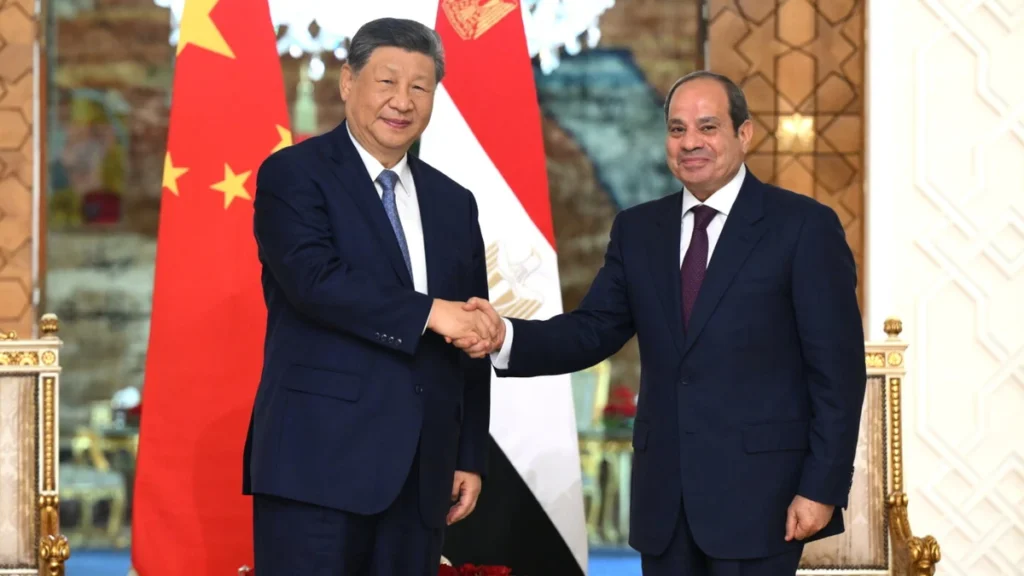
Xi Jinping and Abdel Fattah el-Sisi meet in Cairo on 2 September
Xi Jinping and Abdel Fattah el-Sisi meet in Cairo on 2 September
Xi Jinping’s Egypt visit began on the evening of 1 September with a 21-gun salute at the Ittihadiya presidential palace in Cairo, and it landed on top of a decade of Chinese money that is already in the ground. Beijing has put more than $10bn into Egypt since the Chinese president was last there, in projects running from the business district east of Cairo to an electric rail line serving industry in the Nile Delta. The three days of talks that followed were about what comes next.
The trip marked seventy years of diplomatic relations between the two countries, and it arrived at a moment when the region’s assumptions about who underwrites its security are unusually unsettled. Egypt is still the second-largest recipient of United States military aid. It is also, on the figures its own agencies publish, buying far more from China than it sells back to it.
What a Decade of Chinese Money Built in Egypt
The headline number is more than $10bn of Chinese investment, and unlike a good deal of announced-but-unbuilt infrastructure elsewhere, much of it is visible from a road. Al Jazeera reported that the money has gone into the New Administrative Capital east of Cairo and into an electric rail line serving industry in the Nile Delta, with Chinese firms separately backing container ports, green hydrogen, iron pipes, tyres and satellites.
Most of it is concentrated in one place. The China-Egypt TEDA cooperation zone at Ain Sokhna, on the Gulf of Suez, is the anchor of the relationship and part of Beijing’s Belt and Road Initiative. Egyptian state media put the zone at about 200 companies and investments above $3.8bn. That is a working industrial estate rather than a memorandum of understanding, which is what makes the announcement at the centre of this trip worth reading closely.
The relationship has a clear starting point. Ties deepened from 2014, when el-Sisi travelled to China and the two governments signed a strategic partnership. Egypt joined the BRICS bloc in 2023 and signed Belt and Road agreements in 2024. Each of those steps was incremental on its own; the cumulative effect is a country whose largest non-petroleum trading partner is no longer in the West.
A Third Phase for a Zone That Already Holds 200 Firms
The concrete outcome of Xi Jinping’s Egypt visit was an agreement to launch a third phase of the Egyptian-Chinese industrial zone at the Suez Canal. Egypt did not announce a figure for the new investment, and the other agreements signed alongside it were described in general terms, covering areas including artificial intelligence, transport and manufacturing.
That vagueness is normal for a state visit and it is also the part worth watching. A third phase of an existing zone is a far more meaningful commitment than a new flagship announcement, because the first two phases have to have worked for anyone to fund a third. The 200 companies already inside it are the evidence. What is not yet public is how much capital is attached, and on what terms.
For Cairo the appeal is straightforward. Egypt has spent several years managing a currency crisis, an import bill it struggles to cover and an infrastructure programme it cannot finance domestically. An industrial zone that employs people, exports goods and earns hard currency answers all three at once, which is why the Suez corridor keeps appearing at the centre of every economic conversation Egypt has with anybody.
Xi’s Pitch for a Security Order Without Outside Powers
The political message of the visit was blunter than the economic one. Xi told his hosts that regional states should determine their own affairs, saying, according to Al Jazeera’s account of the meeting, that “we must uphold the principle that the people of the Middle East are the masters of their own affairs, oppose external interference”. He added that China “stands ready to work with countries in the region to safeguard the security of international shipping lanes”.
The second half of that sentence is the operative one. Iran has effectively closed the Strait of Hormuz for six months in response to US and Israeli strikes, and before the war more than a fifth of the world’s oil and petroleum products moved through it. Disruption around the Bab el-Mandeb strait has compounded the problem. Shipping security has stopped being an abstraction for anyone who moves cargo between Asia and Europe, and China moves more of it than anyone.
The regional context also shifted before Xi landed. In August, Saudi Arabia, Turkey and Pakistan signed the Mecca Joint Deterrence Agreement, a mutual defence pact. Both presidents used the Cairo meetings to press for diplomatic solutions and a comprehensive agreement to end the fighting. Neither offered a mechanism for one.
Where the Trade Actually Runs
The trade figures are the least ambiguous part of the story and the least flattering to Egypt. Two-way trade with China runs at roughly $20bn a year, and Egypt’s State Information Service put it at nearly $20.7bn by the end of 2025. US-Egypt trade was worth $15.7bn in 2025, which means China now moves more goods in and out of Egypt than the country’s principal military partner does.
The balance inside that number is heavily one-sided. Data from Egypt’s Central Agency for Public Mobilization and Statistics shows Egyptian exports to China rising nearly 200 per cent in the first half of 2026, to $840.8m. Imports over the same period stood at $10.4bn. A near-tripling of exports sounds like a breakthrough until it is placed beside a figure twelve times its size, which is a useful reminder that a single percentage change rarely tells you what a relationship is worth. MW3.News made a similar point about labour data when July payrolls fell and unemployment dropped anyway.
Egypt has 110 million people and a Cairo metropolitan population above 26 million, which makes it a substantial consumer market as well as a manufacturing base. For Beijing that combination matters more than the export gap. For Cairo, closing that gap is the whole point of a third industrial phase.
Rafales and J-16s in the Same Exercise
The military dimension moved faster than most observers expected. In August, Egypt and China held a multi-day joint air exercise that included Chinese J-16 fighters flying alongside Egypt’s French-built Rafales. It was the first time J-16s had taken part in a combat exercise with Rafale aircraft, and it happened weeks before Xi arrived.
That is not a small signal from a country receiving $1.3bn a year in American military aid. Egypt has bought French, Russian and American hardware over the years and has generally been careful to keep those relationships in separate compartments. Flying a Chinese fourth-generation fighter beside a French one, in an exercise both governments publicised, moves the compartments closer together.
China’s regional record gives the security pitch some substance. Beijing brokered the 2023 restoration of diplomatic relations between Iran and Saudi Arabia, and it buys more than 80 per cent of Iran’s oil shipments, which gives it leverage that no Western capital currently holds.
Hedging, Not Switching
The analysts quoted around Xi Jinping’s Egypt visit were consistent on one point: this is diversification, not defection. Rob Geist Pinfold, a lecturer in international security at King’s College London, told Al Jazeera that China is positioning itself “as an increasingly important economic and diplomatic actor in that environment, particularly as a counterweight to the US, as a more responsible and more hands-off regional actor”. He described el-Sisi’s approach as “one of diversification and strategic autonomy” and said the Egyptian president is “trying to hedge without alienating or annoying Egypt’s indisputably most important ally, the US”.
Others framed it as a contest Washington is losing by default. Amr Hamzawy and Kathryn Selfe wrote that “China continues to build up its soft power reserves while the United States self-sabotages its own stock”, in an assessment cited in wire coverage of the visit. Muhammad Zulfikar Rakhmat described Xi’s calculation more simply, saying Beijing sees Egypt as a base from which to reach the wider Arab and African world at a time when the United States has less attention to spare for it.
Cairo gave Beijing one clear diplomatic return. El-Sisi restated Egypt’s support for China’s position that Taiwan is part of its territory, a line Egypt has held before but one that carries more weight when it is repeated during a state visit rather than in a communique. Xi, for his part, called for countries to work together for a more just and equitable global governance system and to jointly oppose unilateralism and acts of bullying, language Beijing uses consistently in the Global South.
What none of this settles is the question underneath it. Egypt’s leadership has described its posture as an independent foreign policy, and on the evidence of this week that description is accurate in the narrow sense: Cairo is genuinely taking money and equipment from more than one source. Whether an independent foreign policy survives contact with a real crisis, when Washington and Beijing want opposite things and the Suez Canal is the asset in question, is a test this visit did not have to pass.