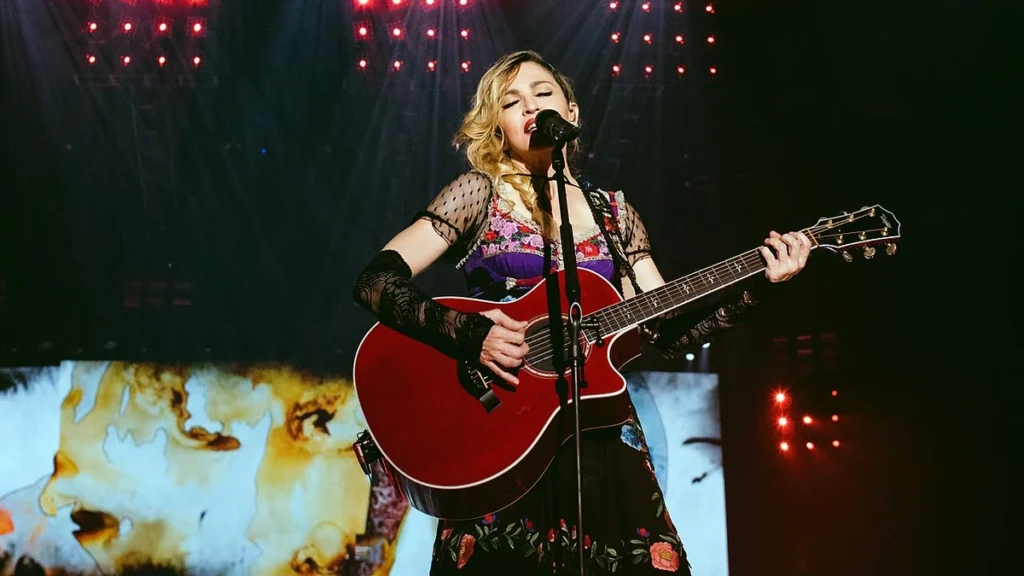
Madonna has gone home – not to a place, but to a sound. With Confessions II, her 15th studio album, the pop icon has returned to the pulsing, euphoric dance-pop that produced one of her most beloved records, and critics are calling the result her best work in twenty years.
The album is an explicit sequel to 2005’s Confessions on a Dance Floor, and it makes no secret of the fact. Confessions II reunites Madonna with Stuart Price, the producer who shaped the original, and rebuilds the same seamless, mirror-ball world – a continuous mix of songs designed to be experienced as one unbroken night out.
After a decade of releases that divided fans and critics, it is being received as a triumphant course correction: the sound of an artist returning, deliberately and joyfully, to the territory where she has always been most at home.
A Sequel Two Decades in the Making
Confessions on a Dance Floor, released in 2005, is widely regarded as one of Madonna’s finest albums – a glittering, disco-and-house-infused record that reaffirmed her as pop’s queen of the dance floor. Returning to it more than twenty years later is a bold move, inviting exactly the comparison most artists would avoid.
What makes the gambit work is the reunion at its centre. Madonna wrote and produced the new album with Stuart Price, the same collaborator who was instrumental in the original’s sound. That partnership is the connective tissue between the two records, and it is why Confessions II feels less like a cash-in on nostalgia than a genuine continuation – the same creative chemistry, picked up two decades on.
The impulse behind it, by Madonna’s own account, was partly escapist. She has spoken of the album growing out of a period of personal and professional strain and of her unease about the state of the world, which pushed her toward making something deliberately upbeat – an antidote rather than a lament. That origin explains the record’s mood: for all its polish, it is fundamentally an album about seeking joy on the dance floor when everything outside it feels heavy.
The Music
Like its predecessor, Confessions II is built as a continuous DJ mix, its 16 tracks flowing into one another so the album plays as a single, escalating set rather than a collection of separate songs. It is a structure that rewards listening front to back, recreating the arc of a night on the dance floor.
The lead single, Bring Your Love, sets the tone. A duet with Sabrina Carpenter – one of the biggest pop stars of the current moment – it rides shimmering Detroit techno and interpolates Inner City’s 1988 house classic Good Life, tying Madonna’s present to dance music’s history. The pair first unveiled it at Coachella, a passing of the torch between generations of pop. A second single, Danceteria, followed: a joyous, name-dropping stroll through the New York nightlife that shaped Madonna in the first place.
The Sabrina Carpenter pairing is more than a marketing move. By sharing her lead single with one of the defining pop stars of the current generation, Madonna links her own legacy to pop’s present – the elder architect of a certain kind of dance-pop standing alongside one of its newest torchbearers. Interpolating a 1988 house classic on the same track threads a third strand into the mix, connecting the song to the very era of club music that Madonna helped carry into the mainstream in the first place.
The Best Reviews in Decades
The critical response has been unusually warm for a legacy artist this deep into a career. Major outlets have lined up to call Confessions II Madonna’s strongest album in roughly two decades – some reaching all the way back to the original Confessions for a fair comparison.
The consensus is that the record works because it is focused. Rather than chasing whatever sound is currently ascendant, Madonna and Price committed fully to the dance-pop lane she helped define, and that clarity of purpose gives the album a confidence her more scattered recent releases lacked. Reviewers have framed it explicitly as leaving the uneven 2010s behind – a reset that plays to her enduring strengths.
That kind of praise is not guaranteed at this stage of a career. Legacy artists are often greeted with polite indifference or graded on a curve, their new work treated as a footnote to the classics. For Confessions II to be discussed as a genuine rival to a beloved twenty-year-old album, rather than a pale imitation of it, is a meaningful vote of confidence – and a reminder that reinvention is not the only way for a veteran to stay vital; sometimes returning to a proven strength, done with real conviction, is just as powerful.
Madonna in Her Element
Part of why the album resonates is that it puts Madonna back where she has always thrived. For four decades she has been a restless reinventor, but the through-line across her best work has been the dance floor – a space she treats not just as a setting but as a philosophy, a place of freedom, transformation and release.
Confessions II leans into that fully. It is unapologetically about the pleasure of movement and music, and reviewers have noted the way it celebrates the mystique of the dance floor even as it revels in its immediate thrill. At a stage in her career when many peers coast on greatest-hits tours, choosing to make a focused, forward-moving dance record is its own kind of statement about who she still is.
The Collaborators
While Stuart Price anchors the album, he is not alone. Confessions II features co-production contributions from a striking roster of names, including Andrew Watt, Cirkut, Mirwais, Arca and others – a blend of pop hitmakers and more experimental voices. Some, like Mirwais, are longtime Madonna collaborators; others bring a contemporary edge.
That mix matters. It lets the album honour the template of the 2005 record while updating its palette, so it sounds rooted in Madonna’s history without feeling like a museum piece. The result is a record that can nod to Detroit techno and vintage house one moment and feel thoroughly modern the next – a balance that is harder to strike than the finished product makes it sound.
What It Means for Her Legacy
For an artist who has spent a career refusing to stand still, Confessions II is a notable choice: a deliberate return rather than another reinvention. But it is a return on her own terms, and its warm reception suggests audiences and critics were hungry for exactly this – Madonna doing, superbly, the thing she does best.
It also lands amid a wider pop moment in which dance music and disco-inflected pop are firmly back in fashion, and in which pop’s biggest names, from Madonna to the stars filling stadiums and headlines alike, are commanding the culture’s attention – the same gravitational pull behind events like the year’s most-watched celebrity moments. Whether Confessions II proves a one-off homecoming or the start of a renewed creative run, it has already done something rare for a legacy act: reminded everyone, in real time, exactly why Madonna earned the crown in the first place.