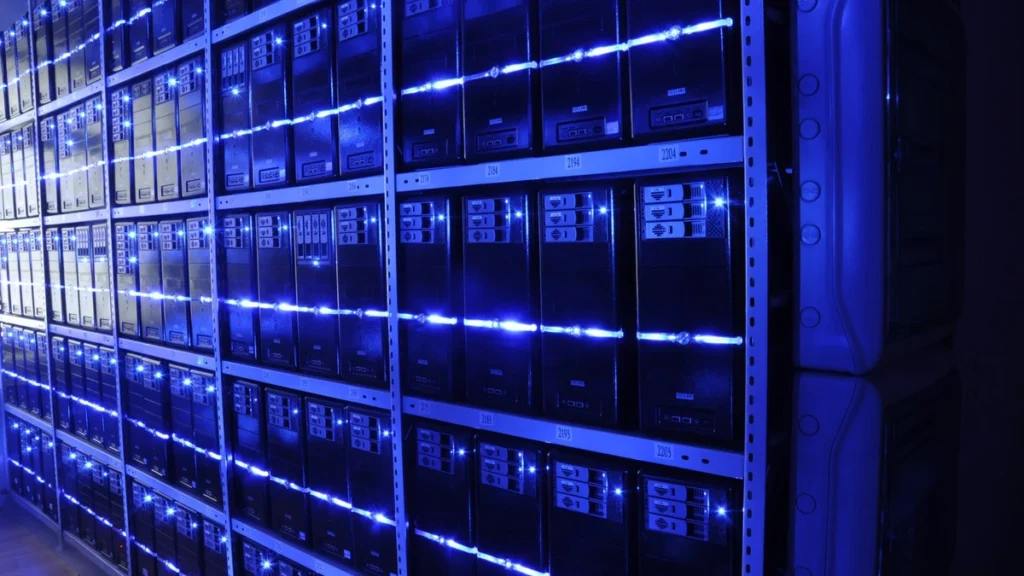
The backlash against the artificial-intelligence building boom just got its first hard legal edge. New York has become the first US state to impose a statewide moratorium on new large data centers, hitting pause on an industry that has been expanding at breakneck speed to feed the computing appetite of AI.
Governor Kathy Hochul’s executive order, signed on 14 July, temporarily freezes state environmental permits for new hyperscale data centers – the giant facilities that house tens of thousands of servers – for up to a year. The stated goal of the data center moratorium is not to kill the industry but to buy time: to write rules that protect the power grid, ratepayers, the environment and communities before the next wave of construction locks in.
It is a landmark moment. For years, states competed to attract data centers with tax breaks and cheap power. New York has just done the opposite, and in doing so it has turned the growing unease about AI’s physical footprint into concrete policy.
What the Order Does
The mechanics are specific. The order bars the construction of new large-scale data centers that would draw 50 megawatts of power or more – a threshold that captures the biggest, most energy-intensive facilities – for a period of up to one year. During that window, the relevant state environmental permits are paused.
Crucially, the freeze is a means, not an end. The year is meant to be used to build a regulatory framework – rules on energy use, environmental impact, water consumption and cost to the public – so that future projects are approved on the state’s terms rather than the developers’. It is a moratorium designed to produce a rulebook, not a permanent wall.
Why New York Acted
The driving concern is cost and capacity. Hyperscale data centers consume staggering amounts of electricity, and when that new demand lands on a grid, it can push up prices for everyone connected to it. New York officials warned that unchecked data-center growth threatened to hike utility bills, strain the grid and deplete natural resources.
The numbers give the worry teeth. The average residential electricity price in New York has climbed nearly 68% since 2019, a punishing increase for households already squeezed by the wider cost of living. Layering the enormous, sudden load of AI data centers on top of that trend is precisely what the state says it wants to manage rather than absorb blindly. Water is a factor too: many large centers use significant volumes for cooling, another strain on local resources.
The scale is hard to overstate. A single hyperscale campus can draw as much power as a small city, and the 50-megawatt threshold in the order is roughly the appetite of tens of thousands of homes. When several such projects are proposed at once, utilities must either build new generation and transmission – costs that tend to be spread across all customers – or risk shortfalls at peak demand. That is the dynamic New York says it wants to get ahead of, rather than discovering the bill only after the concrete has been poured.
The AI Boom Behind the Demand
None of this is happening in a vacuum. The surge in data-center construction is a direct consequence of the AI boom – the same race to build ever-larger models, powered by ever-more chips, that has driven the explosive demand behind companies like those competing in the market for frontier AI models. Training and running these systems requires vast fleets of specialised processors, and those processors have to live somewhere, drawing power and generating heat around the clock.
That is why the footprint of AI has become a political issue, not just a technical one. The abstract promise of smarter software turns out to have a very physical cost – measured in megawatts, land, water and, ultimately, the bills of people who may never use the technology directly. New York’s order is an attempt to reckon with that cost before it becomes irreversible.
The Case on the Other Side
The moratorium is not without real trade-offs, and its critics make a serious case. Data centers bring investment, construction jobs, long-term operational employment and substantial tax revenue to the places that host them. A pause, industry groups warn, risks pushing all of that to other states that are only too happy to welcome it – meaning New York bears the cost of saying no while reaping none of the benefits.
There is also the simple reality that AI infrastructure has to be built somewhere. If the goal is for the United States to lead in artificial intelligence, the argument goes, then the computing capacity to support it must expand, and blocking it in one state does not reduce the overall need – it just relocates it. A durable policy will have to weigh those economic and strategic arguments against the concerns about cost and the grid, which is exactly what the coming year of rule-writing is meant to do.
A Broader Push on AI Governance
The moratorium did not arrive alone. Alongside it, the state announced a new office – referred to as the DIGIT Office – that will focus first on regulating large frontier AI developers, with an emphasis on greater transparency into their safety measures. That pairing is telling: New York is treating the physical infrastructure of AI and the governance of AI itself as two sides of the same problem.
It reflects a wider shift in how governments are approaching the technology. Early enthusiasm is giving way to a more sceptical, guardrails-first posture, in which the question is no longer only how fast AI can grow, but on what terms, at whose expense, and with what oversight. Tying data-center permits to a broader push for AI transparency signals that New York wants a seat at the table on both.
What It Signals Nationally
The most important thing about New York’s move may be that it is first, not that it is unique. Other states are weighing similar measures, and public opinion appears receptive: a June poll found that 46% of New Yorkers believed a one-year moratorium would be good for the state, against just 21% who thought it would be bad. When a policy this interventionist enjoys that kind of margin, other governors take note.
The politics of it are unusual, too, because the concern cuts across the usual divides. Rising electricity bills anger voters everywhere, and the strain that data centers put on local grids and water supplies has drawn objections from rural and suburban communities that would not normally align with a Democratic governor’s tech agenda. That is part of why a data-center pause is spreading as an idea: it lets officials be seen protecting households and the grid without having to oppose AI itself, which remains broadly popular.
Whether the pause becomes a model or a cautionary tale will depend on what New York does with its year. If it produces clear, workable rules that protect ratepayers without strangling investment, it could set a template the rest of the country follows. If it simply drives development elsewhere with little to show for it, critics will say so loudly. Either way, the era in which data centers could be built with little public scrutiny has, at least in one large state, come to an end – and the rest of the country is watching to see what replaces it.