A Royal Caribbean passenger who went overboard in the Ionian Sea was found alive and conscious early the next morning, floating inside an orange lifebuoy, after going into the water roughly 72 nautical miles southwest of the Greek island of Zakynthos. The 44-year-old woman, a national of El Salvador, had been in the water for about 20 hours, according to a spokesperson for the Hellenic Coast Guard.
Her rescue, captured on video released by the Greek coast guard, has travelled around the world this week for a simple reason: the odds were poor. Most people who go over the side of a cruise ship are never brought back alive. What follows is how the search unfolded, why the conditions were on her side, and what investigators are now trying to establish.
How the Search Unfolded off Zakynthos
According to the official statement from the Hellenic Coast Guard, published in full by the Zakynthos news site Imera Zante, the port authorities of Zakynthos, Katakolo and Pylos were alerted on the morning of Friday 9 October by Greece’s Joint Rescue Coordination Centre. They were told that a 44-year-old foreign woman had fallen into the sea from a cruise ship flying the flag of the Bahamas, in waters 72 nautical miles southwest of Zakynthos.
A local emergency plan was activated straight away. The search drew in a Hellenic Coast Guard rescue vessel, a coast guard patrol boat, a Super Puma helicopter from the Hellenic Air Force and merchant ships passing through the area. Imera Zante added that a boat from the Zakynthos port authority assisted from the outset.
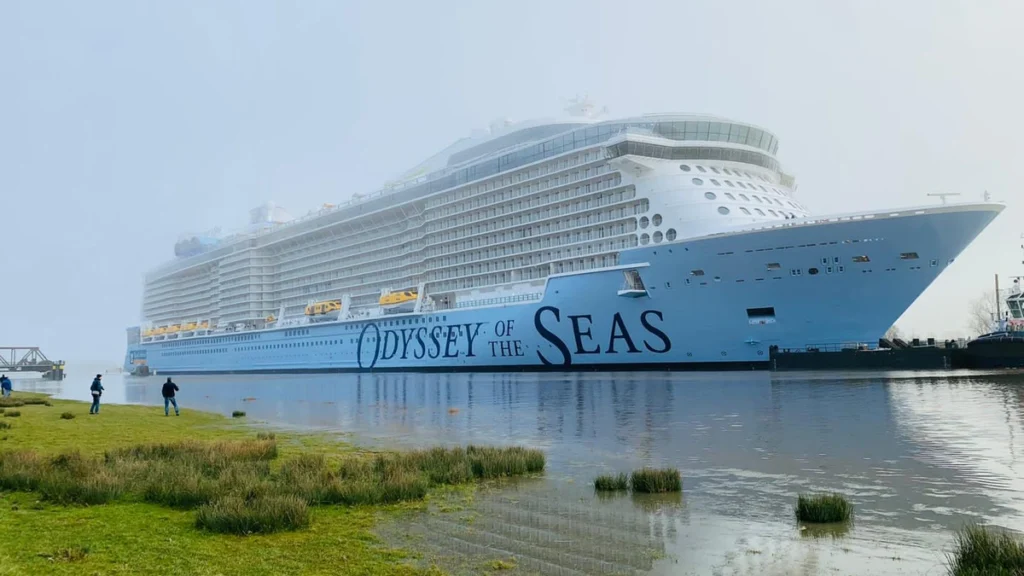
The Greek statement did not name the cruise ship. USA Today reported, citing Greece’s Ministry of Foreign Affairs, that the Royal Caribbean passenger had been travelling on Odyssey of the Seas, according to accounts by Fox 13 and People.
During the search, crews first located the self-activating light of a ring lifebuoy, a find that Ta Nea reported contributed to locating her. Then, in the early hours of Saturday 10 October, the Madeira-flagged cargo ship MSC Rossella III, which had joined the search, found the woman conscious and floating inside the lifebuoy.
She was taken aboard the coast guard rescue vessel, where she received first aid, and carried to the port of Katakolo on the western Peloponnese. From there an ambulance of EKAB, Greece’s national emergency medical service, took her to the Andreas Papandreou General Hospital of Pyrgos for monitoring and medical examinations.
What the Coast Guard Footage Shows
The video released by the Hellenic Coast Guard is short and almost entirely dark. A light shining from above picks out a bright orange ring on black water, with the woman inside it. Someone shouts “Are you okay?” as a rope is thrown down to her, People reported. She can be seen moving as the boat draws closer, then grabbing the line and pulling herself towards the vessel.
The images make plain the hardest part of any night search at sea: finding one person in a vast area of open water. A swimmer is a tiny target from the bridge of a large ship even in daylight. After dark, a light on the flotation device is often the only thing that makes them visible at all, and the Greek account of the search singles out the lifebuoy light for that reason.
Why Warm Water and a Lifebuoy Light Mattered
Two things worked in the woman’s favour: the season and the equipment she was holding on to. The Ionian Sea is still warm in early October. The average sea temperature off Zakynthos in October is 23.3°C, according to long-run records compiled by Seatemperature.info, with readings across the month ranging from about 21°C to 26°C.
That matters because in the open sea, the slow danger is cold. Survival tables used in water-safety guidance, such as the one published by The Engineering ToolBox, put the time to exhaustion for an unprotected adult in water of 21°C to 27°C at three to 12 hours, with expected survival ranging from three hours to unlimited. In water of 10°C to 16°C, the same table gives an expected survival time of one to six hours. A night in the Ionian in October sits in the most forgiving band.
Flotation is the other half of the equation. A lifebuoy keeps the head above the surface without any effort, so a person does not burn energy treading water or fighting waves to breathe. It also makes the person bigger and brighter to searchers. A self-igniting light, the type fitted to ships’ lifebuoys so that it switches on in the water, turns an invisible target at night into a visible one. Greek officials have not said publicly how the lifebuoy came to be in the water with her, and that is one of the questions the investigation is expected to address.
What She Told the Authorities
How the Royal Caribbean passenger ended up in the sea is still being examined. A coast guard spokesperson told Agence France-Presse that she had said she jumped because she “wanted to disembark”, adding that she had spent 20 hours at sea, according to accounts of that interview published by Fox 13 and Tyla. Fox 13 also reported, citing the Hellenic Coast Guard, that a prosecutor ordered a psychiatric evaluation after she reached hospital.
The Katakolo Port Authority is leading the preliminary investigation. Royal Caribbean Group said it had worked closely with the authorities and immediately launched a search and rescue effort when she went overboard. “Our Care Team is actively providing support and assistance to the guest’s loved ones during this difficult time. For the privacy of the guest and their family, we have no additional details to share,” the company said in a statement to USA Today, as quoted by WFLA.
Neither the Greek authorities nor the cruise line has named the woman, and her condition beyond the initial reports that she was conscious and taken for medical checks has not been made public.
How Rare It Is to Survive Going Overboard
Falling or jumping from a cruise ship is rare, and coming back alive is rarer still. A 2020 report from the Cruise Lines International Association, the industry’s trade body, counted 212 overboard incidents between 2009 and 2019, an average of about 19 a year, according to a summary by SlashGear. Of those 212 people, 170 died, which puts the chance of survival at just under 20 per cent.
Ships follow an established routine when someone is seen going over. Crew throw a life ring into the water, raise a “Code Oscar” alert, mark the position, contact the coast guard and turn the ship around, while a rescue boat is launched to search the area, as Islands magazine explains. The search continues until the person is found or the coast guard releases the ship. Speed is everything in that sequence, because the area that has to be searched grows with every minute that passes.
Water temperature, sea state and time are the factors that most often decide the outcome. In this case, warm water, a lifebuoy with a working light and a large multinational search all came together within a single night, which is why the Royal Caribbean passenger is now among the minority who survive.
The Ship and Its Itinerary
Odyssey of the Seas is one of the larger ships in the Royal Caribbean fleet. It is 1,138 feet long and can carry 4,198 guests, and it runs seasonal cruises around the Greek islands, according to figures from the company’s website cited by Tyla. The Greek statement placed the incident in the sea area southwest of Zakynthos, on a route that, according to Fox 13, was taking the ship from Greece towards Italy.
The ship has since continued its programme. People reported, citing CruiseMapper, that it is now on a seven-night sailing that left Rome on Sunday 11 October and is due back on 18 October, with calls in Sicily, Naples, Santorini and Mykonos.
What It Means for Cruise Travellers
For the millions of people who take cruises each year, the incident is a reminder of how much depends on routine safety habits. Islands magazine points to the mandatory safety drill on every cruise, which covers how to use lifejackets and what the emergency protocols are. It also advises that anyone who does end up in the water should stay calm, conserve energy, float on their back and stay put rather than swim after the ship, because waiting for rescue gives the best chance.
Rules for holidaymakers are changing elsewhere as well, so checking the fine print before booking matters; Thailand has halved its visa-free stay to 30 days, for example.
For now, the Katakolo inquiry will establish the sequence of events on board and in the water. Whatever it finds, the outcome of this search is already clear: a woman who spent a night alone in the open sea was found, lifted out and taken to hospital alive.