Astronomers using the James Webb Space Telescope have found something they cannot name. Sifting through fresh infrared readings of Pluto and Saturn’s giant moon Titan, a research team spotted the same unexplained fingerprint of light on both worlds – a mystery molecule on Pluto and Titan that matches nothing in any laboratory catalogue on Earth.
The signal is faint, precise and, so far, unidentifiable. It sits at a wavelength of about 5.11 micrometres, and it appears on the frozen surfaces of two of the most alien places in the solar system. What makes it baffling is not just that the molecule is unknown, but that two worlds with almost nothing in common appear to share it.
It is the kind of small, stubborn anomaly that tends to precede a discovery. Either an ordinary substance is behaving in an unexpected way in these deep-freeze conditions, or Pluto and Titan are coated in something genuinely new to science. Neither answer is dull.
What Webb Actually Saw
Every atom and molecule in the universe absorbs light at its own set of wavelengths, leaving dark gaps – absorption lines – in the spectrum of whatever it coats. Read those gaps carefully and you can work out what a distant surface is made of without ever touching it. It is chemistry by starlight, and it is exactly what Webb was built to do.
In a study uploaded on 11 June to the preprint server arXiv, and not yet peer reviewed, researchers combed through Webb data at very short infrared wavelengths that had been largely overlooked until now. There, on both Pluto and Titan, they found a clear absorption line near 5.11 micrometres that no known substance accounts for. The team, they wrote, “did not find any band referenced in these publications that corresponds to the location of the observed absorption in Titan and Pluto.”
Crucially, they are confident the signal comes from the worlds’ surfaces rather than their hazy atmospheres. That sharpens the puzzle: something is lying on the ground of both bodies, absorbing one specific colour of infrared light, and no one can yet say what it is.
A Telescope Built for Invisible Clues
None of this would be visible to the human eye. Webb sees in the infrared, the band of light where cold, distant surfaces reveal their chemistry, and it is sensitive enough to tease out subtle dips in brightness that earlier instruments smeared over or missed entirely. The very wavelengths where this signal hides had been relatively unexplored, which is part of why it went unnoticed for so long.
That combination – a new window and extreme sensitivity – is why Webb keeps turning up surprises, whether it is unexpected molecules on nearby moons or the chemistry of planets around other stars. The mystery line is a reminder that even worlds we thought we knew still have blank spaces on the map.
Two Worlds With Almost Nothing in Common
The strangest part is the pairing. Titan and Pluto are wildly different places. Titan is Saturn’s largest moon, bigger than the planet Mercury, wrapped in a thick orange atmosphere, and the only world besides Earth known to have liquid rivers and seas on its surface – though there the liquid is frigid methane, not water.
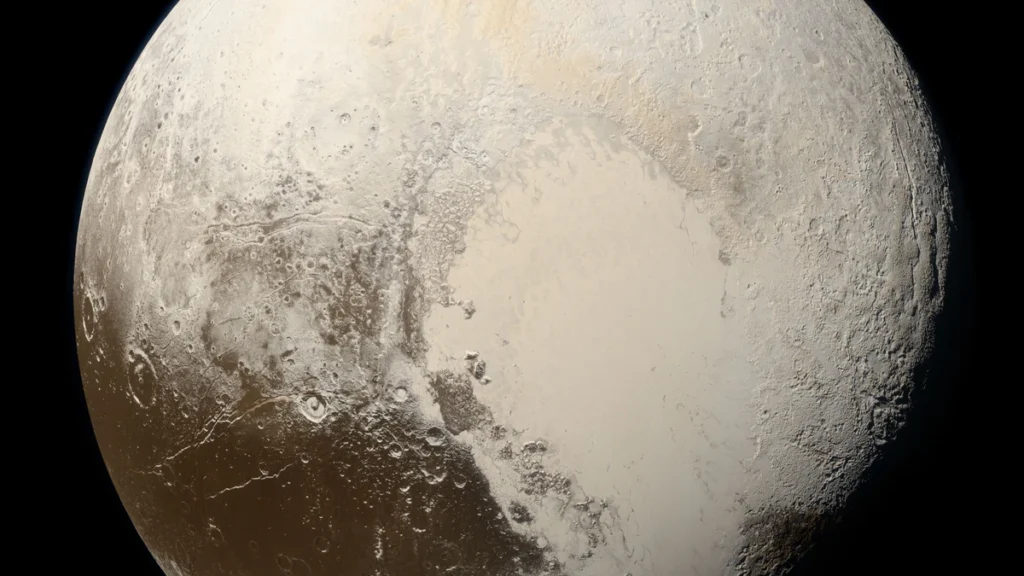
Pluto, by contrast, is a small, deep-frozen dwarf planet roughly half Titan’s size and about four times farther from the Sun. One is a relatively active, weather-driven moon; the other a distant ball of ice at the edge of the planetary system. On paper, they should not share an exotic surface chemical.
What they do share is the raw ingredients. Both are rich in methane and nitrogen, the building blocks that sunlight can slowly cook into more complex carbon-based molecules. That common chemistry is the leading clue to why the same unknown compound might form in two such different settings – and why finding it only there, and nowhere else, is so intriguing.
The Prime Suspects
The researchers have not left the identity entirely open. They propose a short list of candidates that could, in principle, absorb light at 5.11 micrometres. One is benzene – a ring-shaped hydrocarbon already detected on Titan – mixed with some other, unidentified molecule. The alternatives are frozen forms of acetylene or ketene, both simple carbon compounds that could plausibly grow out of methane chemistry.
None of these is a confirmed match. Each would have to be measured in a laboratory under Pluto- and Titan-like temperatures and pressures to see whether it reproduces the exact absorption Webb recorded. For now they are educated guesses – a starting point for the painstaking lab work that turns a mystery signal into a named molecule.
A Signal Written Unevenly
The fingerprint is not identical on the two worlds, and that asymmetry is itself a clue. On Pluto the absorption line is about three times stronger than on Titan, which suggests the mystery molecule is far more abundant on the dwarf planet’s surface.
On Titan the compound seems unevenly spread. The signal is stronger on the moon’s trailing hemisphere – the side facing away from its direction of travel around Saturn – than on its leading face. That kind of lopsided distribution often reveals how a material is laid down or broken apart, for example by the steady rain of charged particles from Saturn’s magnetic field, and it hands chemists another constraint to test their candidates against.
Why an Unidentified Molecule Matters
A single unexplained absorption line might sound like an obscure detail, but discoveries like this are how planetary chemistry moves forward. Every confirmed molecule on a distant surface is a data point about how carbon compounds assemble far from the Sun – the same broad chemistry that, in other settings, connects to the ingredients for life. Finding an unfamiliar one is a reminder of how much basic chemistry still waits to be pinned down on the cold, dark bodies right here in our own solar system.
Webb has been rewriting that story across the solar system and beyond, part of a wider leap in how sharply we can now observe the cosmos – from the atmospheres of distant exoplanets to the flood of black hole collisions in the newest gravitational wave catalog. A molecule that appears on two unrelated worlds, yet nowhere else, hints that our inventory of what nature routinely builds is still incomplete.
Dragonfly and the Long Wait for Answers
Confirming the culprit will take more than a telescope. The most direct test may come from NASA’s Dragonfly, a car-sized rotorcraft due to launch no earlier than 2028 and to arrive at Titan in 2034. Its onboard instruments, including a spectrometer, could sample the moon’s surface directly and identify the mystery molecule in place – which would, in turn, help interpret what Webb is seeing on Pluto.
Until then, the work falls to laboratory chemists recreating these frozen surfaces on Earth and to further Webb observations sharpening the signal. Because the paper is still a preprint, its conclusions may shift as other scientists scrutinise the data. Independent teams will now aim their own instruments and lab experiments at that exact wavelength, and history suggests the answer will arrive not in one dramatic reveal but in a slow narrowing of the possibilities. But the core finding is striking on its own: two of the strangest worlds we know of are quietly wearing the same unexplained coat of chemistry, and for now the label simply reads unknown.