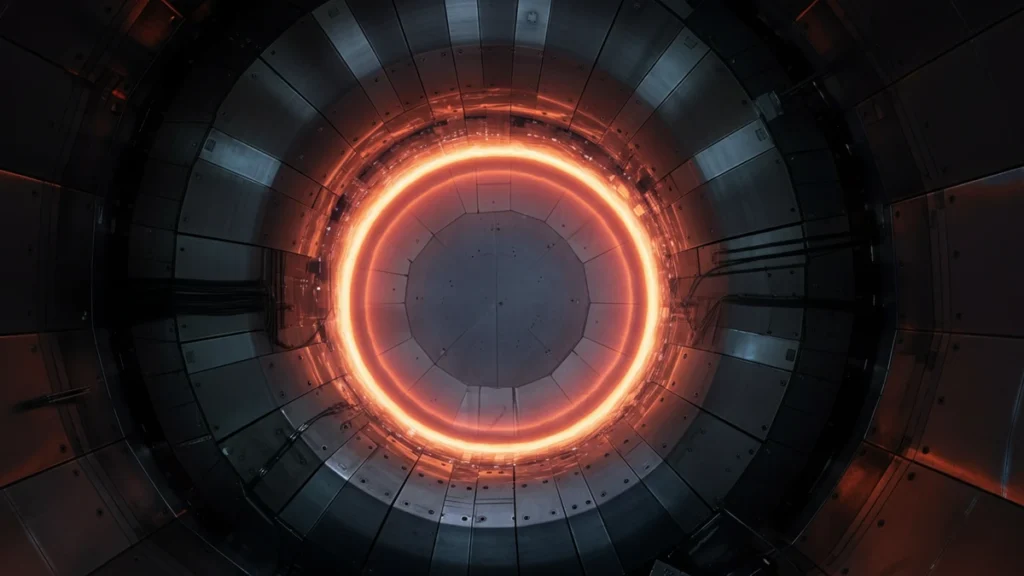
For about 40 years, fusion scientists have run into the same invisible ceiling. Try to pack too much fuel into a doughnut-shaped reactor called a tokamak, and the superheated plasma inside tends to break apart, slip free of its magnetic cage and slam its energy into the machine’s walls. That ceiling has a name – the Greenwald limit – and it has shaped how fusion machines are designed for a generation.
Now researchers running China’s EAST tokamak, the fully superconducting reactor nicknamed the artificial sun, say they have punched through it. In experiments published in the journal Science Advances, they held a plasma steady at densities well beyond the old fusion density limit without the violent disruption that normally ends the run – the first experimental proof that a long-theorised way around the barrier actually works.
It is not a finished power plant, and it does not mean cheap fusion electricity is around the corner. But it removes a constraint that physicists had half-assumed was a law of nature, and it hands reactor designers more room to work with.
What the Greenwald Limit Is
Plasma density – how tightly the hydrogen fuel is crammed into the reactor – is one of the most important dials in fusion. Turn it up and, in principle, the fuel particles collide and fuse more often. The trouble is that every tokamak has historically hit a wall: raise the density past a certain point, set by the machine’s size and current, and the plasma destabilises.
That threshold, identified empirically in the 1980s, is the Greenwald limit. Cross it and the confinement breaks down: the plasma cools at its edge, radiation runs away, and the whole discharge collapses in a disruption that can damage the device. Because the consequences are so severe, operators have treated the limit as a hard boundary, keeping a safe margin below it rather than risking a crash.
The catch is that this cautious approach caps performance. A machine that cannot safely run dense is a machine leaving fusion power on the table – which is why getting past the Greenwald limit has been a long-standing goal, not just a curiosity.
How EAST Got Around It
The EAST team’s answer did not come from brute force. It came from a newer way of understanding why the density limit arises in the first place. A theoretical framework called plasma-wall self-organisation, or PWSO, reframes the limit as something set by how the plasma edge interacts with the reactor wall and radiates away energy, rather than as a fixed number.
Guided by that idea, the researchers reached for two levers. They used electron cyclotron resonance heating – microwaves tuned to the plasma – to assist the start-up phase, and they began with a sufficiently high initial neutral gas density. They also carefully managed the conditions at the reactor’s metal target plates to suppress the impurities that seed a collapse. Together, those steps let the plasma settle into a stable, high-density state instead of tipping into disruption.
The outcome was a line-averaged electron density between roughly 1.3 and 1.65 times the Greenwald limit, held steady. Just as telling, the results closely matched what PWSO theory predicted – the first time the theorised density-free regime has been confirmed in a real tokamak rather than on paper.
Why Density Is the Whole Game
To see why this matters, it helps to know what a fusion reactor is actually racing toward. Fusion power depends on getting a plasma hot enough, dense enough and confined for long enough all at once – a trio often bundled together as the triple product. Density sits right at the heart of it because the reaction rate climbs steeply as particles are packed closer – roughly with the square of the density, so even a modest increase in how tightly the fuel is held can translate into a large gain in fusion output.
Run denser, in other words, and a reactor of a given size produces more power. That is the prize behind these experiments, and it is why the research is arriving just as the world rethinks its energy mix – the same long-term pressure reshaping global oil demand. A practical route to higher density brings the ultimate target, ignition – where a plasma produces enough heat to sustain its own reactions – a step closer.
The team was explicit about the stakes. Breaking the Greenwald limit and accessing the density-free regime, they wrote, “opens a promising path advancing toward achieving the fusion ignition condition.”
A Milestone, Not a Finished Reactor
It is worth being clear-eyed about what this is. EAST is an experimental platform, in operation since 2006 and open to Chinese and international scientists, not a device built to sell electricity. Confirming a density-free regime is a physics result, and turning it into a working reactor means solving many other problems at the same time – sustaining the state for long durations, handling the heat load on the walls, and scaling everything up.
There is also the normal caution that attaches to any single result. It will need to be reproduced, extended to other machines and other conditions, and folded into the broader body of fusion research before anyone treats the old limit as truly gone. The researchers themselves frame it as a practical scheme worth pursuing, not a solved problem.
The Global Fusion Race
The advance lands in the middle of a crowded, fast-moving field. The work was a collaboration between the Institute of Plasma Physics at the Chinese Academy of Sciences, Huazhong University of Science and Technology and France’s Aix-Marseille University, backed by China’s national fusion programme – a reminder that even amid geopolitical rivalry, fusion research remains partly international. EAST itself has been a workhorse of that effort, setting a string of endurance and temperature records in recent years as teams push the reactor closer to power-plant conditions.
Around the world, publicly funded megaprojects and a wave of well-financed private start-ups are all chasing the same goal of net-energy fusion, using tokamaks, stellarators and other designs. A result that raises the achievable density is relevant well beyond EAST; the researchers note it is also germane to the start-up of stellarators, a related class of fusion machine. In a race measured in incremental gains, loosening a 40-year constraint is a meaningful one.
What Comes Next
The immediate work is to push the regime further and understand its limits: how high the density can go, how long the state can be held, and how cleanly it transfers to larger, reactor-scale devices. Each answer feeds back into the designs of the machines meant to follow, from the giant international ITER project now under construction in France to the compact reactors that private ventures hope to build far sooner.
For now, the headline is simpler. A barrier that fusion physicists had lived with for four decades has turned out to be softer than it looked, and one of the world’s leading tokamaks has shown there is room to run hotter and denser than the textbooks allowed. In a field where progress is usually measured in small, hard-won steps, quietly retiring a limit that once looked fundamental counts as a genuine leap – and a sign of how quickly the ground is shifting under fusion research.