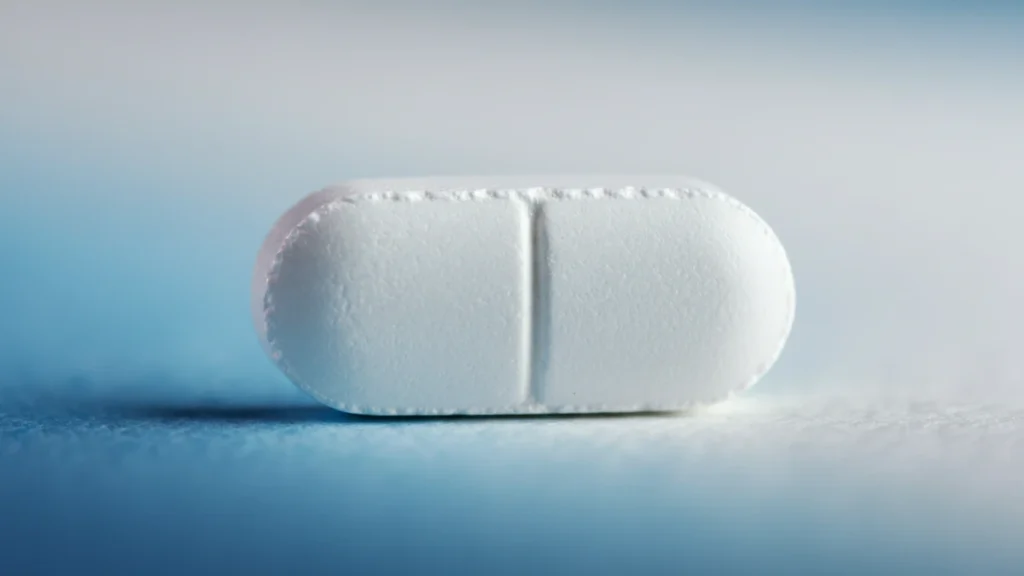
The drugs that reshaped how the world treats obesity have all had one thing in common: a needle. Semaglutide and tirzepatide, sold under names like Wegovy and Zepbound, are injections. Now that is changing. US regulators have approved orforglipron – marketed by Eli Lilly as Foundayo – the first GLP-1 weight-loss medicine that comes as an ordinary once-daily pill.
It is a deceptively simple shift with large consequences. A tablet you can swallow with no injection, and with none of the fiddly food-and-water timing that trips up earlier oral options, lowers the barrier to starting treatment. And because the drug is a small chemical rather than a delicate protein, it could be produced at a scale the injectables have struggled to match.
In short, the story of the first true oral weight-loss pill is not only that it works, but that it could work for far more people than the shots ever reached.
What Orforglipron Actually Is
Orforglipron belongs to the same broad family as the blockbuster injectables: it is a GLP-1 receptor agonist, mimicking a gut hormone that curbs appetite and slows digestion, so people feel full sooner and eat less. What sets it apart is its chemistry. It is a small-molecule, non-peptide drug – closer to an everyday pharmaceutical than to the large, fragile protein molecules that have to be injected.
That difference is why it can be taken so casually. Foundayo is a once-daily pill that can be swallowed at any time of day, with or without food, and without the strict empty-stomach, plain-water rules that have made earlier oral GLP-1 formulations awkward to use. For a medicine meant to be taken for months or years, that everyday convenience matters.
How Well It Works
The approval rests on Lilly’s ATTAIN clinical trial programme, which tested orforglipron against a placebo in adults with obesity or excess weight. In the ATTAIN-1 and ATTAIN-2 studies, people on the highest dose lost about 12.4% of their body weight on average – roughly 27 pounds – over 72 weeks, while those on placebo lost almost nothing.
Those are meaningful numbers, if a step below the very best injectable results. The most powerful shots have pushed average losses higher still, so orforglipron is not necessarily the strongest option on paper. But a slightly smaller effect from a pill that many more people can actually obtain and stick with can add up to a bigger impact across a whole population than a stronger drug that stays hard to get.
It is also worth noting how the trials were run. Participants took the drug for well over a year alongside lifestyle advice, and the weight came off gradually rather than all at once – the same slow, sustained pattern seen with the injectables. Crucially, the benefits depend on staying on the medication: as with the whole GLP-1 class, stopping tends to be followed by some regain, which makes long-term affordability and tolerability just as important as the headline weight-loss figure.
Why a Pill Changes the Math
The real significance is about supply and access. Injectable GLP-1s are biologic drugs, grown and purified through complex processes, and they depend on a limited global capacity for the specialised injector pens that deliver them. That is a big reason demand has repeatedly outrun supply, leaving shortages and high prices in its wake.
A small-molecule pill sidesteps much of that. It can be synthesised with standard chemical manufacturing and packaged like any other tablet – no cold chain, no injector devices, no specialised biologics plants. In principle that means orforglipron can be produced in far greater volumes and at lower cost, which is exactly what would be needed to treat obesity at the scale it actually exists. The broader promise of medicine reaching more people cheaply is a thread we have followed before, from diagnostics to AI in healthcare, and a manufacturable pill is one of the more concrete versions of it.
The scale of the need is enormous. More than a billion people worldwide are now estimated to live with obesity, a figure no injectable supply chain could realistically serve. A pill that ordinary pharmaceutical factories can turn out by the billion is, at least in principle, the first form of these drugs that could be matched to a problem of that size – which is why the launch is being watched as much for what it signals about access as for the drug itself.
The Costs and the Cautions
Cheaper to make does not automatically mean cheap to buy, at least at first. Lilly has set self-pay pricing starting around $149 a month for the lowest dose, with a savings card bringing the cost as low as $25 a month for some people with commercial insurance, and access for eligible Medicare Part D patients priced at about $50 a month. Where the price settles over time, as competition and volume grow, will do much to determine how widely the pill is ultimately used, especially in lower-income countries where obesity is rising fastest and the injectable drugs have barely reached.
There are medical cautions too. Like other drugs in its class, Foundayo carries a boxed warning – the strongest kind – over a risk of thyroid C-cell tumours seen in animal studies, and it is not for people with certain thyroid-cancer histories. The most common side effects are gastrointestinal: nausea, constipation, diarrhoea, vomiting, indigestion and abdominal pain, along with headache and some hair loss. For most users these ease over time, but they are the main reason people stop treatment.
What It Means for the Weight-Loss Race
Orforglipron lands in the middle of a fierce commercial contest. Lilly and its rival Novo Nordisk have built enormous businesses on GLP-1 drugs, and both have been racing to crack the oral version, precisely because a convenient pill is seen as the key to the mass market. Being first to a flexible, once-daily oral option is a strong position for Lilly.
For patients, the competition is the good news. More approved options, in more forms, at more price points, tends to push costs down and availability up over time. An effective pill also broadens the appeal beyond people willing to inject themselves, potentially drawing in a much larger group who have wanted these drugs’ benefits but balked at needles.
What Comes Next
The immediate questions are practical: how quickly Lilly can ramp up production, how insurers choose to cover it, and how the real-world results compare with the trials once millions rather than thousands are taking it. Longer term, researchers are studying whether GLP-1 drugs help with conditions beyond weight, from heart disease to sleep apnoea, and an easy-to-take pill makes running those studies – and delivering any benefits – far simpler.
None of this makes obesity a solved problem. These drugs work while you take them, they carry costs and side effects, and they sit alongside, not instead of, diet, activity and the wider social drivers of weight. But the arrival of a genuine oral weight-loss pill is a milestone all the same: it turns a treatment that required a prescription, a needle and a fridge into something much closer to an ordinary daily tablet – and that is how medicines reach the many, not just the few.