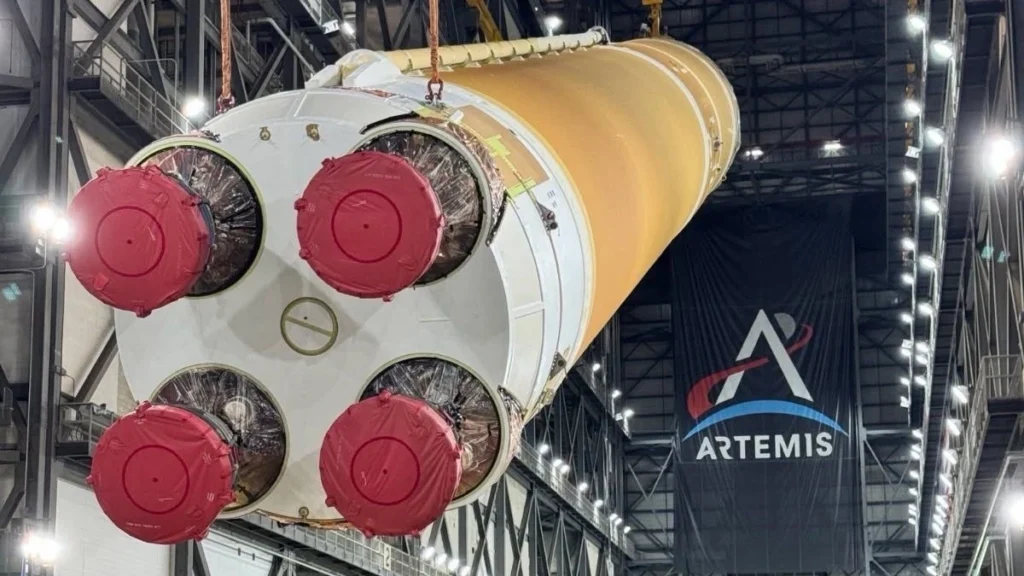
The Artemis III core stage is lifted out of its holding cell in the Vehicle Assembly Building at Kennedy Space Center
The Artemis III core stage is lifted out of its holding cell in the Vehicle Assembly Building at Kennedy Space Center
NASA’s next crewed Moon mission will not go to the Moon. At a briefing at the Kennedy Space Center on 23 October, Administrator Jared Isaacman and his deputies set out a plan in which Artemis III becomes a two-week test flight in low Earth orbit in mid-2027, while the first landing of the Artemis programme moves to Artemis IV in 2028.
The four Artemis III astronauts will instead dock their Orion capsule with the two commercial landers that will one day take crews to the surface, Blue Origin’s Blue Moon and SpaceX’s Starship, and test them where a return to Earth takes hours rather than days. NASA also confirmed that Artemis V is planned for 2028, which would mean two landings in a single year.
Why the Next Moon Mission Is Staying Close to Home
The change is not new, but the 23 October briefing was the fullest account yet of how it will work. Isaacman revealed in February that Artemis III would not land as originally planned because the programme was not ready, Spectrum News 13 reported. Artemis II has since flown and returned its crew home, leaving the landers and the spacesuits as the pieces still to be proven.
Testing the landers in Earth orbit first is a way of retiring risk before anyone commits to a descent. A docking problem, a faulty life-support system or a software fault discovered in low Earth orbit leaves options that do not exist around the Moon. NASA described the briefing as setting out “the agency’s path forward to returning Americans to the lunar surface in 2028”.
Three senior officials led it: Isaacman; Amit Kshatriya, NASA’s associate administrator and chief engineer; and Jeremy Parsons, manager of the Artemis programme. Their message was that hardware is moving. The Artemis III boosters had been stacked by 13 October, and NASA photographs dated 23 October show the rocket’s core stage being lifted out of its holding cell in the Vehicle Assembly Building.
Two Weeks, Two Landers and Four Astronauts
The Artemis III crew is NASA’s Randy Bresnik as commander, the European Space Agency’s Luca Parmitano as pilot, and NASA’s Andre Douglas and Frank Rubio as mission specialists. They will launch on the Space Launch System from Launch Complex 39B for a mission of about two weeks.
The order of events, as set out by SpacePolicyOnline’s account of the briefing, is precise. Blue Origin’s Blue Moon MK2 lander launches first. Orion then launches on SLS, flying with a “spacer” in place of the upper stage that would be needed to push it towards the Moon. On the third day Orion docks with Blue Moon, and the crew spends two days testing it from the inside, including its environmental control, life support, software, flight computers, avionics and reaction control systems.
“The Blue Moon lander is going to allow the crew to dock, to ingress, and carries many of the same systems of the lunar lander,” Parsons said. Blue Moon can loiter in orbit for up to a month, although NASA intends to keep that time short for the health of the vehicle.
On the sixth day Starship launches carrying a passive docking system on its nose. Orion docks with it for only two hours, and the crew does not go inside. The asymmetry reflects how differently the two landers are designed, and how differently each will reach the Moon.
How SpaceX and Blue Origin Plan to Reach the Moon
Starship needs to be refuelled in space before it can fly to the Moon, which means building up a depot of cryogenic propellant in orbit. SpaceX plans its first demonstration of cryogenic fuel transfer early next year and an uncrewed landing on the Moon late in 2027. For the 2028 landing, NASA has changed the plan: Starship will dock with Orion in Earth orbit and push it to the Moon, rather than meeting it in lunar orbit.
SpaceX brings scale to that task. It operates more than 10,000 Starlink satellites, out of about 15,900 active satellites in orbit, according to Orbital Radar’s weekly count. The same network has become a geopolitical issue in its own right, as Iran’s claim that it disabled Starlink showed this month.
Blue Origin has gone the other way and dropped in-space propellant transfer from its plan. Its Blue Moon MK2 will instead use three smaller Blue Moon MK1 spacecraft as tugs to reach lunar orbit, where it will meet Orion. Which company lands astronauts first has not been decided, and both landers will have been tested with a crew aboard Orion before NASA has to choose.
The Memo That Said the Schedule Was Broken
The briefing also addressed an internal note Isaacman sent in September, which said the mid-2027 date for Artemis III was “90 days broken to schedule”. Asked about it, he said the memo was intended “to galvanize the workforce to find solutions”, and that the mid-2027 target stands.
He pointed to progress at Kennedy as evidence. “The absolutely outstanding performance of the workforce that has cut the assembly and integration schedule in half,” Isaacman said, referring to the teams stacking the rocket. Whether a slip can be recovered depends less on the rocket than on the lander milestones, which NASA does not control directly.
Those milestones are the real schedule risk. The cryogenic transfer demonstration, the uncrewed Starship landing and Blue Origin’s tug-assisted flight profile all have to work before 2028 is realistic, and each is a first.
Two Hours on the Surface, Twice
The spacesuits are behind schedule too. Axiom Space is building them, and NASA has changed its requirements to allow a simpler, lighter “sortie” suit. The trade-off is time outside: crews on the first landings will be limited to two hours on the surface, on two excursions.
That is far shorter than the multi-hour moonwalks of the later Apollo missions, and it reflects how much of the first landings will be about proving the system rather than doing extended science. The change lets NASA keep its landing date without waiting for a fuller suit.
Why the South Pole Is Still the Target
NASA is still aiming for the lunar south pole, where water ice is thought to lie in permanently shadowed craters. Isaacman said the region “is probably the most advantageous area”, while acknowledging that more data from robotic landers is needed before a final site is chosen. Kshatriya said engineers “will always debate” the best landing spot. Asked about returning to an Apollo landing site, Isaacman said that would be “very cool at some point in the future”.
The south pole is also harder. Steep slopes, low sun angles and temperature extremes complicate landing, and there are fewer options to abort. NASA’s Aerospace Safety Advisory Panel has raised concerns about the readiness of the landers, about a plan that requires only one uncrewed landing test per provider, and about the first use of cryogenic propellants on the Moon, since Apollo relied on hypergolic fuels that ignite on contact.
A report from the National Academies of Sciences, Engineering, and Medicine, requested by NASA and released in the same week, identified four non-polar sites that could also yield valuable science. NASA’s commercial robotic landers are expected to supply the data that settles the question.
The next twelve months will show whether the plan holds: a propellant transfer test early in 2027, Artemis III in the middle of the year and an uncrewed Starship landing towards the end. If all three succeed, Artemis IV would put astronauts on the Moon in 2028, more than half a century after Apollo 17 left in December 1972.