
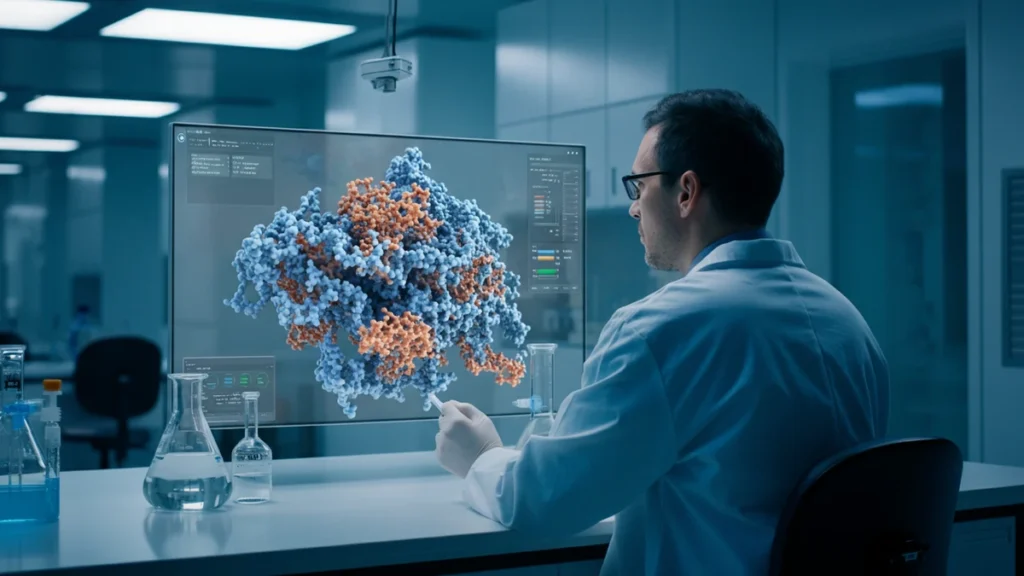
A researcher in a modern laboratory looks at a large screen displaying a 3D model of a protein molecule. | MW3.biz
The Clinical Co-Pilot: AI’s Integration into Daily Medical Practice
For years, artificial intelligence in medicine seemed like science fiction. But by 2026, that future is here. The integration of AI in healthcare is no longer a question of ‘if’. Instead, the focus is on how deeply we can embed it into clinical workflows. Across leading hospitals and research labs, AI has moved from a niche tool. It is now an essential co-pilot for doctors, researchers, and administrators. AI fundamentally reshapes how we diagnose illness, develop treatments, and manage patient care.
This transformation isn’t about replacing human expertise but augmenting it. Sophisticated algorithms can now sift through immense datasets. These include radiological scans and genomic sequences. They process this data at a speed and scale far beyond human capacity. This helps clinicians make faster, more informed decisions. It frees them from repetitive analytical tasks. They can then focus on providing compassionate, patient-centric care. AI’s impact reaches everywhere, from the emergency room to the pharmaceutical lab.
The New Era of AI-Powered Diagnostics
Perhaps the most visible impact of AI in healthcare is in medical diagnostics. By 2026, AI tools routinely analyze medical imaging. These algorithms often outperform human experts in specific, narrowly defined tasks. This is especially true in radiology. Here, AI systems analyze thousands of X-rays, CT scans, and MRIs. They detect subtle signs of disease that human eyes might miss.
Leading institutions like the Mayo Clinic and Stanford Medicine have validated these tools with extensive studies. For example, AI algorithms from Google Health now identify signs of diabetic retinopathy or certain cancers. They do this with astonishing accuracy. A recent peer-reviewed study in The Lancet Digital Health highlighted an AI model. This model reduced the error rate in early-stage lung cancer detection from chest X-rays by over 30%. It even surpassed experienced radiologists. This has led to faster regulatory approvals. The FDA now establishes clear pathways for “Software as a Medical Device” (SaMD).
Beyond imaging, AI is also conquering digital pathology. Instead of physically examining tissue slides under a microscope, pathologists now work with high-resolution digital scans. AI tools can pre-screen these slides. They flag areas of concern, count cells, and identify complex patterns. These patterns indicate specific diseases. This significantly speeds up workflow and improves diagnostic consistency.
Accelerating Drug Discovery and Development
Historically, bringing a new drug to market was a decade-long, multi-billion-dollar endeavor. AI in healthcare is radically altering this equation. Scientists use machine learning and massive computational power. This compresses timelines and reduces the astronomical costs of pharmaceutical research and development.
Tech giants and specialized biotech firms are at the forefront of this revolution. Companies like NVIDIA have developed powerful platforms such as BioNeMo. This platform allows researchers to train and deploy large language models on biological data. They use this data to understand proteins, DNA, and chemical compounds. This technology helps with the very first step of drug discovery: identifying a viable target. AI can predict how different molecules will bind to proteins. This helps shortlist the most promising candidates for further testing from billions of possibilities.
AI-first drug discovery companies, such as Recursion Pharmaceuticals and BenevolentAI, build automated labs. Robots perform experiments guided by AI in these labs. This generates vast datasets. These datasets then refine the AI’s own predictive models. This closed-loop system involves prediction, experimentation, and learning. It is uncovering novel biological insights and drug candidates at an unprecedented rate. For example, a landmark paper in Nature Medicine recently detailed how one platform identified a novel compound for a rare fibrotic disease in just 18 months. This process traditionally took five years or more.
Personalized Medicine at Scale
Modern medicine aims to shift from a one-size-fits-all approach. Instead, it seeks treatments tailored to each individual. AI in healthcare makes this vision a reality. AI systems create highly personalized treatment recommendations. They integrate data from various sources. These sources include a patient’s electronic health record, genomic profile, lifestyle factors from wearables, and environmental data.
At institutions like Johns Hopkins University, researchers are creating “digital twins” of patients. These are complex computational models that simulate an individual’s physiology. Doctors can test different treatment strategies on the digital twin first. This helps them see which approach is most effective and has the fewest side effects. They can then administer it to the real patient. Data from consumer devices and platforms like Apple HealthKit is also crucial. It provides a continuous stream of real-world information: activity levels, heart rate, and sleep patterns. This data can be fed into these predictive models.
This is especially transformative in oncology. AI can analyze a tumor’s genetic makeup. It then cross-references this with vast databases of treatment outcomes. This helps recommend the most effective chemotherapy regimen or targeted therapy for that specific patient.
Navigating the Ethical and Regulatory Maze
Despite immense progress, the rapid adoption of AI in healthcare faces challenges. The most significant hurdles are ethical, regulatory, and logistical. Using sensitive patient data raises profound privacy and security concerns. This requires strict adherence to regulations like HIPAA in the United States and its global equivalents.
Algorithmic bias is another critical issue. Developers might train an AI model on data from a predominantly white, male population. If so, it may be less accurate for women or people of color. This could exacerbate existing health disparities. Consequently, regulators like the FDA and the European Medicines Agency are pushing hard. They want to ensure AI tools are validated on diverse datasets before widespread approval.
Finally, there’s the “black box” problem. Many powerful AI models, especially those based on deep learning, operate without full transparency. It can be difficult for doctors to know exactly *why* the AI recommended a certain diagnosis or treatment. To build trust in these systems, we need more explainable AI (XAI). We also need a framework where the human clinician always has the final say. The clinician remains ultimately responsible for patient care.
What’s Next? The Road to 2030
Looking ahead, the pace of innovation shows no signs of slowing. The next wave of AI in healthcare will likely involve more advanced generative AI. This AI can summarize patient histories or even draft initial communications for patient follow-ups. We will also see tighter integration between AI software and medical hardware. This includes AI-assisted robotic surgery and smart diagnostic devices for the home.
This ongoing revolution needs continued collaboration to succeed. It requires partnership between the tech industry and the medical community. Cloud providers like Amazon Web Services (AWS) and Microsoft Azure provide the computational backbone. As these partnerships deepen, AI will unlock more breakthroughs. These will redefine care standards and improve the health and well-being of millions around the globe.
This regulatory momentum isn’t limited to the US. Similar frameworks are emerging worldwide. For example, the new EU AI Act will reshape the landscape for tech startups.
Stay Informed with MW3.biz
The world of health and technology is evolving faster than ever. To keep up with the latest breakthroughs in AI, medical science, and more, explore the MW3.biz app. Get the insights and analysis you need to stay ahead of the curve. Download today and join a community of forward-thinkers and innovators.