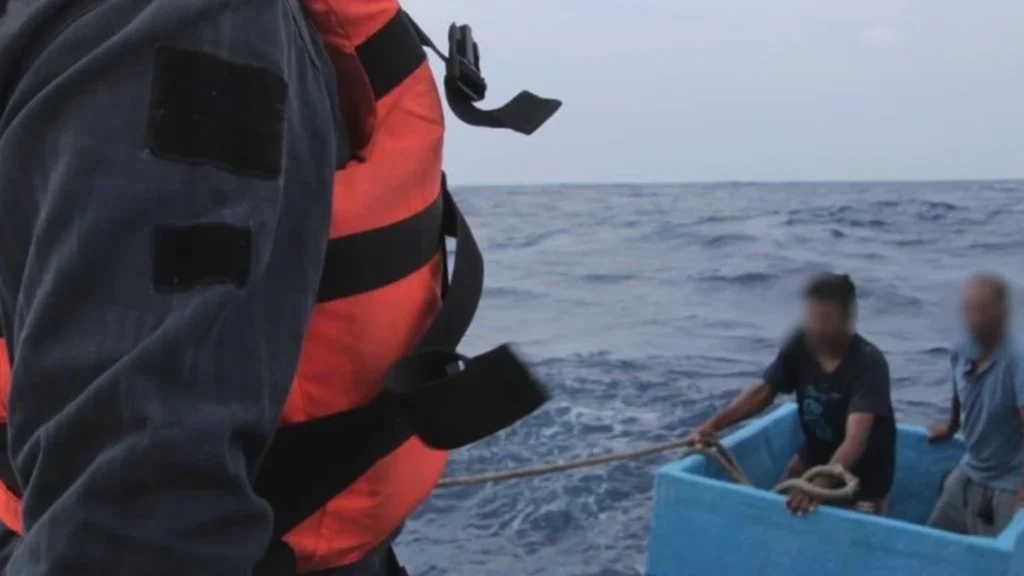
Navy personnel reach the two fishermen, who spent five days adrift in a fishing cooler about 150 miles off Chiapas.
Navy personnel reach the two fishermen, who spent five days adrift in a fishing cooler about 150 miles off Chiapas.
The photograph the Mexican navy released on 20 August is hard to read at first. A sailor in an orange life vest fills the left of the frame, hauling on a rope. At the other end, riding open Pacific swells, is a pale blue box with two men sitting inside it. The box is a fishing cooler. It had been their boat for five days.
The two fishermen rescued in a cooler about 150 miles off the coast of Chiapas were found alive on Wednesday, according to CBS News, which published the navy’s images and account. They were 53 and 32 years old. They had eaten nothing and drunk nothing since the day their vessel went silent.
What the Navy Found 150 Miles off Chiapas
The men last spoke to their fishing cooperative on 14 August. They were aboard a boat called the Camaronera. When the cooperative could not raise them, its staff sent out a distress call, and the Secretariat of the Navy — SEMAR, in its Spanish initials — opened a search by sea and by air across what CNN described as a vast area of the Pacific.
Chiapas is Mexico’s southernmost Pacific state, sharing a land border with Guatemala. Its coastal towns run on small-boat fishing, the kind done in open craft within sight of land on a good day and well beyond it on a bad one. The navy has not said how the Camaronera became disabled, and it has not released the names of the two men.
What it has confirmed is the distance. SEMAR put the rescue at more than 240 kilometres from the Chiapas coast; the wire reports rendered that as roughly 150 miles. Either way, the men had drifted far outside the range any small fishing boat is built for, and far outside the area a first search would normally cover.
Five Days With Absolutely Nothing
The detail that stops people is the supplies, because there were none. Both men told the navy they ate and drank absolutely nothing across the five days, a point CNN’s report by Diego Mendoza and Ivonne Valdes records directly from them.
Five days without fresh water sits at the outer edge of what a body tolerates. In tropical sun, on salt water, with no shade and no way to lie down, dehydration moves quickly from thirst to confusion. The cooler that kept them afloat would also have been radiating heat back at them all day and offering nothing at night.
There is a grim logic to why it was a cooler at all. An insulated fish box is one of the few objects on a small commercial boat with real buoyancy, a rigid hull shape and high sides. If a vessel goes down fast, it is the thing most likely to still be on the surface — and big enough to hold two adults out of the water, which matters more than almost anything else for survival time.
How the Search Actually Worked
SEMAR described the operation in its own announcement using a term it applies to coordinated maritime searches: the Trinomio, or triad — buque, interceptora, aeronave. Ship, fast interceptor and aircraft, working the same search area at different speeds and altitudes.
That structure is the reason the men were found at all. An aircraft covers enormous water quickly but sees poorly in swell. A patrol ship sees well but covers little. A fast interceptor closes the gap between a possible sighting and a confirmed one before the target drifts out of the box again. A pale blue cooler in open ocean is a target barely a couple of metres across, set against a search area the navy itself called vast — close to invisible from anything but low and slow, and never in the same place twice.
Once located, both men were given medical evaluations at sea and then airlifted to port for further treatment. Navy photographs taken on land show one man on a stretcher and the other in a wheelchair. SEMAR has not detailed their condition beyond confirming they were in good enough shape to be sent home to their families right away, as the CNN Newsource summary of the navy statement notes.
The Words the Two Men Used
In video released by the navy, the two speak briefly. One of them says simply: “We didn’t think we were going to survive these days.” He adds: “The only thing we could do was pray to God and wait for the help of all of you here from the Navy.”
The second man is blunter. “It was the hardest thing imaginable,” he says. “I wouldn’t wish it on anybody — not even my worst enemy.”
Neither man describes what happened to the boat. Neither offers a survival narrative of the kind these stories usually collect afterwards. What comes through instead is the flatness of people who have just stopped needing to hold themselves together, which is its own kind of testimony about the five days.
Why the Pacific Keeps Swallowing Small Boats
Cases like this are not freak events on Mexico’s Pacific coast. They are a structural risk of how the fishery works. Small-scale crews work from open boats with a single outboard motor and limited radio range, and the safety margin is thin by design. A failed engine or a swamped hull is not an inconvenience out there — it is the whole emergency, because there is no second system and no way to call for one.
Once a boat is disabled, the ocean takes over, and a drifting hull does not sit waiting to be found near where it stopped. This case measures that directly: the search began from a last known position near the Chiapas coast and ended more than 240 kilometres out. That is the problem every maritime search has to solve — the box you are looking in has to grow outward faster than the crew inside it runs out of water. In the end it was two fishermen rescued in a cooler, not a boat, that the navy pulled from the water.
SEMAR framed the outcome in exactly those terms, saying the rescue reflects its “commitment to the public to safeguard human life at sea” and urging anyone in a maritime emergency to call the Secretariat directly.
The 8,000-Kilometre Drift That Set the Bar
Mexico has produced the most extreme drift cases on record, which is part of why the navy searched as far out as it did. In August 2006, three fishermen from the Pacific town of San Blas were picked up near the Marshall Islands by a Taiwanese fishing boat after drifting more than 8,000 kilometres across the ocean in a small boat with two dead outboard motors.
They had been adrift for at least three months. Al Jazeera reported at the time, citing the manager of the fishing company whose vessel found them, that they survived on rainwater and seabirds and were “skinny and hungry when they were picked up last week but otherwise healthy.”
Set against three months and 8,000 kilometres, five days and 240 kilometres reads as a near miss. That is the wrong comparison. The 2006 crew had a hull, some shade and rain to catch. The men found this week had a fish box, an equatorial sun and no water at all. The clock they were running against was far shorter.
What Happens to the Two Men Now
Both of the fishermen rescued in a cooler were reunited with their families after their medical checks. The navy has kept them anonymous, and nothing in its statements suggests they intend to speak publicly beyond the few sentences already recorded.
Numbers carry most of the weight in a story like this one — five days, 240 kilometres, two men, nothing to eat or drink. It is the same reason a total eclipse comes down to how long the shadow holds, as in our report on the 108 seconds of totality over southern Spain. Strip away the framing and the fact is simply that a search which could have easily been called off ran long enough, and wide enough, to find a two-metre box.
The unresolved part is the Camaronera itself. Until the navy or the cooperative explains how a working fishing boat went down fast enough to leave its crew with nothing but the cooler, the most important safety question in the story stays open.
This article was AI-assisted and edited for accuracy.