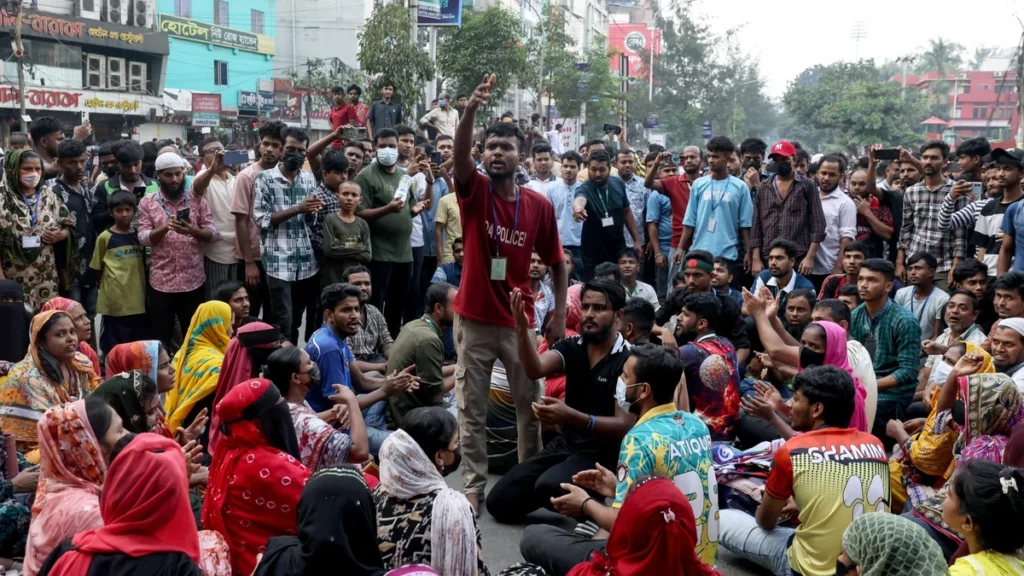
Garment workers block a road in Dhaka during a protest for higher wages on 1 November
Garment workers block a road in Dhaka during a protest for higher wages on 1 November
Bangladesh garment workers have spent most of November on the streets around Dhaka, demanding that the minimum monthly wage in the country’s clothing factories rise from 12,500 taka to 30,000 taka, roughly $101 to $242. That is a 140% increase for an industry that, according to AFP figures reported by Al Jazeera, generates $38bn a year and employs more than four million people.
The protests have closed hundreds of factories, drawn tear gas and stun grenades from police, and pushed an awkward question onto the desks of the fashion brands that buy from Bangladesh: if the wage goes up, who pays for it?
What the Workers Are Asking For
The current floor of 12,500 taka took effect after the last minimum wage revision, in December 2023. Prices have kept climbing since. Official data put annual inflation at 8.34% in September, including 7.22% for food and 9.30% for non-food items, Al Jazeera reported in a feature from the industrial belt outside the capital.
The workers’ case rests on what that inflation has done to household budgets. Laili Begum, a 37-year-old sewing operator at a factory near Dhaka, told Al Jazeera she earns around 15,000 taka a month, rising to 18,000 to 20,000 taka when she works overtime, and that her 15-year-old daughter and 12-year-old son left school this year because she could not afford it. “We can barely afford one proper meal a day,” she said. Rasel Khan, a 30-year-old worker in Ashulia, said he had built up debts of about 100,000 taka. “It’s impossible to support a family on this income anymore. Prices keep rising, and we have to borrow money just to survive,” he told the outlet.
Zahid Hussain, a former lead economist at the World Bank’s Dhaka office, said persistent inflation over the past five years had sharply eroded the purchasing power of low-paid workers. “When real income falls, they have to cut their daily living standards,” he told Al Jazeera. He also pointed to a recent salary rise for government employees, which he said had created a “demonstration effect” among private-sector workers waiting for similar relief.
Comparisons with competing producers sharpen the argument. Al Jazeera put Cambodia’s garment minimum wage at $210 a month, Vietnam’s range at $140 to $210, and wages in China’s Guangdong manufacturing hub at $286 to $378. Babul Akhter, general secretary of the Bangladesh Garment and Industrial Workers Federation and a workers’ representative on the wage board, described Bangladesh’s pay as “among the lowest garment wages in the world”.
How Far the Disruption Has Spread
The protests began on Saturday 31 October and quickly reached the industrial hubs of Savar, Ashulia, Gazipur and Mirpur. The Bangladesh Garment Manufacturers and Exporters Association (BGMEA) said operations were disrupted at 529 factories on 1 November, affecting nearly a million workers. By the third day, Al Jazeera reported a heavy police presence in Mirpur, where protesters faced tear gas and sound grenades, while workers in Gazipur blocked the Dhaka-Tangail highway.
The unrest flared again on 17 November after a scheduled wage board meeting was postponed because a member representing the workers was unwell, according to a BGMEA source quoted by AFP. Protesters blocked the main highway between Dhaka and Mymensingh, threw bricks and set vehicles alight, and police responded with tear gas and stun grenades. About 500 of the country’s 4,500 garment factories were shut, and Border Guard Bangladesh deployed hundreds of personnel, using drones and body-worn cameras to monitor the demonstrations. The Clean Clothes Campaign, a labour rights network, said on 16 November that another worker had died amid the unrest.
The workers’ own words show the bind they are in. “The owners seem unwilling to meet our salary demands. They are already dragging their feet,” Khanom, a 24-year-old worker, told AFP. Another worker, Rakib, 28, said: “We want to return to our machines.” Closures cost them money as well as their employers: a “no work, no pay” provision in Bangladesh’s labour law allows owners to suspend operations and withhold wages when production is disrupted.
Why Factory Owners Say the Number Is Too High
Employers argue that the industry is being squeezed from several directions at once. Factory owners told Al Jazeera that they face higher costs, energy market uncertainty linked to the United States-Israel war on Iran, and slowing demand in some export markets, while competing with Vietnam, Cambodia and India for orders.
Mahmud Hasan Khan, president of the BGMEA, said the government “has already taken a step by forming the wage board” and added: “We expect workers to allow the review process to proceed.” At the start of November he warned that if protests continued, “we will have no option but to invoke the ‘no work, no pay’ provision.”
Not every employer voice treats the buyers as bystanders. Sheikh Hossain Muhammad Mustafiz, a BGMEA official and managing director of Cute Dress Industry Ltd, told Al Jazeera: “Workers deserve wages that support a decent standard of living. However, without fair purchasing prices from international brands, significant wage increases could put pressure on factories and threaten employment.” He added: “Sustainable wage growth cannot be achieved by manufacturers alone.”
The gap between the two sides is wide. According to the Clean Clothes Campaign, which cited reporting by Times of Bangladesh, industry sources said employers were considering an offer of 14,000 to 15,000 taka, no more than half of what the protesters are demanding.
Where the Fashion Brands Stand
Bangladesh is the world’s second-largest garment exporter after China, and its factories supply brands including H&M, Zara, Levi Strauss, Walmart and Primark. Ready-made garments account for more than 80% of the country’s export earnings, which reached $39bn in the last financial year.
That puts the brands that Bangladesh garment workers sew for at the centre of the dispute, and their public positions so far have been cautious. In a review of brand and industry statements published on 20 November, the Clean Clothes Campaign, which is backing a minimum of 32,000 taka, said the American Apparel and Footwear Association had written to the Bangladeshi government supporting a fair process and condemning violence against workers, with its members committed to responsible purchasing practices, but without naming a figure. It said statements from ACT, the Fair Labor Association and a joint group of eight organisations including the Ethical Trading Initiative backed higher wages in principle without saying how member brands would build the cost into the prices they pay.
The campaign named two companies that it said had gone further. The Italian outdoor company Oberalp supports 32,000 taka and has committed to reflect it in its pricing, the group said, while Varner Group has said publicly that higher labour costs will be reflected in its purchasing practices. It listed H&M, Inditex, New Yorker, Bestseller, M&S, Next, Primark, Kontoor, C&A and LPP among the major buyers that had stayed silent or relied on statements from the initiatives they belong to.
The Gap Between Pledges and Pay Packets
The dispute lands on a long-running question about the industry’s promises. The Business of Fashion reported on 20 November that nearly a decade after some of fashion’s biggest brands pledged to improve wages across their supply chains, progress remains limited, and that the fresh unrest in Bangladesh is exposing the gap between those promises and workers’ reality.
The Clean Clothes Campaign’s own monitoring points the same way. Its Fashion Checker, released in September, found that 32% of the 110 brands it assessed had made a living wage commitment, but only 4% reported tangible progress. Workers it surveyed in Bangladesh earned 73% less than a living wage, and only 3% of brands disclosed wage levels at the factories in their supply chains.
Views on where the responsibility lies differ sharply. Taqbir Huda, a human rights lawyer and Clarendon Scholar at the University of Oxford, told Al Jazeera: “One party that could change the situation overnight has held the most extractive and exploitative role: the western buyer brands who hold the lion’s share of the value that is generated by the clothes that these workers produce.” Factory owners make a related point from the other side of the table, arguing that they cannot absorb a large rise without better prices from buyers. Akhter, speaking for the workers, put it this way: “If factory owners cannot pay workers properly, they should negotiate better prices with international buyers.”
What Happens Next at the Wage Board
The government formed the wage board on 1 November, the day after the protests began, and Prime Minister Tarique Rahman held an emergency meeting with ministers and advisers. Home Minister Salahuddin Ahmed met factory owners and assured them that a new minimum wage would be fixed through negotiations, while Labour Minister Ariful Haque Choudhury urged workers to return to work. The board brings together representatives of employers and workers, and its workers’ side includes Akhter, an independent union leader. A recent amendment to labour law cut the wage review cycle from five years to three, and the current period ends in December.
The board said its next meeting would be held on 23 November. The new minimum wage is due to be announced in December and to take effect in January 2027. Akhter has called for the new rate to apply from January 2027 salaries and for the release of arrested workers, while the BGMEA and the Bangladesh Knitwear Manufacturers and Exporters Association have jointly called for negotiations to resume as soon as possible.
Rising living costs are not only a Dhaka story: companies around the world keep raising them, with inflation mentioned 820 times on S&P 500 earnings calls in October. For Bangladesh garment workers, the question for the coming weeks is narrower and more concrete. It is what number the wage board settles on, and whether the brands that buy the clothes say publicly that they will pay prices that cover it. For Laili Begum, the answer cannot come soon enough. “Wages must rise, but food prices must also come down,” she told Al Jazeera.