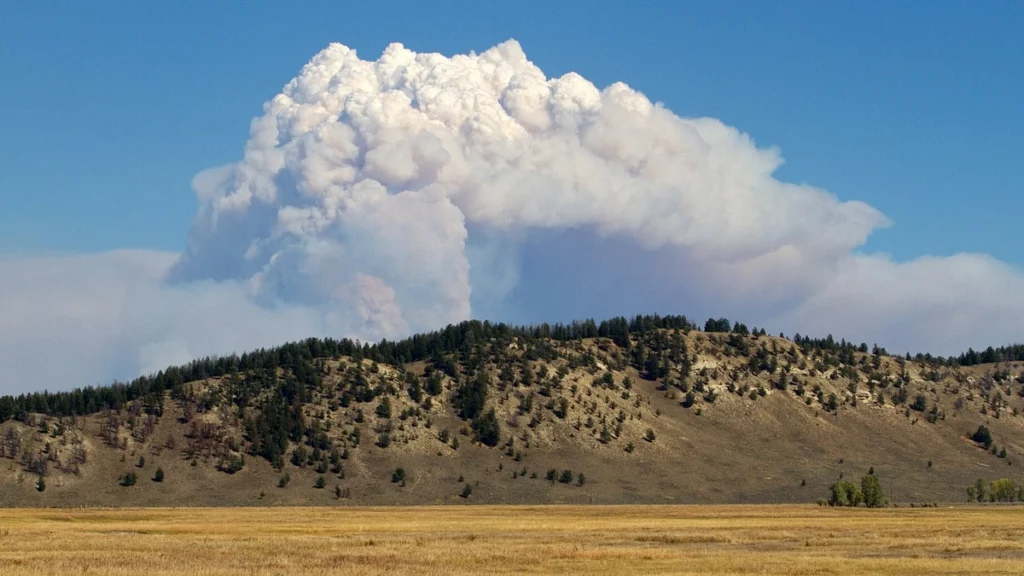
Southern Europe is burning. A punishing heatwave has dried the landscape to tinder and set off wildfires across France, Spain, Greece and beyond, forcing tens of thousands of people from their homes and killing at least 14. But the fires, dramatic as they are, may not be the deadliest part of the story.
Behind the visible emergency of flame and smoke lies a quieter, larger one. Scientists estimate that the record-breaking heat that gripped the continent in June caused more than 10,000 excess deaths – people who died from the heat itself, largely out of sight. Taken together, the fires and the heat make this Europe heatwave one of the most damaging in recent memory.
It is also, researchers say, exactly the kind of event a warming climate is making more common: hotter baselines, longer fire seasons and extremes that arrive earlier and hit harder than they used to.
Fire Across the South
The most acute crisis right now is the fires. In France, authorities evacuated around 10,000 residents after a fast-moving blaze broke out near Trevillach, in the Pyrenees-Orientales region close to the Spanish border, burning through roughly 46 square kilometres. Across the frontier in Spain’s Costa Brava, flames scorched thousands of acres and forced the evacuation of nearly 50,000 people.
Greece has battled fires near Thessaloniki, west of Athens and in the central Fthiotida region, where a man and his 12-year-old son died – a reminder of the human cost behind the statistics. Portugal, Italy and Turkey have all faced blazes too. By early July, the fires had killed at least 14 people and driven tens of thousands to flee, with firefighters working in dangerous, fast-changing conditions.
What makes these fires so hard to fight is the combination of heat, wind and drought. Vegetation parched by weeks of extreme temperatures ignites easily and burns intensely, while gusty conditions throw embers far ahead of the main fire line, opening new fronts faster than crews can respond. Nighttime, once a natural respite when cooler, damper air slowed a blaze, increasingly offers little relief as temperatures stay high long after dark – robbing exhausted crews of the window they once used to regain ground.
Record-Shattering Heat
The fires are being driven by heat that has broken records across the continent. Temperatures reached 45.1C at Andujar in southern Spain, and anomalies peaked at around 9C above normal over France and Germany. France recorded its hottest day since national records began in 1947, and France, Germany and Denmark all set all-time temperature highs, while Hungary, Austria, the United Kingdom, the Netherlands and Switzerland broke June records.
Those numbers are not just abstractions. Extreme heat buckles infrastructure, strains power grids as air-conditioning demand surges, and turns forests and farmland into fuel. The same conditions that make a city dangerous for its most vulnerable residents also prime the countryside to ignite – which is why a heatwave and a wildfire season so often arrive hand in hand.
This July surge follows a record-breaking heatwave that scorched the continent in June, an early-summer extreme that arrived weeks before such heat would normally peak. That the season’s most dangerous conditions are appearing earlier each year is itself part of the pattern scientists have warned about, and for hospitals and emergency services, back-to-back extremes mean coping capacity is eroded before the worst of summer has even arrived.
The Silent Toll
The starkest figure is the human one. As of early July, researchers estimated that the June heatwave was associated with more than 10,440 excess deaths across the affected countries – a modelled estimate of how many more people died than would have in a normal summer. Germany was hit hardest, with roughly 5,120, followed by France with around 2,025, Belgium with 1,747, Spain with about 1,028 and the Netherlands with some 480.
Heat is often called a silent killer for exactly this reason. Its victims rarely make dramatic headlines; they are mostly older people, those with heart or lung conditions, and the isolated, who die at home or in hospital from a body pushed past its limits. The wildfire death toll of 14 is tragic and visible; the heat’s toll is far larger and largely unseen, which is part of why it is so often underestimated.
A Coordinated Emergency
The scale has forced an unusually coordinated response. The European Commission said that around 777 firefighters from 14 countries had been or would be deployed to high-risk areas across Cyprus, Greece, Italy, France, Spain and Portugal, pooling crews and aircraft through the bloc’s civil-protection system.
That cross-border cooperation is increasingly the norm rather than the exception. As fire seasons lengthen and overlap across the Mediterranean, no single country has enough aircraft, crews and equipment to cover its worst days alone, so nations lend resources back and forth as the front lines shift. It is an adaptation of sorts – though one that treats the symptoms of a hotter continent rather than the cause.
The Climate Signal
Scientists are unambiguous that human-caused warming is loading the dice. Climate change does not conjure a heatwave out of nothing, but it raises the baseline from which every hot spell starts, making record temperatures more likely, more intense and more frequent. It also lengthens the fire season and dries out vegetation, so that when a fire does start, it spreads faster and burns hotter.
The broader driver is no mystery: the continued burning of fossil fuels. Even as the world debates its energy future – a shift visible in this year’s fall in global oil demand – the carbon already in the atmosphere guarantees more summers like this one. Europe, which is warming faster than any other continent, is on the front line of that reality.
What Comes Next
In the immediate term, forecasters warn the heat and fire risk will persist for weeks, keeping emergency services stretched and vulnerable communities exposed. The priorities are familiar: contain the active fires, protect the elderly and sick through the hottest hours, and keep power and water flowing under record demand.
There is an economic dimension too. Beyond the immediate emergency costs, repeated summers of fire and heat strain agriculture, tourism, power systems and insurance across the Mediterranean, with damage that mounts year after year. Insurers have begun warning that some of the highest-risk areas may become harder and costlier to cover – which for ordinary residents can mean rising premiums or, in the worst cases, homes that become effectively uninsurable, turning a climate problem into a very personal financial one.
The longer-term challenge is adaptation. Cities are redrawing plans around cooling centres, shade, water and early-warning systems; countries are rethinking building codes, land management and how they staff and equip fire services for a season that now starts earlier and ends later. None of it removes the underlying trend, but it can decide how many of the next heatwave’s victims are counted among the excess dead. For now, though, Europe is simply trying to get through a summer that has arrived hotter, drier and more dangerous than almost any on record.