England vs Spain was a measuring stick for Thomas Tuchel’s side, and for a spell on Saturday night it looked like one England could pass. They came from behind to lead 2-1 at Wembley, then watched Harry Kane slip as he struck a penalty that would have made it 3-1. The ball hit the crossbar, Spain scored twice more, and the European and world champions left London as 3-2 winners in the opening match of UEFA Nations League Group A3.
The result stretched Spain’s record-breaking unbeaten run to 39 matches, according to Sky Sports’ match report, and it leaves England third in the group before they travel to Czechia on Tuesday. It was also the first of four matches England will play in 11 days, because this is the first autumn of a new international calendar that folds the September and October breaks into one long window.
How Spain Came Back at Wembley
The start could hardly have been worse for the home side. In the second minute Marc Guéhi lost the ball under Spain’s press and Lamine Yamal ran through to score. Sky Sports noted it was the third-quickest goal England have ever conceded at Wembley, behind only first-minute goals for Scotland in 1957 and Hungary in 1953. Ferran Torres then had a header ruled out for offside and was denied by James Trafford, who was a surprise starter in goal ahead of the regular number one, Jordan Pickford.
England’s reply came in a four-minute burst before half-time. On 36 minutes Elliot Anderson won the ball after Nico Williams slipped, Jude Bellingham carried it over halfway and Anthony Gordon finished low from 20 yards, as ESPN’s report describes the move. Four minutes later Kane stretched to meet a cross from Nico O’Reilly with a header that Marc Cucurella could not keep out. In those four minutes Spain conceded more goals than they had in their eight World Cup matches combined.
The second half turned on two loose passes and one slip. After Kane’s miss on 54 minutes, O’Reilly gave the ball away on the hour, Dani Olmo intercepted and the substitute Álex Baena struck from the edge of the area to make it 2-2. On 74 minutes patient Spanish passing ended with Baena releasing Mikel Oyarzabal, who lifted his finish over Trafford. Bellingham forced a save from Unai Simón in stoppage time, but Spain held on.
The Penalty That Could Have Changed the Night
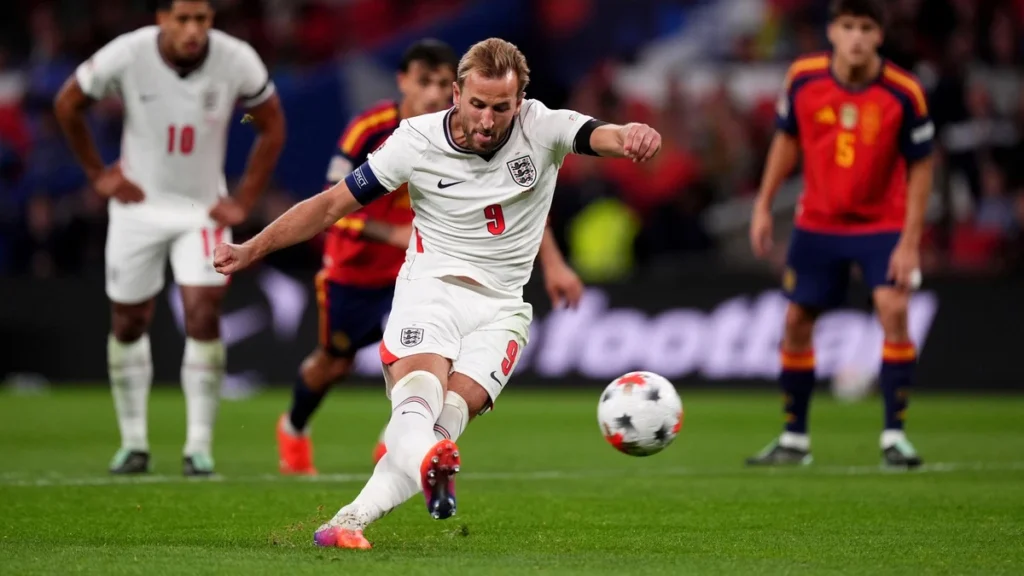
The decisive moment came nine minutes into the second half. Bellingham went down under a challenge from Rodri, and after a VAR review the referee, Davide Massa, awarded a penalty. Kane slipped at the moment of contact, and the ball flew off his standing foot and onto the crossbar.
Tuchel was clear about what the miss cost. “Unfortunately, we couldn’t convert the penalty, which maybe would have been the decisive moment, because I think then Spain would have maybe, for the first time, believed that their long run of unbeaten games ends here,” he told England’s official website.
It is a reasonable reading of how England vs Spain unfolded. A 3-1 lead with more than half an hour to play would have forced Spain to open up against an England side that had been winning the ball high up the pitch. Instead, Spain were level within six minutes of the miss and ahead 20 minutes after it. Sky Sports described the result as a blow to Tuchel’s stated aim of winning this competition, which is why a single slip is being discussed as more than bad luck.
What Tuchel, Kane and De la Fuente Said
Tuchel’s verdict was mixed rather than gloomy. “The start was terrible, the worst start possible,” he said. “It makes it so, so difficult to be behind against this kind of team.” He argued that England had been the better side for long spells and pointed to their pressing: “I think we had 12 or 15 more ball wins in the opponent’s half than Spain today. But we couldn’t convert enough into chances and goals, because otherwise we would have won the match.”
Kane took a similar line with ITV Sport, as quoted by Sky Sports: “We went toe to toe with Spain. On another day we would have won. It’s disappointing, but we have to take the positives.”
Spain’s coach, Luis de la Fuente, saw a different match. “The game was under control most of the time, except for six to seven minutes, when England dominated us. We got disconnected,” he said. Both accounts of England vs Spain contain some truth. England’s best spell produced two goals and a penalty. Spain’s control produced three goals, a disallowed header and several clear chances for Torres before the break.
A Pattern England Recognise From the Summer
England arrived as the World Cup’s third-placed team. They beat France in the third-place play-off after losing their semi-final to Argentina, TNT Sports notes, and Sky Sports observed that England had also let an advantage slip against Argentina in the summer. Kane drew the same line himself: “We reached good levels in the World Cup but didn’t put a full 90 mins together. Similar today.”
That is the uncomfortable thread for Tuchel. The evidence of the last three months is that England can match the best sides for long periods, press them into mistakes and score against them. The gap shows in the moments when a lead needs protecting. Spain’s recovery at Wembley was not built on sustained pressure so much as on punishing two errors in possession, then keeping the ball calmly until an opening appeared for Oyarzabal.
Selection will be part of that conversation. Sky Sports reported that Jarell Quansah started at right-back ahead of Trent Alexander-Arnold and that Myles Lewis-Skelly started in midfield, while the first-choice front four of Kane, Bellingham, Bukayo Saka and Gordon all played. Sky Sports’ verdict picked out Gordon, who scored the equaliser, as England’s best player on the night.
Why the International Break Now Lasts Three Weeks
Club football has stopped for longer than usual this autumn, and that is by design. FIFA’s men’s international match calendar for 2025 to 2030, approved by the FIFA Council in March 2023, replaced the separate September and October windows with a single 16-day window allowing four matches, starting in 2026. This year it runs from 21 September to 6 October, according to beIN Sports, with the next window from 9 to 17 November returning to the familiar nine-day format.
TNT Sports says the change was made with player welfare in mind. After the latest World Cup final since 1966, the longer window means players do not have to travel as much across two separate autumn breaks. Previously there were four international breaks across the season, each lasting a fortnight with two rounds of matches. The three-week window will remain in place until at least 2030, while the November and March breaks stay the same length as before.
For national coaches it is a mixed blessing. Four matches in 11 days gives Tuchel more continuous time with his players than any autumn camp has offered before, but it also tests the depth of the squad. England had already lost five players to withdrawals before the Spain game, including Chelsea’s Cole Palmer and Manchester United’s Marcus Rashford, according to TNT Sports.
England’s Route Out of Group A3
The Nations League rewards consistency over six matches, and one home defeat is not fatal. After the first round, Spain and Croatia lead the group on three points each, because Croatia won 2-1 away to Czechia on Saturday. England and Czechia have none. The top two progress to the quarter-finals, which are played in March 2027 alongside the promotion and relegation play-offs, with the finals in June 2027.
Sky Sports set out the arithmetic plainly: if England are to top the group, they will need to beat Spain in Madrid in November and win their games against Czechia and Croatia in the meantime. A second-place finish would still reach the quarter-finals, so the group is far from settled after one round of six.
There is a longer horizon too. The draw for Euro 2028 qualifying takes place on Sunday 6 December 2026, TNT Sports reports, with group winners qualifying directly along with the eight best-ranked second-placed teams. For a squad trying to learn how to close out games against elite opposition, the remaining five group matches are a useful rehearsal before that qualifying campaign begins.
What to Watch in Prague, Rijeka and Wembley
England’s next three matches come quickly. They face Czechia at the Fortuna Arena in Prague on Tuesday 29 September at 19:45 BST, then Croatia at Stadion HNK Rijeka on Saturday 3 October at 17:00 BST, before Czechia visit Wembley on Tuesday 6 October at 19:45 BST, according to the official England fixtures list. The group finishes in November, with Croatia at Wembley on 12 November and Spain away at the Riyadh Air Metropolitano on 15 November.
Three questions stand out. The first is the goalkeeper. Trafford was preferred to Pickford for the biggest home game of the autumn, and how Tuchel rotates across four games will show whether that was a one-off or a change of order. The second is the defence in possession. Two of Spain’s three goals came from English mistakes on the ball, from Guéhi and O’Reilly, and a side that wants to press high has to be secure when it wins the ball back. The third is Kane. A missed penalty rarely defines a striker of his standing, but the slip came at the worst possible moment, and England’s captain will want to answer it quickly in Prague.
MW3.News covered a very different title race earlier this month, when Kimi Antonelli left Madrid 81 points clear in the Formula 1 standings. England’s position is far less comfortable. They have five group games left to show that their spell before half-time at Wembley, rather than the 20 minutes after Kane’s penalty, is the truer picture of where they stand against the world champions.