The standard treatment for bowel cancer has followed the same broad script for decades: operate to remove the tumour, then, if the cancer is aggressive, follow up with months of chemotherapy. A UK-led trial has just shown that for one group of patients, a very different approach can work far better – and it starts with a short course of immunotherapy before the surgeon ever picks up a scalpel.
In the NEOPRISM-CRC study, patients with a specific type of bowel cancer were given up to nine weeks of the immunotherapy drug pembrolizumab and then went to surgery. Nearly three years later, the results are striking: after 33 months of follow-up, not one of the patients has had the cancer come back. This form of bowel cancer immunotherapy is challenging the assumption that chemotherapy after surgery is the best a patient can hope for.
The findings come with an important condition – they apply to a particular subtype of the disease, not to bowel cancer as a whole. But for the patients who qualify, they hint at a future of shorter, gentler and more durable treatment.
What the Trial Did
Bowel cancer is the fourth most common cancer in the UK, with around 44,000 new cases every year. NEOPRISM-CRC focused on patients whose tumours are what doctors call mismatch-repair deficient, sometimes written as MMR-deficient or MSI-high. These cancers carry large numbers of genetic mutations, which paradoxically makes them more visible to the immune system – and so more likely to respond to drugs that unleash that immune response.
Rather than operating first, the team gave these patients up to nine weeks of pembrolizumab, a checkpoint-inhibitor immunotherapy, before surgery. The idea was to attack the cancer while it was still fully in place, using the whole tumour to prime the immune system, instead of mopping up afterwards with chemotherapy.
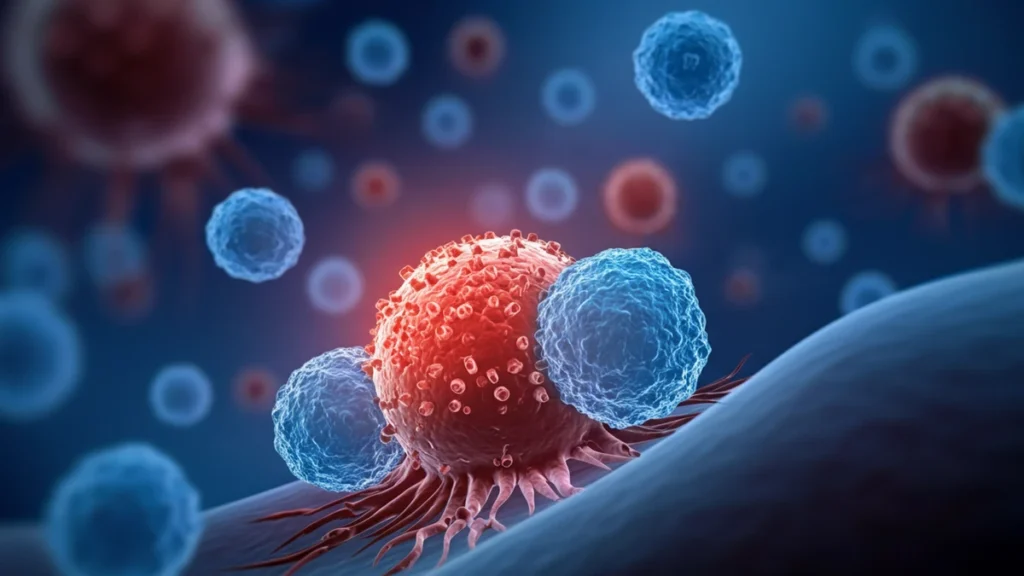
Checkpoint inhibitors like pembrolizumab do not attack cancer cells directly. Instead they release a natural brake on the immune system – a molecular ‘off switch’ that many tumours exploit to hide from attack. With that brake lifted, the body’s own T-cells can recognise the cancer as foreign and destroy it. In mismatch-repair-deficient tumours, which are studded with mutations, there is simply more for the reawakened immune system to see, which is why this subtype responds so unusually well.
Cancer That ‘Melted Away’
The early results were arresting. By the time patients reached surgery, 59% had no detectable cancer remaining – the tumour had already been cleared by the immunotherapy alone. For a disease usually tackled with the knife first, that is a remarkable reversal of the normal order of things.
Surgery still went ahead, both to confirm the cancer was gone and to remove anything that remained. But the finding that most tumours had already vanished raises a question researchers are now pursuing: whether some carefully selected patients might one day be spared the most extensive operations altogether, once doctors can be confident the immunotherapy has done its job. For a patient, hearing that the disease is undetectable before the operation even begins is a profound shift from the usual sequence of surgery first, anxious waiting second.
One participant, 73-year-old Christopher Burston from Dorset, was diagnosed after routine screening picked up blood in his stool. He received three doses of immunotherapy over nine weeks before his operation in May 2023. “The outcome of the surgery was essentially that the cancer had melted away – these were the doctor’s words,” he said. Stories like his are what the raw percentages translate into.
Why the Durability Matters
Shrinking a tumour is one thing; keeping it gone is another. The most important part of the new data is time. After 33 months – close to three years – of follow-up, none of the trial’s patients have relapsed, suggesting the responses are not just dramatic but durable.
That endurance is the crux of the result. Cancer treatments are ultimately judged on whether the disease stays away, and a nearly three-year clean record across the group is a powerful signal. “These results not only confirm the durability of responses we saw almost three years ago, but also provide crucial biological insights into why immunotherapy is so effective in this setting,” said Professor Marnix Jansen of the UCL Cancer Institute and UCLH, who helped lead the work.
NEOPRISM-CRC is also part of a wider movement in oncology toward giving immunotherapy before surgery, known as the neoadjuvant approach. Similar strategies have shown strong results in melanoma and some other cancers, on the logic that an intact tumour gives the immune system a richer target to learn from than the scattered cells left after an operation. The bowel-cancer data adds one of the most striking examples yet to that growing body of evidence, and that momentum matters because it means the approach is likely to be refined and extended rather than left as a one-off.
Learning to Predict Who Benefits
Alongside the headline outcome, the researchers dug into why the treatment worked so well and how to spot the patients most likely to benefit. Two findings stand out. First, immune profiling of tumour tissue taken before treatment began could help predict who would respond – a step toward tailoring the approach in advance rather than by trial and error.
Second, the team tracked tumour DNA circulating in patients’ blood. When that DNA disappeared, patients were far more likely to remain cancer-free over the long term. That kind of blood-based monitoring, part of the same wave of data-driven and AI-assisted tools reshaping healthcare, could one day tell doctors in near real time whether a treatment is working, without waiting for a scan or an operation.
The Important Caveats
Enthusiasm has to be tempered with precision. The dramatic results apply specifically to mismatch-repair-deficient tumours, which make up only a minority of bowel cancers – very roughly one in seven. For the majority of patients, whose cancers do not carry that immune-visible signature, this particular approach is not expected to work the same way, and standard surgery and chemotherapy remain the mainstay.
The trial is also still maturing. These are results from a defined group followed for a few years, not decades, and larger studies with longer follow-up will be needed before pre-surgical immunotherapy becomes a formal standard of care. Impressive early data has disappointed before in oncology, which is exactly why the durability seen here is being reported carefully rather than trumpeted as a cure.
What It Means for Patients
For the group it fits, the implications are genuinely hopeful. A nine-week course of immunotherapy that can clear a tumour before surgery – and in some future scenarios might even avoid the most extensive surgery altogether – would spare patients the long, gruelling months of post-operative chemotherapy, with its own toll on the body and on daily life.
It also reinforces a broader shift in cancer care: away from one-size-fits-all treatment and toward matching therapy to the biology of an individual tumour. Identifying which patients carry the mismatch-repair-deficient signature is becoming a routine part of diagnosis, and results like these give that testing real, life-changing stakes. For the right patients with bowel cancer, the message emerging from NEOPRISM-CRC is simple and rare in oncology: less treatment, better results, and years of living cancer-free.