An Ebola outbreak in the eastern Democratic Republic of the Congo is spreading faster than aid workers can contain it. Since it was declared in mid-May, the virus has killed more than 700 people, infected over 1,900, and pushed into new provinces – and the World Health Organization warns the real toll is almost certainly higher.
What makes this Ebola outbreak so dangerous is not only the virus itself, one of the deadliest known to medicine, but where it has struck: a region torn by armed conflict, mass displacement and health services that were already stretched to breaking point. The result is an emergency in which the tools to stop Ebola exist, but the conditions to use them often do not.
It is Congo’s 17th Ebola outbreak, and in some respects the response is more advanced than ever, with rapid testing and a new treatment trial. Yet the epidemic keeps outrunning it.
A Fast-Moving Emergency
The outbreak was formally declared on 15 May and is centred on Ituri province, in the country’s turbulent east. It is caused by the Bundibugyo species of Ebola – a strain for which there is no approved, proven cure, unlike the better-known Zaire strain behind previous epidemics.
The figures have climbed steadily. In early July, the WHO reported around 1,561 confirmed cases and 506 deaths; by mid-July, official tallies had risen past 1,900 cases and more than 700 deaths. Behind each number is a family and a community, and the pace of the rise points to transmission that contact tracing has not yet caught up with.
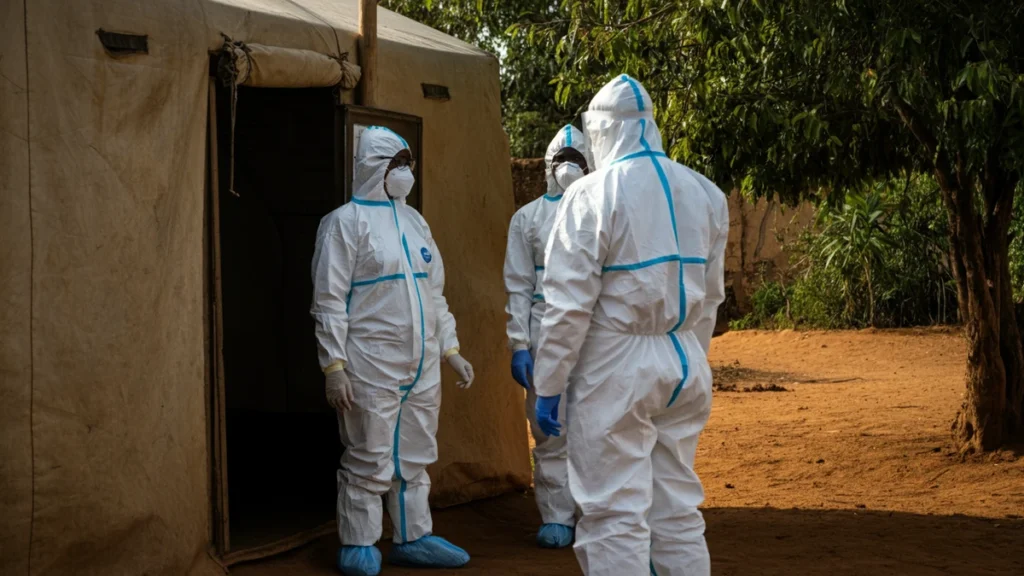
Ebola spreads through direct contact with the blood or bodily fluids of an infected person, or with contaminated surfaces, and it can also pass from the bodies of those who have died – which is why traditional burial practices can seed new infections. It is not airborne, so it does not spread as easily as a respiratory virus, but its high fatality rate and the intimacy of its transmission make care and burial some of the most dangerous moments, especially for family members and health workers.
Spread to a Transport Hub
Most alarming to health officials is where the virus is now turning up. Congo’s health minister confirmed that Ebola had reached Tshopo province – home to Kisangani, a major city and river-transport hub on the Congo River – and Haut-Uele, which borders South Sudan. Five provinces are now under enhanced surveillance.
A city like Kisangani changes the calculus. Ebola has largely been fought in rural health zones, where cases can, in principle, be ring-fenced. A sustained chain of transmission in a densely populated transport hub, connected by river and road to the rest of the country and beyond, would be a far harder problem to contain. The cross-border risk is real too: a single case was detected in France in a physician returning from a medical mission in the DRC – the first in Europe from this outbreak, with no onward spread reported.
A Virus in a War Zone
The central reason the outbreak is so hard to stop is the conflict around it. Eastern Congo has for years been the scene of fighting between government forces and armed groups, and the violence has not paused for the epidemic. Clashes continue across North Kivu, South Kivu and Ituri, displacing families and cutting responders off from the very communities where the virus is circulating.
That instability undermines every part of an Ebola response. Contact tracing depends on reaching and monitoring everyone an infected person met; isolation depends on people trusting and accessing treatment centres. Both break down when populations are fleeing, roads are unsafe and territory changes hands. At one point an armed group even claimed the virus had been eradicated in areas under its control – a claim the WHO said it could not verify, precisely because responders cannot get in.
That access problem is the crux. In previous Congolese outbreaks, responders were sometimes attacked and treatment centres came under threat, and the same insecurity now blinds officials to how far the virus has travelled through contested territory. Where the state and aid agencies cannot safely go, the outbreak effectively goes unmonitored – and an unmonitored Ebola chain is exactly how a local emergency becomes a national one.
A Response Stretched to the Limit
Even where health workers can operate, they are overwhelmed. WHO officials describe treatment centres at saturation point, unable to take in every patient who needs care. Funding is short, and in a troubling echo of past outbreaks, some health workers have reported going unpaid since the emergency began – a grievance that has interrupted contact tracing at critical moments.
There have been genuine gains. Testing capacity has expanded dramatically, with around ten decentralised laboratories now operating in the affected provinces, the newest in Bunia, cutting the time to confirm a case. A clinical trial began on 2 July to identify treatments that work against the Bundibugyo strain – important progress, given how fast medicine has advanced against other conditions, from the newest cancer drugs to the bowel cancer immunotherapy making headlines elsewhere, while this strain of Ebola still has no cure. Community engagement is growing. But responders say these gains are being outpaced by the spread.
One tool that helped end recent epidemics is also less available here. The licensed Ebola vaccine that proved so valuable in past outbreaks was developed against the Zaire strain, not the Bundibugyo species driving this one, so its protection cannot be assumed. That gap removes a powerful line of defence – ring-vaccinating the contacts of each case – that helped bring earlier Congolese outbreaks under control, and it puts even more weight on the slow, dangerous work of tracing and isolation.
Why the True Toll May Be Higher
Officials are candid that the reported numbers understate the crisis. The WHO has warned that the true case count may be two to four times the official figures, and that the outbreak’s full scale has not yet been established. In areas cut off by conflict or lacking testing, cases and deaths simply go unrecorded.
That uncertainty is itself a danger. An outbreak whose real size is unknown is one that is difficult to resource correctly or to model, and undetected chains of transmission are how a contained emergency becomes a regional one. It is why the WHO keeps stressing the need to trace the history of every single case and isolate every contact – painstaking work that only succeeds with access and trust.
What Happens Next
The immediate priorities are clear: get the new provincial clusters under control before they take root, keep Kisangani from becoming a sustained hotspot, sustain the funding and pay the workers on the front line. The treatment trial offers hope of a therapy that could cut the death rate over time, and expanded laboratories should keep sharpening the picture.
But the outbreak is a stark illustration of a wider truth: epidemics are not just medical events, they are shaped by politics, poverty and war. The medicine to fight Ebola has never been better, yet a virus is still spreading through a population because peace, funding and functioning health systems are not there to back it up. Until they are, eastern Congo’s Ebola outbreak will remain a race that the responders are, for now, struggling to win.