
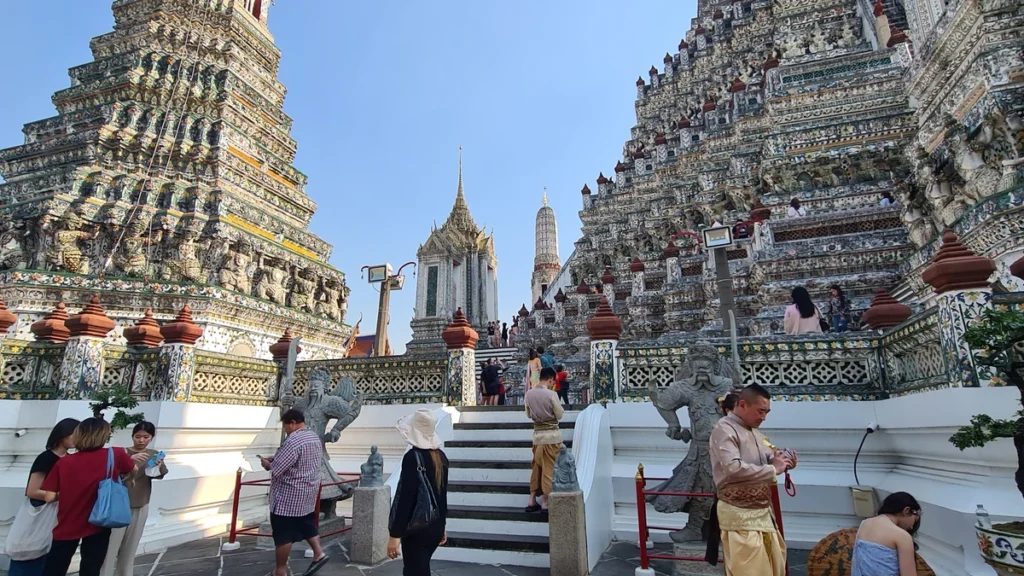
Visitors at Wat Arun in Bangkok
Visitors at Wat Arun in Bangkok
Thailand’s visa-free stay for visitors from 60 countries and territories, including the United Kingdom, the United States, Australia, Canada, India, Japan and all 27 European Union member states, fell from 60 days to 30 on 15 September. It ends a two-year experiment: in July 2024 the kingdom doubled the permitted stay and widened eligibility to 93 countries.
The new rules were published in the Royal Gazette on 31 August in announcements signed by Anutin Charnvirakul, who serves as both prime minister and interior minister, and they took effect 15 days later. The shorter stay comes with a second change that long-stay visitors will notice first: entries through land-border checkpoints under the exemption are now generally capped at two per calendar year.
What Changed on 15 September
The Tourism Authority of Thailand set out the new framework on 1 September. Holders of passports or travel documents from 60 countries and territories are now eligible for a visa exemption for tourism, with a permitted stay of up to 30 days. The list runs from Australia to the United Arab Emirates, and alongside the major Western markets it includes the Gulf states, Taiwan, Türkiye, Ukraine, South Africa, the Philippines, Malaysia, Singapore and Indonesia.
Two countries, Seychelles and Mauritius, moved to a shorter 15-day exemption. Nationals of Azerbaijan, Belarus and Serbia became eligible for a visa on arrival instead. Separate bilateral agreements are untouched, and according to TAT they continue to provide exemptions of 90, 30 or 14 days depending on the arrangement. The authority’s advice is direct: “Travellers should check the entry conditions that apply to their nationality before travelling.”
The switch was not retroactive. Immigration law firm Fragomen, in guidance first published on 1 September and updated on 18 September, notes that foreign nationals who entered under the 60-day exemption before the change “may remain for the full period granted upon entry.” Anyone arriving on or after 15 September is on the new 30-day allowance, which puts Thailand’s visa-free stay for most Western holidaymakers back at the length it was for years before 2024.
The Two-a-Year Cap on Land Crossings
The less-publicised half of the reform may matter more to people who treat Thailand as a base rather than a holiday. Travellers using the 30-day exemption can generally enter through a land-border immigration checkpoint no more than twice per calendar year. The limit does not apply to nationals of Malaysia, Brunei Darussalam, Indonesia and Singapore, or to other nationalities the minister may designate. The same two-entry rule applies to the new 15-day exemption.
The target is the visa run, in which a visitor crosses into a neighbouring country and comes straight back to start a fresh exemption. The Bangkok Post reported that the land-border limit is intended to cut down on visa runs used by foreigners to extend their stays. Air arrivals face no fixed annual number, but Fragomen cautions that admission remains at the discretion of immigration officers, and that travellers who make frequent visa-exempt visits “may be questioned about the purpose and frequency of their travel.”
In practice, the old habit of stacking exemptions back to back is now harder on both routes: capped by number over land, and open to questioning in the air.
Who Lost Visa-Free Entry Altogether
The list shrank as well as the stay. The 2024 scheme covered 93 countries and territories, while the new one covers 60. Not every country that dropped off now needs a visa, because some have their own agreements with Thailand. VisasNews, which compared the two lists, counts China, Hong Kong, Kazakhstan, Laos, Macao, Mongolia, Russia and Vietnam among the places keeping visa-free access through bilateral arrangements.
By the same tally, 21 nationalities now need a visa before they travel. They include Mexico, Colombia, Morocco, Sri Lanka, Uruguay, Monaco, Albania, Ecuador, Jamaica and Uzbekistan. Travellers in that group apply through Thailand’s official e-Visa system, and the simplest safeguard is to leave enough time for processing before a flight rather than assuming anything can be fixed on arrival.
Why Bangkok Reversed the 2024 Expansion
The rollback has been months in the making. According to TAT, Cabinet approved revising the 60-day measure in May and signed off on the country-by-country framework in July, before the Ministry of Interior announcements appeared in the Royal Gazette at the end of August.
Officials presented the decision as a response to misuse. The Bangkok Post reported that authorities said the system was being abused, with an increase in illegal activity by foreigners taking advantage of the longer stays. The same report noted that Thailand for many years allowed nationals of 56 countries to stay without a visa for 30 days, so the new framework returns the typical allowance to that older length while keeping a longer list of eligible countries.
For the tourism authority, the message to its biggest long-haul markets is that a shorter stay is still a welcome one. At a meeting in New York on 17 September, chaired by Minister of Tourism and Sports Surasak Phancharoenworakul, TAT set a target of 1.5 million US visitors under what it calls a “Value over Volume” strategy. TAT governor Thapanee Kiatphaibool said the authority “is focusing on travellers who stay longer, spend more and seek experiences with greater depth.”
A Tourism Economy Already Running Behind Last Year
The change lands on an industry that is already short of last year’s pace. Thailand welcomed 20,935,135 foreign visitors between January and August, down 3.08% on the same period of 2025, according to Ministry of Tourism and Sports figures reported by The Nation.
China, which sits outside the list of 60 and is covered by its own arrangement, was the standout with 3,543,272 arrivals, up 16.05%. Most other large markets fell. Malaysia was down 11.87% to 2,658,686, and South Korea was down 24.78% to 769,930, the steepest drop in the top ten. The United Kingdom sent 677,689 visitors, down 3.44%, Japan 665,368, down 5.42%, and Germany 594,981, down 2.07%. Among the top ten, the United States was the only Western market to grow, up 0.91% to 687,610.
The ministry still expects full-year arrivals and revenue to finish close to 2025 levels. That is a demanding bar. In 2025, international tourism brought in 1.53 trillion baht from 32.97 million foreign visitors, part of 2.7 trillion baht in total tourism revenue once domestic trips are included.
The same data suggests the shorter stay will matter less than it sounds for many visitors. TAT’s own figures show that US visitors in 2025 stayed an average of 14.59 nights and spent more than 69,415 baht per person per trip, comfortably inside a 30-day window. The people most affected are those planning stays of more than a month, which is exactly the group the land-border cap is also aimed at.
What Travellers Should Check Before Booking
For most holidaymakers from the UK, the US or Europe, the practical change is simple arithmetic: a two- or three-week trip still fits well within 30 days. Those planning a longer winter stay on the old allowance, or relying on repeated exemptions, need to plan differently. Four checks are worth making before booking.
- Count the days. Arrivals from 15 September onwards receive 30 days, not 60, so a stay longer than a month needs the right visa arranged before departure.
- Carry proof of funds. In a July reminder, TAT noted that immigration officers can ask to see money: 10,000 baht per person or 20,000 baht per family for certain visa-exempt cases, or the equivalent in another currency or documents. The requirement does not apply to children under 12, and TAT is clear that “the final decision on entry into Thailand rests with Immigration Bureau officers at the entry checkpoint.”
- Complete the arrival card. Foreign visitors still need to fill in the Thailand Digital Arrival Card. The Immigration Bureau’s optional THIM app, which TAT said in June was in pilot ahead of an expected August launch, can handle that registration, including for groups of up to 10 travellers at a time.
- Match the trip to the activity. Fragomen notes that non-work activities, such as attending an exhibition as a visitor, remain permitted under the exemption, while activities considered work still require authorisation such as an Urgent Work Permit.
Long-haul travellers have one more thing to plan for once they are on the plane. Hours in a seat are a health question as well as a comfort one, and our report on how five vigorous minutes cut the cancer risk of prolonged sitting is a useful read before a long flight.
For visitors from the 60 countries on the list, Thailand’s visa-free stay still covers a month without a visa, only the usual entry requirements. The rule most likely to catch people out is not the 30 days; it is the assumption that a quick border hop can add more.