
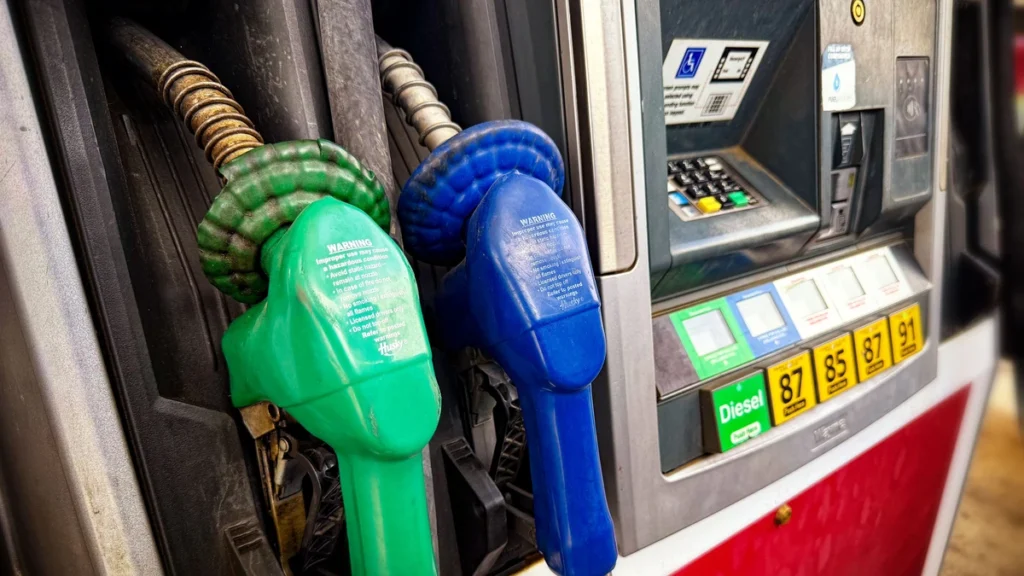
The green handle on an American fuel pump has never cost this much. AAA put the national average for a gallon of on-highway diesel at $5.9015 on 7 September, and the association’s own record table now lists that figure as the highest it has ever recorded. Regular gasoline, the number most drivers actually watch, sits at $4.1505 on the same day. That is expensive by any normal standard, but it is still about 87 cents below regular’s all-time peak of $5.0165, set on 14 June 2022.
The split between those two lines is the story. A Diesel Price Record is not simply a more painful version of a gasoline problem. It is a different problem, with a different cause and a different set of people who absorb it. Gasoline is mostly a household cost, felt directly and complained about loudly. Diesel is an input cost. It moves through the economy quietly, and it usually shows up on a supermarket shelf before it ever shows up in a family’s monthly budget.
What the Pump Actually Reads Today
The numbers on AAA’s national fuel price tracker describe a market that is climbing steadily rather than spiking. Diesel at $5.9015 is up from $5.8970 the previous day, $5.6002 a week earlier and $5.3313 a month earlier. A year ago the same gallon averaged $3.7088.
That yearly change is the figure worth holding on to. Diesel has risen roughly $2.19 a gallon in twelve months, an increase of close to 59 percent. Over the same period regular gasoline went from $3.1971 to $4.1505, a rise of about 95 cents, or roughly 30 percent. Both went up. One went up twice as fast.
Mid-grade gasoline averages $4.6325 and premium $5.0255, which produces an odd piece of arithmetic: a gallon of ordinary truck diesel now costs more than a gallon of premium unleaded, and by a wide margin. E85, the high-ethanol blend, sits at $3.1268 and is the only common fuel still priced near where the market was a year ago.
Why Diesel Set a Record and Gasoline Did Not
Crude oil is the shared ingredient, so a pure crude shock would lift both fuels together. That is not what the data shows. The gap between diesel and regular has widened to $1.75 a gallon, and a gap that large points to something happening after the barrel is bought.
Reporting by NPR attributes much of the move to the war with Iran, noting that diesel has risen more than $2 a gallon since the conflict began. Distillate fuels are unusually exposed to that kind of disruption. Diesel, heating oil, jet fuel and marine fuel are close cousins refined from the same middle of the barrel, and they compete for the same processing capacity. When supply from one region is interrupted, the shortfall cannot simply be covered by running refineries harder, because the constraint is not always crude availability. Sometimes it is what a refinery is physically configured to produce.
Gasoline has an easier time of it. There is more refining flexibility on the light end of the barrel, more domestic production geared toward it, and, in early September, a seasonal tailwind as summer driving demand fades. The result is two fuels drawn from the same barrel moving on quite different trajectories.
Refining Is a Bigger Share of a Gallon of Diesel
The US Energy Information Administration, which publishes the official weekly retail series for both fuels, also breaks down what buyers are actually paying for, and that breakdown explains the divergence better than any single headline. In its May 2026 figures, a $4.48 gallon of regular gasoline was 52 percent crude oil, 22 percent refining, 15 percent distribution and marketing, and 12 percent taxes.
A $5.60 gallon of diesel broke down differently: 42 percent crude oil, 25 percent refining, 23 percent distribution and marketing, and 11 percent taxes. Crude accounted for a noticeably smaller share of the diesel price, while refining and distribution together accounted for far more.
That is the mechanism in one table, and it is why a Diesel Price Record can arrive in a month when crude oil is not at a record. Because a smaller portion of the diesel price is the barrel itself, diesel is less protected when refining and logistics tighten, and it can set records in periods when crude alone would not justify them. It also means that a fall in oil prices does not automatically flow through to a haulier’s fuel bill.
The EIA’s weekly series, released on 1 September, put on-highway diesel at $5.599 nationally, $1.865 above the same week a year earlier. The same table shows the climb through August in steps: $5.257 on 10 August, $5.454 a week later, then $5.652 on 24 August before easing slightly to $5.599. The weekly survey and AAA’s daily average use different methods and will never match exactly, but they agree on direction and on scale.
The Cost Reaches Food Before It Reaches Drivers
Almost nothing on a supermarket shelf arrived there without a diesel engine. Tractors plant and harvest, trucks move pallets to distribution centres, and smaller trucks complete the last leg to the store. Each of those stages carries a fuel cost that is now roughly 59 percent higher than it was a year ago.
NPR spoke to Joe Sciarrotta, a chef who owns the Hey Bebe food truck in central Alabama, and his position illustrates how quickly the increase becomes someone’s business problem. “Diesel gives me the power to pull that 26 foot food truck,” he said. “It’s heavy, it’s a heavy trailer.” Two refuels a week now cost him around $300. Asked whether that changes what he charges, his answer was blunt about the ceiling every small operator runs into: “A lot of people are raising prices. You can only get so much for jambalaya.”
That constraint is the reason diesel matters beyond the transport sector. A haulier can add a fuel surcharge. A restaurant can raise prices a little. Neither can raise them indefinitely, because customers stop buying. The cost therefore gets distributed unevenly across margins, wages, portion sizes and shelf prices, which is exactly why it is harder to see than a number on a forecourt sign.
Energy costs also sit underneath a great deal of international economic activity, from shipping routes to the infrastructure deals that shape them. Our recent report on how Xi Jinping’s Egypt visit rests on $10bn already invested covers one such arrangement built around a trade corridor.
Nearly Two Dollars Separates California From the Gulf Coast
National averages hide enormous regional variation. In the EIA’s 31 August figures, on-highway diesel averaged $7.218 in California and $6.497 across the West Coast as a whole, while the Gulf Coast averaged $5.360. That is a spread of about $1.86 a gallon between the most and least expensive regions.
Gasoline splits the same way. California averaged $5.520 while the Gulf Coast sat at $3.618, a difference of more than $1.90. The Midwest, at $3.847, remained one of the cheaper places to fill a car, and the Rocky Mountain region averaged $4.266.
Refinery concentration, pipeline access, blending requirements and state taxes all contribute. For a long-haul operator, the practical consequence is that route planning and refuelling stops now carry real financial weight. For a regional business with no such flexibility, the local price is simply the price.
What Would Have to Change for the Record to Fall
Three things would need to move. The first is the geopolitical disruption to distillate supply that NPR identifies as the main driver; while it continues, the pressure on middle-distillate availability continues with it.
The second is refining capacity, which cannot be adjusted quickly. Refineries are configured years in advance, and shifting output toward distillates is a matter of maintenance schedules and capital projects rather than a decision that can be taken in a week.
The third is seasonal. Heating oil comes out of the same part of the barrel as diesel, so demand for it typically strengthens as northern-hemisphere winter approaches. That is a seasonal headwind arriving on top of an already tight market, not a relief valve.
None of that guarantees further increases, and a Diesel Price Record is a marker rather than a forecast. Prices are still moving in fractions of a cent day to day, not dollars, and the EIA’s weekly series actually showed a small decline of 5.3 cents in the last week of August. But it does mean the current level is structural rather than a brief spike, and that the businesses absorbing it should plan on the assumption that it persists rather than the hope that it does not.
For most households, the visible number will remain the gasoline price, which is uncomfortable but not historic. The number that will quietly shape what they pay for groceries this autumn is the one on the green handle.